
Inclusivity, equity efforts make strides toward change

The past month has been filled with new and continuing efforts toward addressing racism in the county from leaders, nonprofits and activists alike, all responding to national outcry after the death of George Floyd at the hands of police earlier this year.
The most recent move came from local nonprofit directors, specifically, the 100-plus members of the Executive Exchange of Tompkins County (EXEX), which announced its commitment to equity and anti-racism this week (view full PDF at EXEX_Commitment_to_Equity_and_Anti-Racism-Final).
The commitment outlines plans for supporting the county Legislature’s George Floyd Resolution, the county’s equity and anti-racism agenda and other local efforts, as well as actions EXEX members plan to take toward improving their own systems and actions needed from others involved with the nonprofits.
“Anything that’s as large, significant, impactful, long-lasting, enduring, persistent as racism in the country that we live in and in the county that we live in needs all hands on deck,” said EXEX President Erin Marteal. “There can be a smattering of commitments — there can be a lot of commitments even — but … until we can do that all together, it will feel like small steps at a time when the time for small steps has long expired.”
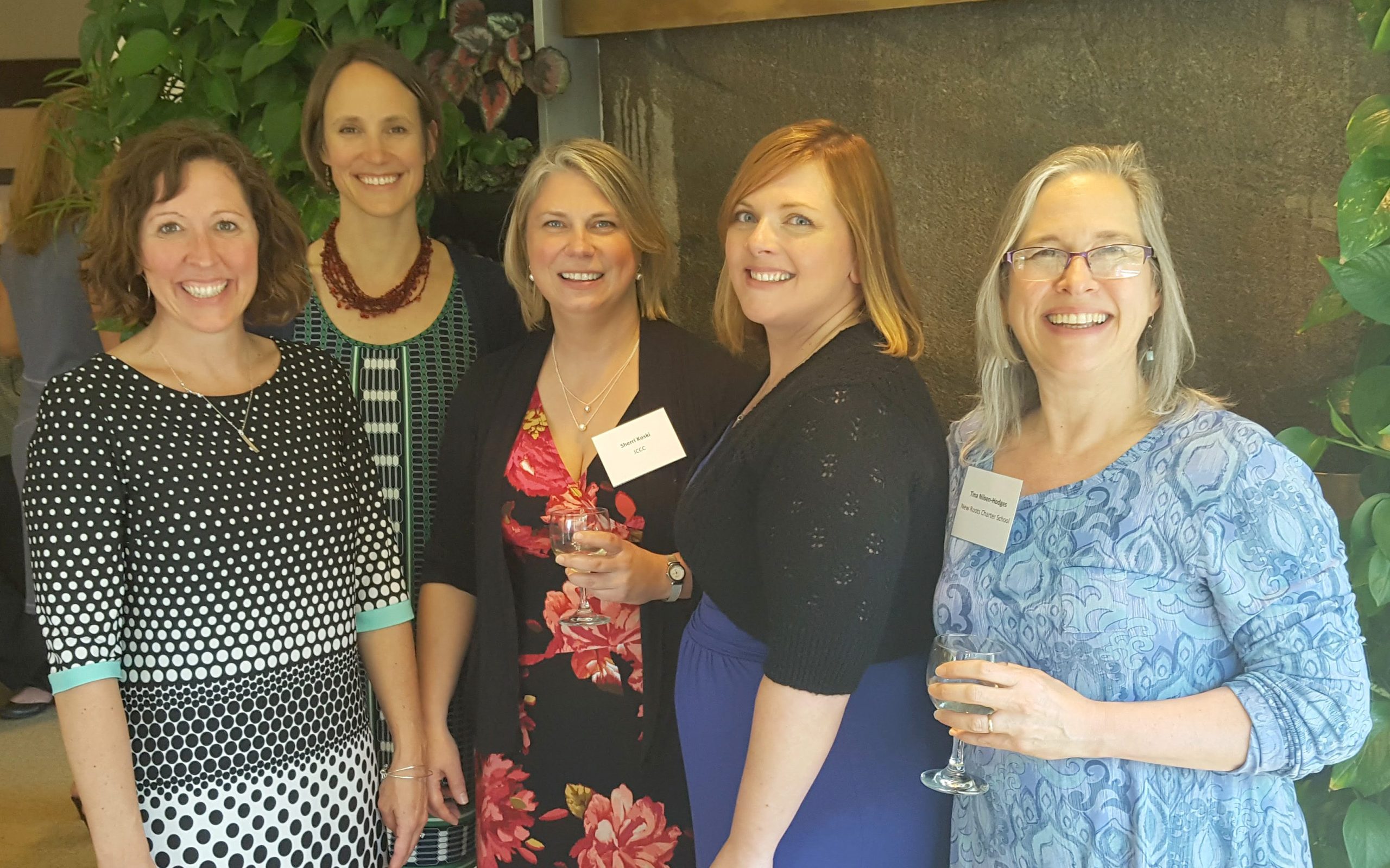
Tina Nilsen-Hodges, founder and principal of New Roots Charter School and a member of EXEX’s leadership team, added that the document focuses on the power of collective action.
“What it provides is an opportunity for that coordination and synergy among agencies and among nonprofit organizations — so, giving us a way to communicate, to coordinate efforts, to have a conscious framework for identifying what actions would help, to take our organizations from where they are now and take them a step forward as we all seek to live into this bold vision for our community,” she said.
Marteal, who is also the executive director of the Ithaca Children’s Garden, said the commitment started taking shape in June. What was expected to be a rather simple process soon became a much more lengthy journey of drafting an all-inclusive document that addressed different groups, like those the nonprofits serve, their boards, committees, employees, funders and volunteers, and Black, Indigenous and People of Color and Asian/Asian American communities.
Emily Butler, EXEX vice president and director of school administration at the Ithaca Waldorf School, said that while extra time was needed to make the document comprehensive, members recognized that the commitment itself had to be flexible and open to change.
“At some point, wordsmithing itself becomes part of the systemic racism because we are just getting caught in the perfectionism of the word and delaying the real work: the action,” Butler said. “Once that came up as a reality, everyone just said, ‘Oh, yeah, actually, it doesn’t have to be this perfectly woven quilt. Actually, it’s good to have some flaws in it so that we have something to work on and that we can really get to the specific action items within the boxes.’”
Getting folks to sign the document was just as complicated and lengthy of a process as drafting the document itself. While Butler, Marteal and others were met with considerable cooperation from many nonprofit leaders, others were slow to respond or even resistant to sign for numerous reasons. As of the time of this publication, roughly 80 nonprofits have signed the commitment.
Frank Towner, CEO of the YMCA of Ithaca and Tompkins County, was one of the founding members of EXEX and an early signer of the commitment.
“We, as a force to be reckoned within Tompkins County, a group of people who care, who run organizations that truly serve people, … have an opportunity to move the needle to make an impact towards better equity and diversity,” he said.
Sue Dale-Hall, CEO of the Child Development Council, was another early signer of the commitment. She said fulfilling the action steps outlined in the document will start with listening to community needs and educating staff and others. While addressing systemic racism properly during a pandemic is difficult, she said it’s well worth the effort.
“Right now, I think one of the biggest challenges for nonprofit directors is that … we’re working really, really hard, full time,” she said. “We have lots of challenges ahead of us. And yet, this is one of them, and it deserves to rise to the top. So, I think anything we can do to help that happen will be good.”
Shirley Serotsky, associate artistic director and education director at the Hangar Theatre, came into the process slightly later, but she said when she and her team heard about the commitment, they were eager to get on board.
“We are a predominantly white organization,” Serotsky said. “We are white led. So, we have had a series of actions over the past several months that we as a theater have engaged in to start working towards becoming an anti-racist and anti-oppression organization. … I was thrilled to read [the commitment] and see how the work overlapped with the work we were doing.”
Like Serotsky, Rick Manning, executive director of the Friends of Stewart Park, said the commitment aligns with the goals and work his group is already doing, as well as the inclusive nature of the park.
“It’s really time for all of us to understand the race issue to do something about it,” he said. “So, I think that’s really the spirit of the paper and making a commitment that our organizations work together to address systemic racism, whatever the work that we do as an organization. And it just felt very natural, given the place that we’re working in, to make that statement.”
Kenneth Clarke, Tompkins County Office of Human Rights director and member of the county’s Diversity and Inclusion Infusion Team (DII), was the commitment’s editor, and he’s also part of other recent anti-racism work on the county level.
Team JEDI (Justice, Equity, Diversity and Inclusion), an expansion of the DII, launched in August. Its 38 members from all 27 county departments are still in the beginning stages of their efforts, as Clarke explained.
So far, the group has had two meetings, the most recent of which included Chief Equity and Diversity Officer Deanna Carrithers, to develop JEDI’s structure and relationship with other county leadership. Clarke explained the next steps from here.
“One of the things that will be done, I think, will be really looking at some existing documents that the county has related to diversity and inclusion and determining whether those are in need of updating, expansion, and also looking at the ways in which they also correspond with our work, with a discussion about the values of the county,” he said.
Carrithers, who started her position last month, is engaging in similar conversations and work with county leadership. Her first month has been filled with meetings with various community leaders to get a full picture of what’s needed and what are some possible paths forward toward real change.
“You can’t ask anybody to do something that you’re not willing to do,” Carrithers said. “My first 30 days is trying to get where we are and then what do I need to do as a leader to keep our Legislature informed, to keep our county administrators informed, so that we can do the work of the people.”
Anne Koreman, Tompkins County legislator and chair of the Workforce Diversity and Inclusion Committee (WDIC), shared Carrithers’s commitment to listening to the needs of the community. Like Team JEDI, the WDIC has been working with other county leadership on anti-racism efforts, including the Sheriff’s Department’s diversity training, and
Koreman hopes to continue these efforts well into the future.
“We need to know what’s going on,” she said. “The whole community needs to know, and it needs to come from the community. I think there needs to be more conversations with the community to find out what they want. … We need to ask people what they want to see to make it better.”
Beyond these efforts, educators are also addressing systemic racism head on. One example of this is Ithaca College’s work toward improving the equity and representation in the college’s Department of Theatre Arts. IC’s efforts are in response to a letter published in July by the IC Department of Theatre Arts Black, Indigenous and People of Color group that called attention to the white supremacy that writers said was inherent in department leadership and practices.
In response, IC appointed two equity diversity inclusion facilitators: Cynthia Henderson and Kristina Dale. Henderson, as mentioned in a previous Tompkins Weekly article, is the college’s first African American full professor and a local activist in the county. Since classes began, Henderson’s work has centered around IC’s Department of Theatre Arts, and she said she feels that the college is making real progress.
“The college has upped its efforts in becoming an anti-racist institution,” she said. “We have been working on expanding the canon, not to get rid of people like Shakespeare and Shaw and O’Neill and things like that, but also to include Suzan Lori Parks, August Wilson, Lorraine Hansberry. … And as we do the work of becoming anti-racist, we are also opening up to other marginalized communities because the work is intersectional.”
While all of these efforts deal with different sectors, sources universally emphasized that it is the hard work of many groups and leaders that will help make change that lasts. Sources agreed that plans are good, but they need action to be effective. Carrithers said that in her time so far, she’s seen ample evidence that Tompkins County is on the right track toward achieving that goal.
“I can’t tell you that I’ve met a group that’s more excited, more enthusiastic, more introspective and reflective on ‘we don’t know this,’ or ‘we do know this’ and having heart around critical conversations,” she said in regards to county leadership. “I would absolutely say we’re headed in the right direction because Tompkins County has made an absolute stand in that racism is not going to be tolerated in an equity agenda. They have a plan, and they’ve had that stated plan, and they’ve made substantial strides.”
For more information about the work mentioned in this article, visit the county’s website (tompkinscountyny.gov) for links to the WDIC, DII and others.
Related Articles
Street Beat: What are you looking forward to in the new year?
We asked five random people. Here’s what they had to say.

5 things to do in Tompkins County this weekend
Plan your visit and discover what’s happening this weekend.