
Innovative housing solutions outlined at Cornell Town-Gown conference
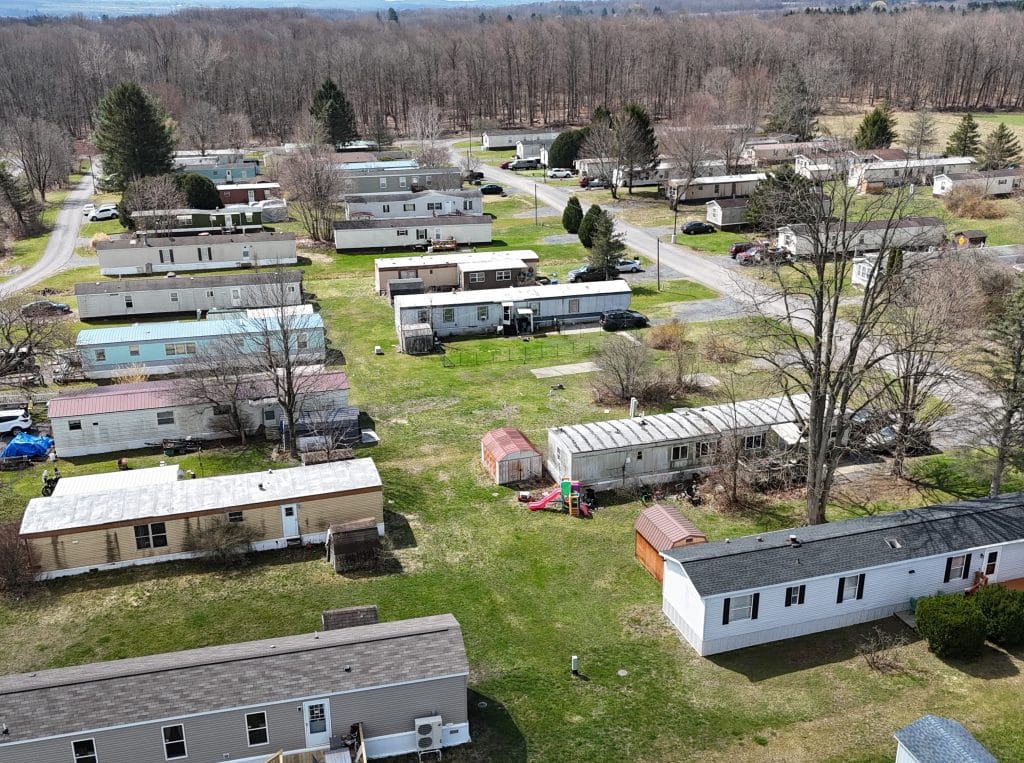
Compass Mobile Home Community in Ulysses is one example of the ways in which Ithaca Neighborhood Housing Services is reimagining its housing strategies.
Rethinking perceptions of multi-unit dwellings, revitalizing mobile home parks and embracing modular homes as a cheaper way to build were just a few of the strategies discussed by the four panelists of diverse backgrounds who spoke during the “Innovative Strategies to Expand Middle-Income Housing” panel at the Cornell University Regional Town-Gown Conference.
The theme of the event was “Housing: Meeting the Needs of Our Communities.”
Rusty Weaver, director of research at the Buffalo Co-Lab at Cornell University, said that “middle-income” housing refers to two ideas: the people who qualify as “middle income” in terms of the housing market and the residences that qualify as the “middle-income” housing they require.
“In terms of the design side of urban planning, there’s a concept of missing middle housing that thinks about housing on a gradient against single-family homes all the way up to high rises or bigger apartments,” Weaver said. “Generally, when you see this concept presented in that gradient, the units that are all in the middle are ones that our planners will tend to say, ‘They don’t exist,’ in a lot of markets, or at least they’re relatively rare in a lot of markets.”
Townhomes and the Jefferson County case study
Mid-tier density units — units like townhomes and duplexes that have a density slightly higher than a single-family home but lower than a high-rise — are going to be more compatible with urban form and community and are not resisted as heavily as larger-scale developments targeted toward middle- or low-income people, Weaver said.
Middle-income housing is relatively rare in terms of its distribution throughout New York state. It is about 21% of the state’s total housing stock, and only 2% of units currently classified as vacant and available for rent or sale.
Outside of New York City, middle-income housing tends to be concentrated in the Buffalo and Albany areas.
“There is maybe something of an anomaly up there in the North Country: Jefferson County,” said Weaver, who brought up the example of Jefferson County to illustrate how government dollars can make a big impact on communities when those dollars are allocated toward middle-income housing.
The county has such a high percentage of middle-income housing because of Fort Drum.
“The federal government largely got out of being a housing developer back in the 1970s,” Weaver said. “But that’s only on the social services side, or the urban development side. On the military side, the Department of Defense is still a housing developer.”
Fort Drum Mountain Community, which is targeted toward members of the military but is also open to the general population, was part of an initial $25 million investment by the Department of Defense to create a new, urban-style neighborhood. It was established in 2005 and is still thriving, Weaver said, adding that currently Jefferson County still has about 75% of its rental units below $1,500 a month.
“We have a very successful model,” he said of the Fort Drum community. “The big takeaway is that we can do this. The federal government used to do this. We still can, but we need that bill. We need the public to say it’s a good idea, and we need to support the community.”
Tompkins County will start seeing construction of $500,000 townhomes and above, predicted Kate de la Garza, executive director of Ithaca Neighborhood Housing Services, an organization based in Ithaca that is dedicated to expanding housing opportunities for low- and moderate-income residents of Cayuga, Chemung, Cortland, Schuyler, Seneca, Tioga and Tompkins Counties.
“When I check with realtors, I’m like, ‘No, really?’ That’s where we’re at. And so there could be a market for that,” de la Garza said. “I think because of such a supply shortage and because of the dynamics of median income here, we do have folks who are willing to pay for new supply [in that category].”
The cost of financing and land assembly has created “real barriers” for market rate developers, de la Garza said, “and so that leaves us with this middle tranche. And how do we support that? Is it working with local employers on more robust down payment assistance? Is it working with local institutions on potential development partnerships, where we can target different income levels? It demands more creativity than just subsidy alone. It demands that we come to the table at all levels and talk about how to reduce construction costs.”
Utilizing modular and mobile homes
INHS has found that modular homes are an effective way to cut costs.
“We are pioneering products, especially on the modular side, that we believe could be scalable, if there’s a will and a method to make it happen,” de la Garza said.
In downtown Ithaca, four modular homes were placed on Sears Street last winter. Though they were designed for those with a household income below 80% of the county average, de la Garza said the project is a good example of the cost savings associated with modular construction.
“Right now, the differential we’re seeing is about $277 per square foot for modular versus $350 [for stick-built],” de la Garza said.
In Trumansburg, the INHS team has taken ownership of the community formerly known as Auble’s Mobile Home Park. INHS officially acquired the park, now called Compass Mobile Home Community, in August of 2021.
There are 50 empty pads available for homeownership and rental, along with existing apartments and manufactured housing.
“We’re undertaking infill aggressively right now,” de la Garza said, adding that there is still a significant amount of stigma around what used to be called “trailer parks.”
INHS also purchased land surrounding Compass and is currently assessing the best use for that land, adding more affordable and middle-income opportunities for renters and buyers.
De la Garza explained that owners of a property in a mobile home park pay pad rent, which is $495 per month at Compass.
“So where else can you own a three-bedroom unit outright and pay $495 a month?” de la Garza asked. “There’s a lot of different options, and that really is our focus, is to have as many different options for people as possible, and really making sure that municipalities are empowered to help create those options.”
Zach Zeliff, chief of staff for State Senator Rachel May, who represents the 48th District (which includes Baldwinsville, Auburn and Syracuse) brought up the example of a project in Cleveland. The City of Cleveland and the Site Readiness for Good Jobs Fund announced last December that they issued a request for proposals to modular home manufacturers across the United States and internationally to establish a manufacturing facility in Cleveland.
The initiative aims to renew the use of disinvested commercial property and to create new manufacturing jobs while also addressing the city’s housing needs and utilizing thousands of residential vacant lots, the city of Cleveland website states.
“They came together and created a demand guarantee for modular housing,” Zeliff said. The municipality then sent out a request for proposals on a piece of land for a company to come in and build a factory in Cleveland, he explained. “So, you get workforce benefits. A lot of the savings in modular costs can be enhanced by reduced transportation.”
“It reduces uncertainty for the private sector,” Zeliff said.
Municipalities taking the reins and harnessing public dollars
Outside of the very few exceptions, where middle-income housing is so rare, “How do we go forward and actually build this type of housing?” Weaver asked.
One path toward progress could be to examine “the importance of the town,” he said, pointing to the Ulster County town of New Paltz, where residents voted by referendum to create a community preservation fund that is funded by real estate transfer tax.
In 2020, 72% of residents voted in favor of the 1.5% tax, which is to be paid by the buyer of a property, according to the town of New Paltz website.
The real estate transfer tax applies only to properties that sell above median home value for Ulster County. “It’s targeted as a progressive type of impact, but there are funds that are generated there,” Weaver said. Because this plan was created with a very general type of usage, the community of New Paltz can now take those funds and disperse them to projects that it has identified as enhancing the character of the community.
“When you have a plan … that gives you a ticket to a lot of new opportunities that you didn’t necessarily have,” Weaver said.
Panel facilitator Jeremy Thomas, assistant vice president of asset management at Cornell University, asked Weaver about strategies to bolster the supply of middle-income housing on a larger scale.
Public dollars are key to building large scale middle-income housing projects, Weaver responded. “The way that we do this best is when it’s publicly funded,” he said, “when it is a goal that we have as residents of a place, and that we’re willing to contribute, allocate our tax dollars to it.”
Low-income initiatives such as Section 8 came about because there was a need, Weaver said, suggesting that it may be time to “get back to that era where we have a more — and I know, this is a scary term for a lot of people — but a more heavy hand as a public sector in the building and decommodification of housing is how we get it to scale.”
“We have in upstate New York a lot of vacancy,” Weaver added. “We have a lot of land. We have a lot of potential because of histories of depopulation. And unlocking that land, unlocking all of that publicly owned land for scalable, supportive and affordable housing is a path forward — a path forward that might not be as far off as trying to go to all the grant applications for eight or nine different sources of funding and trying to line up project by project that way.”
Author

Related Articles
Holiday traditions bring community cheer
Tompkins County holiday traditions light up homes, farms, and schools with festive cheer and community spirit.
The gift of an experience: Local businesses offer hands-on holiday fun
Holiday experience gifts in Tompkins County include candle making, gourd crafts, and pottery workshops for creative seasonal fun.
Code Blue shelter opens amid praise, concerns and ongoing debate
Ithaca’s Code Blue shelter opens with larger space, showers, and case management to help residents during cold weather.