
Ithaca-based app addresses COVID-19 transmission
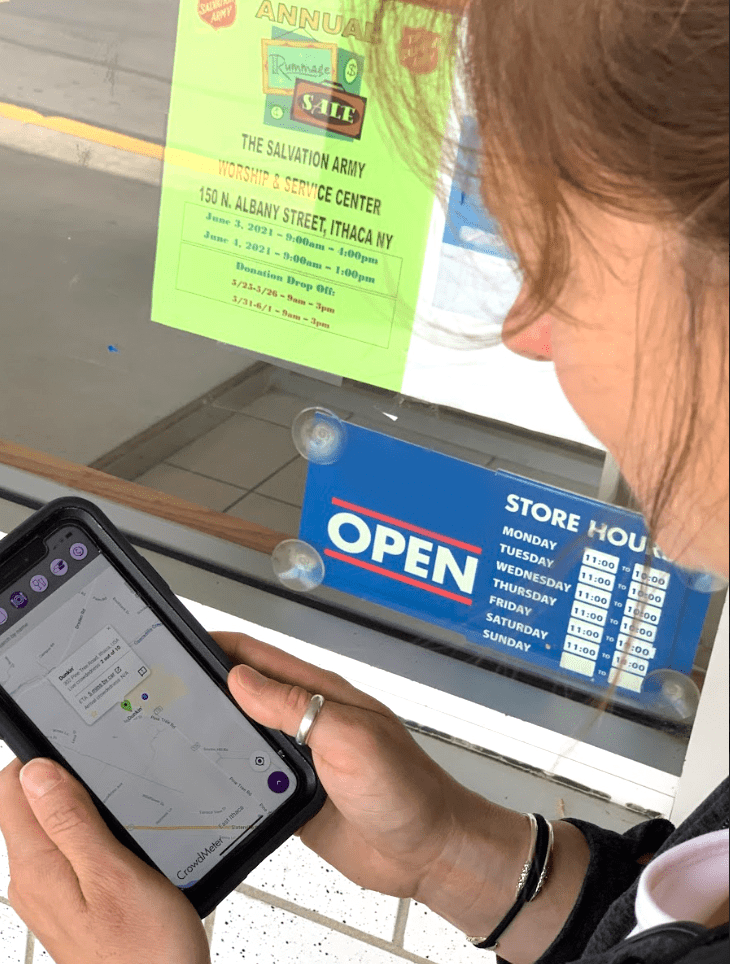
About a year ago, the Human Computation Institute (HCI), a nonprofit dedicated to “advancing the science of crowd-powered systems for the betterment of humanity” (hcinst.org), released CrowdMeter, an app meant to help Ithaca residents make informed choices about where to go for things like dining out or grocery shopping.
CrowdMeter was created in response to the pandemic and seeks to reduce virus transmission rates by allowing users to quickly check how crowded a public place is before they leave and compare the crowdedness between different grocery stores, restaurants or coffee shops.
Though the app has been out for some time now, it has yet to grow its user base large enough to go global with the project. So, as HCI Director Pietro Michelucci explained, the institute is hard at work trying to get more Ithacans involved.
Michelucci, an Ithacan himself, founded the HCI in 2014, with a large focus on the power of artificial intelligence (AI).
“My training is in cognitive science, but my specific field of interest is an area of artificial intelligence called human computation, where, basically, it’s like cheating,” he said. “You take AI, and you say, ‘Let’s try to use AI to solve this problem.’ And if AI can handle certain parts of the problem, then are there places where we could insert a human in the loop to do that part for the AI? And by sort of combining AI systems and humans in this way, we’re able to achieve futuristic AI capabilities today. And that’s kind of the approach we take.”
That AI focus is imbedded in CrowdMeter’s history and design. As Michelucci explained, the idea behind CrowdMeter arose in 2020, when the first coronavirus spikes hit China. Michelucci observed that China was largely addressing virus transmission through meticulous, mandatory contact tracing, but he knew that a similar approach likely wouldn’t work in the U.S.
“Culturally, we’re very different,” he said. “We don’t like to be told what to do. Especially, we don’t like the government telling us what to do. … So, how do we align goals between individuals who want their own autonomy and agency and be able to make their own decisions and sort of the societal good, what we were calling flattening the curve back then, which was not to prevent COVID from spreading, but to reduce how fast it was spreading.”
When COVID-19 hit the U.S. and most residents were in quarantine, Michelucci saw that most people weren’t going out at all except for essentials like grocery shopping. So, he started there.
“I thought, ‘OK, grocery stores are the intervention place. And if we give people a way to know when they’re crowded or not crowded, then they can sort of pick and choose which stores they go to or when they go to them,’” he said. “And I looked around, and I couldn’t see anything online that gives you an actual live map of crowdedness of venues. So, I thought, ‘OK, this is something we could potentially do.’”
Thus, the idea for CrowdMeter was born, but turning it into reality wouldn’t be easy. Michelucci was concerned early on that an app like CrowdMeter could actually make COVID-19 transmission worse in some respects.
“If you tell everyone, ‘This is the grocery store with the least amount of people,’ and everybody rushes there, then suddenly, it’s the worst grocery store [in terms of density],” he said. “So, I decided to engage some collaborators from various disciplines that were all kind of related.”
Research into the viability of CrowdMeter was conducted in collaboration with various field leaders, including at Harvard University, ETH Zurich, Microsoft Research and Cornell University’s College of Veterinary Medicine.
“It was a dream team,” Michelucci said. “We had all the best minds who were doing the kind of work that was related to a pandemic virus and the social implications of that and the interaction between social and virus spreading, which is exactly what we wanted. And then, we did what we call agent-based modeling, which is kind of like we create this little SimCity.”
Michelucci explained that he and the researchers crafted an AI-based prediction model, which had a similar look and feel to cities created in the video game SimCity.
“We kind of made some assumptions about how people might or might not behave in different situations, and we assumed that some people will behave in one way, some people will behave in another way,” he said. “And we said, ‘OK, let’s put some grocery stores in this imaginary town and let people run around, infect some people with COVID and then see how quickly the COVID spreads with or without people using something like the CrowdMeter.’”
The results showed that there was a “sweet spot” of factors where CrowdMeter was largely beneficial in its effects, but in some situations — like if folks are driving over an hour to get to a particular venue — it could make things worse. The team used the data from the simulation to then craft the design of the app.
As Michelucci explained, CrowdMeter displays a map of venues in Ithaca (as well as in some other towns within Tompkins County), each with a colored indicator telling users how crowded it is — green for not a lot of people, yellow for fairly crowded and red for so crowded that users should pick a different venue altogether. There is also a feature to predict how crowded a venue will be by a user’s projected arrival time.
User feedback was also a big driving factor behind the app’s final design, Michelucci said.
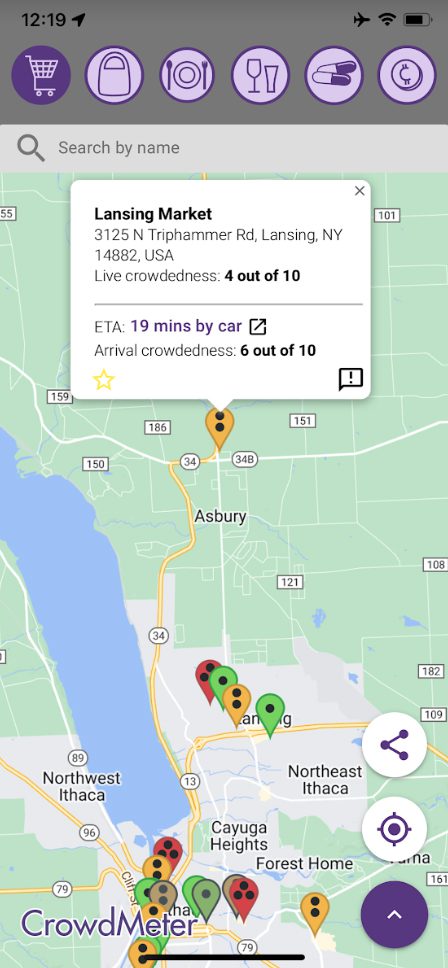
“There were some features that people were requesting that were already built into the app, but it wasn’t clear how to find those features,” he said. “So, we realized we had to make it more intuitive to find those features, like there’s actually a feedback mechanism. So, if you go into a venue, and it says this venue’s crowded, and you get there, and you think, ‘actually doesn’t look that crowded to me,’ we have a way to sort of check in and quickly let us know what you think, whether you think it’s low, medium or high crowded. And then we can incorporate that back into our predictive model.”
Though funding was initially a challenge, CrowdMeter has seen considerable support throughout its development and launch, Michelucci said. In the research phase, HCI won a COVID-19 Challenge Grant from the Aspen Institute, which funded the SimCity-like simulation. And since its soft launch several months ago, feedback has been generally positive.
“My wife and I have both been using CrowdMeter when we’re thinking of going to the grocery store at a time it might be crowded,” one user, Ithacan Dennis Frederick, told Michelucci. “We’ve changed our minds about when to go based on the app. We’ve been avoiding crowds, partly because of COVID but also just to avoid the gong show that happens when too many Ithacans go to the same place at the same time.”
While Michelucci and his team are grateful for the support they’ve received so far, as mentioned previously, they are hoping to expand CrowdMeter well beyond Ithaca, and they haven’t had enough participants in their home turf yet to do so.
“It really, at this point, depends on Ithacans, to be honest,” Michelucci said in regard to how far off expansion is. “So, if we can get, I think, 5 to 10% of Ithacans using it, … that would be enough people using it to not only potentially make a significant impact in transmission risk and that kind of thing but also give us the data that we need to be able to scale it beyond Ithaca. So really, I think we have sort of a laser focus right now on engaging with fellow Ithacans and saying, ‘Hey, can we rally around this idea and see if we can test the success of this with the prospect of actually scaling this globally?’”
Michelucci said that he’s hoping CrowdMeter’s usership base grows in the coming months, as he’s already had people from across the globe expressing interest in the idea. He said he also sees applications outside of disease prevention, like with folks looking for a popular venue to visit on a night out.
“Our institute is actually a distributed global institute, which means we have people working on four different continents, and our colleagues in each of these places are saying, ‘Hey, I’ve talked to some people here, and they would really love to have something like that,’ like, for example, in Santiago, Chile, or Vilnius, Lithuania,” he said. “So, I think there’s an opportunity to also kind of try this out in different cultural environments, which would be very interesting, as well.”
Those interested can download CrowdMeter for free from the Apple Store or Google Play or by visiting crowdmeter.app. Learn more about the Human Computation Institute at hcinst.org.
Jessica Wickham is the managing editor of Tompkins Weekly. Send story ideas to them at editorial@VizellaMedia.com.
Related Articles
AmeriCU proudly connects students with annual scholarship opportunity
AmeriCU scholarship program awards $1,000 to students pursuing college or vocational education. Applications are open through March 15.
Street Beat: What’s one of the best holiday gifts you ever received?
We asked five random people. Here’s what they had to say.

5 things to do in Tompkins County this weekend
Plan your visit and discover what’s happening this weekend.