Ithaca cemetery preserves history, welcomes Halloween visitors
Volunteers help preserve Ithaca City Cemetery, while visitors enjoy historic tours and Halloween events celebrating the city’s past.
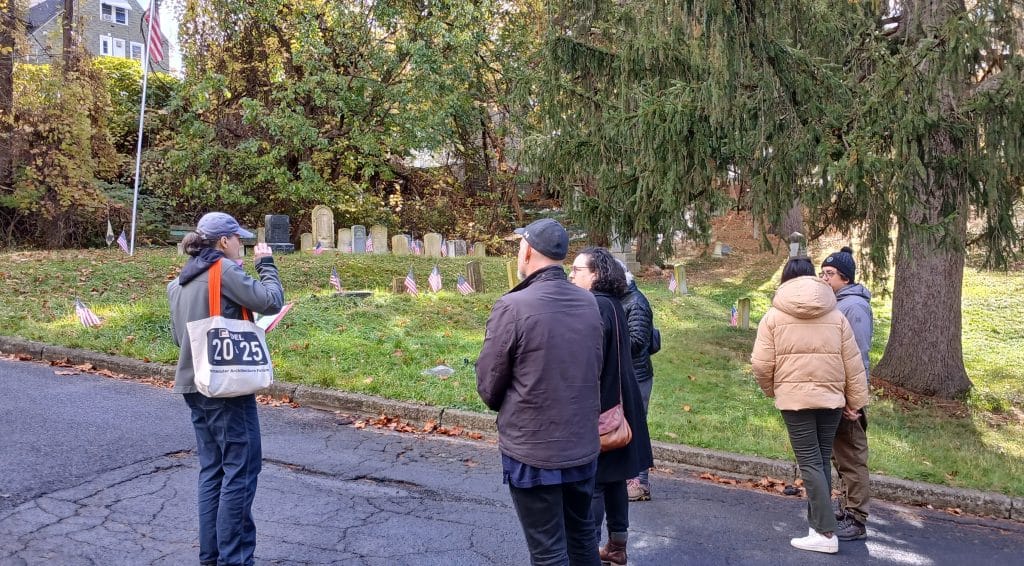
Christine O’Malley, Preservation Services Manager at Historic Ithaca, Inc.,
leads a tour group east after examining the Henry Selby headstone at a recent Halloween cemetery walk. Selby was a member of Co. B, of the 26th U.S. Colored Infantry, during the Civil War.
In the heart of Ithaca there’s a public park, frequented by dog walkers and joggers and mothers with strollers, that holds stories of the city’s past. Around October, the cemetery receives even more visitors than usual, as those seeking a spooky graveyard experience traverse the hillside during Historic Ithaca’s annual Cemetery Tours.
Within the 17-acre Ithaca City Cemetery are buried some of the community’s most distinguished citizens, many of them with recognizable family names like Esty, Cornell and Johnson. It’s this irreplaceable, tangible connection to the past that drives volunteers to painstakingly maintain the cemetery’s headstones — some so old that they could be mistaken for regular rocks in the ground — cleaning them up and arranging them in their proper place within family plots.
Despite the occasional theft of headstones and spates of graffiti, many visitors to the cemetery find it to be an attractive public space as well as a glimpse into the past, and the volunteers aim to keep it that way.
Julee Johnson,Julee Johnson, manager of Historic Urban Plans, Inc., an Ithaca-based map company, is one of the founders of the cemetery cleanup and conservation group Friends of the Ithaca City Cemetery, along with her friend Ellen Leventry, a media relations professional at Cornell.
Johnson was a longtime volunteer with Historic Ithaca, and a little over a decade ago, she and Leventry visited the cemetery for a late-October tour.
“We were sort of distressed about the state of the cemetery,” she said. “We thought it could be better taken care of.”
They looked into it and found that as a city-owned, much utilized green space, people were interested in improving the condition of the cemetery, and the city was able to furnish some resources to help. They formed the Friends of the Ithaca City Cemetery and organize volunteer groups that clean and organize headstones around Memorial Day, Labor Day and, if they have enough willing volunteers, Veterans Day, as well.
Volunteers also clear out brush and other impediments to keeping the grass mowed, making it easier for city employees to do their jobs.
Most recently, Johnson and Leventry recruited one of the largest groups they’ve ever had for a cleanup on Aug. 30. The majority of the volunteers were students from Cornell who were studying historic preservation and city planning.
They were graduate students who were, “for the most part, new to the community,” Johnson said. The event was a way for them to learn about Ithaca and to be introduced to their fellow students.
“It’s a lovely cultural landscape for people already interested in history, art and sculpture,” Johnson said, “and the fact that it’s basically an outdoor archive of the community — it’s a good introduction, especially for history classes. You’re getting your hands dirty, and it’s a lot of fun.”
Daxton Gautreaux is a graduate student in his second year of the Historic Preservation Planning Program at Cornell.
“Our program is very practical-based, so it’s a lot of working with materials, doing documentation, getting involved in grant writing and advocacy,” Gautreaux said. “It’s about how we can help the people we interact with and do meaningful work.”
He is also president of the college’s Preservation Studies Student Organization, and he helped lead the effort to amass students from his program and the Department of Regional and City Planning. They received the help of about 25 volunteers, most of them students and alumni.
“Having that amount of people out there, we were able to accomplish a lot of work,” Gautreaux said. One of his best memories from the volunteer day was the restoration of a family plot that needed a lot of work.
It was completely overgrown with ivy, which had gotten into one of the headstones, cracking and breaking it. Another headstone was almost completely buried and overgrown with vegetation. “We were able to get all that cleared out and really clean up that family plot, as well as repair that headstone,” Gautreaux said, “so that was super, super rewarding.”
Having once herself been a student of historic preservation at Cornell, Johnson said she can relate to the sense of accomplishment that comes with a hard day’s work at the cemetery.
“It goes beyond the theory, and people really enjoy that, especially when cleaning the headstones,” she added. “You scrub with the brush and voilà! It used to be old and dingy, and now it’s like new, and beautiful. It’s very satisfying.”
It has been many years since plots were sold in the main portion of the cemetery. Its first burial took place in the 1790s.
In village records dating back to the 1820s, there is mention of the people who took care of the cemetery, and there are even records of vandalism, which was “not so much reported in the paper,” Johnson said, until Cornell University was founded in 1865 and students began to walk through the cemetery on their way to campus.
“There were undergraduate hijinks — that sort of thing,” Johnson said. “Not all students lived on campus, so Fall Creek has always been a place students lived. In fact, [the route] was called the Bone Yard Cut, a shortcut from downtown to campus.”
Just recently, a headstone that had been removed and taken to a location elsewhere in the city was found and returned to its cemetery home, Johnson said.
There have been incidents of graffiti, including some hate speech, but for the most part the cemetery is a well-loved and respected feature of the city.
Whether one can get a satisfyingly spooky experience from touring the grave sites is probably in the eye (and imagination) of the beholder.
“I’ve never experienced anything spooky there,” said Christine O’Malley, Halloween tour guide and preservation services director. “People’s imaginations get carried away.” She added that people who grew up in Ithaca might have more stories to share than she does.
One of her favorite stories that often has the most impact on tour-goers is that of Daniel Jackson, a Black man who was born a slave who travelled north to Ithaca in the 1840s seeking freedom.
People find his story touching and interesting, O’Malley said, because of the intersection of local life with the greater course of American history. “And,” she added, “his mother, who was 103, is buried right next to him.”
While a chill down the spine might be a bonus for those looking for a thrill, haunted hijinks do not appear to eclipse the Halloween tours’ main mission.
“We’re trying to show people how important the cemetery is as a historic landscape,” O’Malley said.
Author

Related Articles
Quantera’s new tech promises faster, safer chemical testing
Quantera Analytical is developing faster, safer chemical testing technology in Ithaca with roots at Cornell University.

“A Silent Force”: Gail Belokur brings creative leadership to the United Way
Gail Belokur, a Hometown Hero, brings compassionate and creative leadership to the United Way of Tompkins County.