
Ithaca city manager Mohlenhoff settling into new role
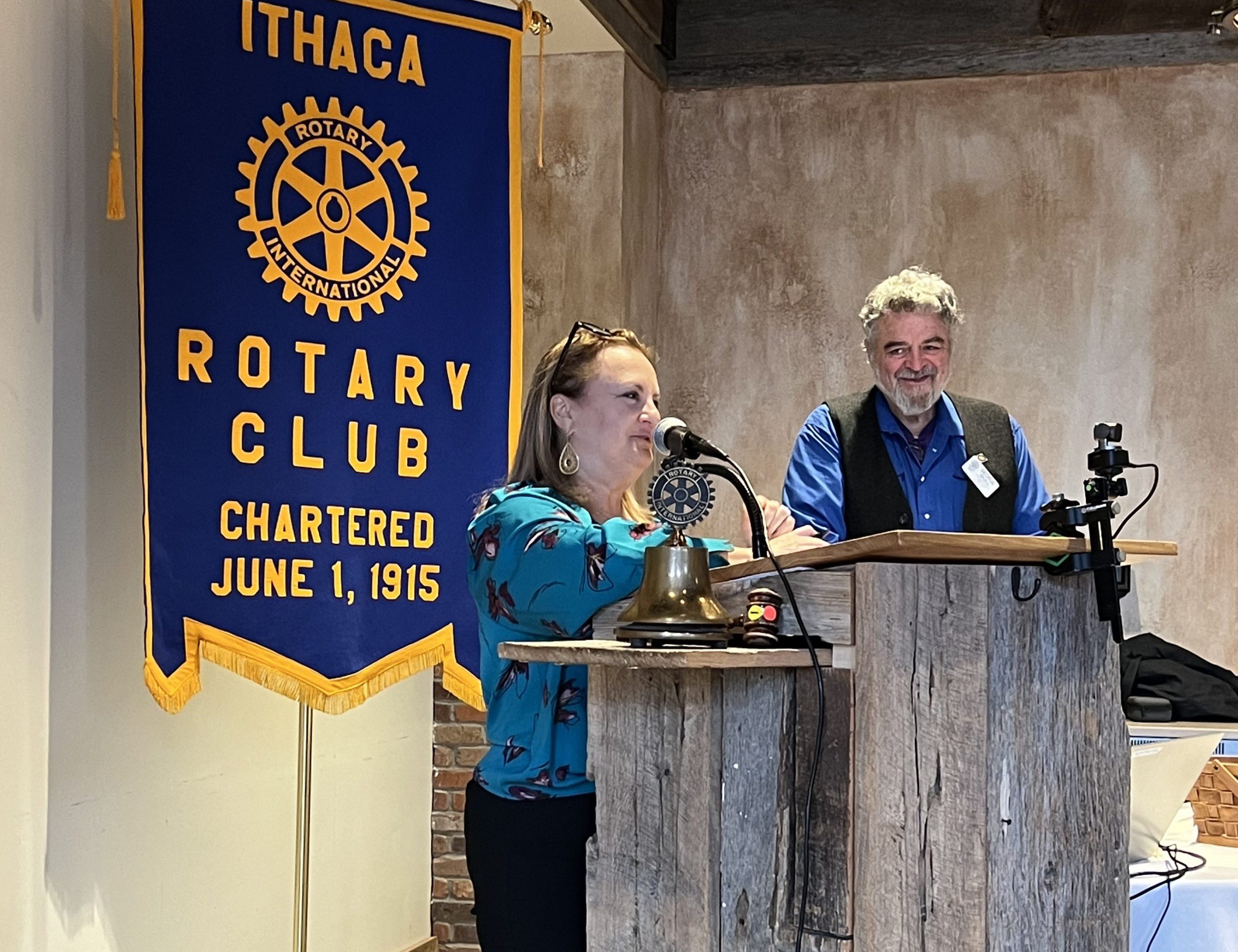
Deb Mohlenhoff was recently the featured speaker at a meeting of the Ithaca Rotary, where she shared her background and experiences in the first few months since she was hired to be the city of Ithaca’s first city manager.
Mohlenhoff, a fan of sitcom “Parks and Recreation” who strives to channel Leslie Knope’s tenacity and passion for local government, said that things were pretty rocky for a while after she started in the position Jan. 1.

“Literally everything was on fire,” she said, flashing to a PowerPoint slide with calamitous memes from “The Office” and “Parks and Recreation,” eliciting giggles from the audience.
“More than I even knew,” she said.
But she tackles the challenges head on and even sees herself as a bit of a trailblazer.
“If you look at the statistics of city managers across New York state, only 21% of them are women. So I’m excited to be kind of taking on a new leadership role for the city and also, you know, helping to change the dynamic of that position a little bit,” she said.
Mohlenhoff was set on the path of local government years ago when she was asked to serve on the city’s comprehensive planning committee as the young professional representative.
Right around the same time, a vacancy came up in the ward where Mohlenhoff happened to live. The process at the time was that the mayor would choose the person to replace the alderperson who had left.
“And she asked me to fill that role, and that’s really where I started my journey in city government, and kind of ended up falling in love with it, even though it’s not anything that I intended to study or anything that I intended to do in my career,” said Mohlenhoff, who was working for Tompkins Cortland Community College (TC3). “I was pretty embedded in higher ed at the time.”
Despite her rewarding career at TC3, over time Mohlenhoff felt drawn to local government. She was inspired by the projects she was able to work on as an alderperson, including the city’s innovative sidewalk program. “We did something pretty transformational, and that was one of the first major projects that I got to work on when I was a member of Common Council. And it really kind of demonstrated to me that when you put the right minds together […] you really can do innovative things,” Mohlenhoff said.
She explained the role of Ithaca’s city manager; the Ithaca City Common Council has 11 members, including the mayor, she said.
“They pass policies, and they have oversight, and then it is the city manager’s job to ensure that the city is operated in what is determined to be an economical and responsible manner,” she said. “So that’s a lot of weight on the city manager’s shoulders.”
She described the former government structure, calling it “the infinite loop of non-action.”
“Many of you may have experienced being stuck in that infinite loop as you were trying to contact the city or the mayor or anyone that would listen to what your problems were. Right? So, the reason that this was happening was almost a little bit by design. When you have a strong mayor form of government, you’re asking that person to be both entirely responsible for all of the political activity, the managing of all of the political capital [and] all of the very essential relationships that our elected officials need to have,” Mohlenhoff said.
In recent years, the city of Ithaca had received several reports indicating that a city manager government would be more effective. In response, the city created a chief of staff position.
“We didn’t think there was the political will or community support to move fully to a city manager, so we implemented that chief of staff position,” Mohlenhoff said. But that was not really effective, either, she said.
“The chief of staff position was similarly problematic because they did not have the designated authority to make the same decisions that a city manager would, and they still were appointed at will by whoever the particular mayor was or whatever political affiliation the mayor had,” Mohlenhoff said. “It helped in the sense that there was another person to offload some of the responsibilities of the mayor onto, but that person didn’t necessarily have the entire ability to make the decisions in the same way that a city manager would.”
Svante Myrick, mayor at the time, put together a working group to try to solve the problem, which Mohlenhoff chaired.
“This is not a grand conspiracy to put me in this job right now. It was just, like, what was happening at the time,” she said.
Backed by a 73% percent citywide vote in favor of creating a city manager position, the city moved ahead with that plan while simultaneously dealing with the resignation of Myrick, who left mid-term and was replaced by Fifth Ward Common Council member Laura Lewis.
The mayor–city manager model separates the activity of elected officials and the politics of government from the operations, day-to-day management and administration of government, putting the city manager in a role similar to that of the director of a nonprofit, Mohlenhoff explained.
“This is where I got dragged back into government,” she said. “I decided that I actually really liked being back in government and made a choice to apply for the position. I was very pleased and humbled that I was chosen to be in the job. I was appointed to the job in December and started the first day of January.”
“We had a year of transition, but there was literally a flip of a switch,” she added. “Like, on Jan. 1, a gazillion things that the mayor used to do where now the city manager is doing them and yes, lots of things look nice on paper, but so many little things would just keep popping up.”
Her first 100 days in the role have been relentlessly busy, she said, including some days that started with early-morning wakeup calls from the fire department and ended with evening governmental meetings.
“There isn’t any way that anyone would have been successful in this job,” she said, “without leaning on the talent that we have at the heads of all of our city departments.”
Author

Related Articles

Design details unveiled for new Center of Government
Design details for the Tompkins County government building in downtown Ithaca are now public, with a county survey open for feedback.

Holiday traditions bring community cheer
Tompkins County holiday traditions light up homes, farms, and schools with festive cheer and community spirit.
Cayuga Medical Center improves patient safety score
Cayuga Medical Center Leapfrog Grade rises to “B,” showing improved patient safety and nursing care quality.