
Ithaca policy would sanction homeless camping at Southwest Park, aiming for improved support in conjunction with local organizations
The Salvation Army Ithaca Corps staff members gather in front of their new van outside The Salvation Army offices in downtown Ithaca. (Left to right) Back row: Diana Vrabel, Karen Sargent, Ana Machado, Captain Shaun McNeil. Front row: Brady Bond, Andrew Ink, Felicia Whatley. Missing from the picture is Captain Stacy McNeil.
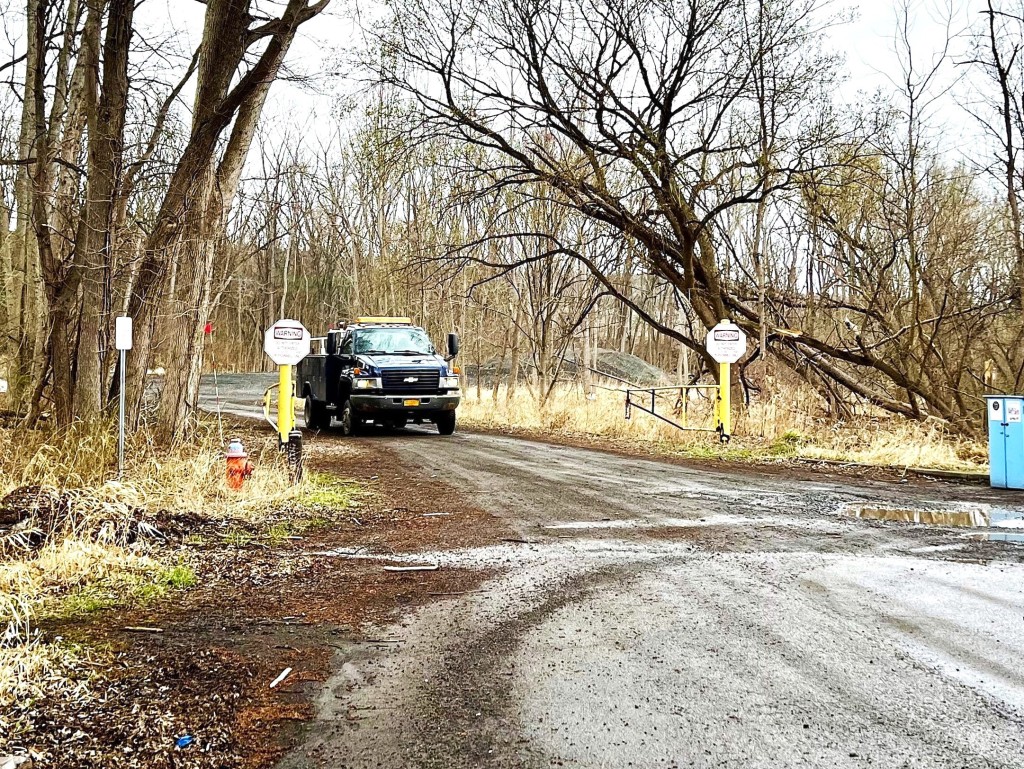
As part of a new city of Ithaca policy that is expected to be implemented in early May, the city of Ithaca would sanction camping in the homeless encampment located behind Walmart on South Meadow Street, often referred to as Southwest Park.

Parts of the 28-acre parcel of city-owned land would exist as a place where outreach workers could relocate unhoused people living in unsanctioned areas when they cannot find housing or other resources.
Another encampment area, located behind Lowes on South Meadow Street, was being used by just two people during the day and not overnight, according to city officials, so the city cleaned up the area, removing 170 tons of debris, which was sent to the Tompkins County Recycling and Solid Waste Center. The new policy would label this area an unsanctioned area, where camping is not allowed.
The Salvation Army: Providing on-the-ground assistance in an evolving homelessness landscape
“For us, there’s been a considerable amount of change within the last year within the homelessness population,” said Brady Bond, community outreach director for The Salvation Army Ithaca Corps.
Last summer, about 40 apartments were filled in Asteri, a new downtown apartment building, in an effort to relocate local unhoused individuals in what was termed the “housing surge.”
“Asteri and the housing surge has had a drastic impact on who was living in the streets, for sure,” Bond said. “We were going out weekly to the encampments – to the Jungle, to Lowes – with hot meals to try to get them connected to services, and a lot of other agencies were doing that. We were not alone. We would go with other agencies to make it a one-stop shop.”
Before the housing surge, Bond would see about 30 people come out for a meal every Wednesday at the homeless encampment near Walmart. After many of those people were relocated to permanent housing, including apartments at Asteri, he would see only four of five. Those who remained were usually people who had been living at the encampment for a long time and were “settled in their place,” Bond said.
The encampments were a place where The Salvation Army was able to make regular and consistent connections with members of the local homeless population, but the organization also interfaces with those in need through Ithaca Kitchen Cupboard, a food pantry located at the Salvation Army building, 150 N. Albany St., open Monday through Friday.
The Salvation Army can also offer vouchers for clothing and furniture, and it hosts a hot meal called Our Brother & Sister’s Table every Saturday at noon and Sunday at 3 p.m. “Loaves and Fishes is incredible, but it’s only Monday through Friday,” Bond said. “Ours is one of the only hot meal options on the weekends.”
The Salvation Army works with the Empire State Housing Initiative, a housing-first model that matches homeless people with a long-term residence.
The organization also has a partnership with Second Wind Cottages, a supportive community of tiny houses for homeless men, located in Newfield. Second Wind recently opened a second location for women in Dryden.
The housing surge reduced Salvation Army staff’s ability to connect with the people who did receive housing at Asteri, Bond said. “The Salvation Army isn’t at that building regularly,” he said.
“There’s actually an added barrier,” he added. “Now we’re trying to connect with people in an apartment, so there’s a difference there.”
“Nobody wakes up one day and says, ‘I want to be homeless,’” Bond said. “Everybody acknowledges the complexities of life that lead to that reality. Something we have discussed with the housing-first stuff is that everybody deserves to be housed. I totally believe that. But some of those compiling issues that lead to that point — that’s something that takes support and a vision for what life looks like just beyond surviving.”
“Part of our meal program is we will provide grocery orders to people who are immobile, so we will go to that building to bring groceries,” Bond added, “or to provide move-in support.”
“The dynamic has definitely changed,” he said. “On the street you can provide more help. You know where everybody is, and you’re communicating with other agencies.”
The city’s search for a solution
A draft of the city of Ithaca’s pilot administrative policy to manage homeless encampments on city property was presented by Dominick Recckio, deputy city manager of the city of Ithaca, at the April 2 meeting of the Housing and Economic Development Committee of the Tompkins County Legislature.
Recckio began his presentation by thanking several local organizations.
“The city has been really fortunate to have outreach workers from OAR [Opportunities, Alternative and Resources], Second Wind Cottages and REACH supporting its efforts, far before my time, under the purview of the city manager, working on encampment response,” he said.
“We’re all really supportive of a navigation hub,” said Samantha Stevenson, REACH’s director of operations. “One of the realities of being a community-based organization, especially a nonprofit, is that you learn really quickly that funding is siloed, and that makes collaboration really hard.”
A hub where organizations can interact not only with the unhoused population but with each other would help increase communication and cut back on the amount of accidental duplication of services.
“I think a navigation hub would be really nice, to have all the resources that are clear and concise all under one roof,” Stevenson said.
Recckio said the city has $800,001 available in its capital program, plus $150,000 from 2024 available for operational expenses, but the city needs to maximize its partnerships and existing programs if the new policy is going to be feasible. “We’re being scrappy on how we budget some of this together and don’t have all of that quite ready for prime time yet to share,” Recckio explained.
The policy has been several years in the making. From 2022 to 2023, a working group on unsanctioned encampments led to the adoption of a policy at the city level in 2023. “That really went into effect in 2024,” Recckio said. “The work I’m presenting to you today is from the advisory committee to review the policy, and we’re getting closer and closer to implementing recommendations.”
The policy’s original implementation last year resulted in a framework for how the city would respond to unhoused people living on city-owned land. The city designated certain areas as “actively managed,” “lightly managed,” or a “non-enforcement zone.”
“Something that I’ve learned after meeting with many of the outreach workers, IPD [Ithaca Police Department], and really in understanding information from people who’ve been experiencing unsheltered homelessness in our community, is that this is offered an opportunity to engage with the people who are camping rather than a previous approach of just ignoring it,” Recckio said. “And the engagement is a really good approach that seems to have worked very well for us so far, instead of having an enforcement approach.”
There was one IPD-issued ticket at an unsanctioned encampment site last year, according to Recckio.
Recckio said that he has heard from outreach workers that there is a concern about the lack of beds available in the area, especially in the spring when the local Code Blue shelter stops providing services. This led the city to develop the new policy that would create a sanctioned area at the existing encampment site so that even if an individual cannot find a bed, they will have a place to stay.
Recckio said there are many factors that contribute to a person being displaced from a stable housing situation, including the inability for a local shelter to accommodate the person’s wish to stay with a partner or animal and the loss of temporary assistance due to work requirements, challenging paperwork or substance use disorder.
Sometimes people become homeless again after an unsuccessful attempt at achieving stability within new permanent supportive housing units, Recckio said, and sometimes a person becomes unhoused after fleeing an unsafe living situation in another municipality.
Two additional recommendations have been made by the city, Recckio said, the first being that the city open and operate a navigation hub facility near Southwest Park. The hub would likely be located on a space close to but not in the current Southwest Park location.
“I see this as a space to support transitions to and from the non-enforcement zone,” Recckio said. “So, if someone is at the encampment that is not allowed to be on the Waterfront Trail, for example, and they’re asked to move and they can’t find housing, having a navigation hub for them to go as an intermediary place before they are asked to use the camping area outside.”
The second recommendation is to make infrastructure and livability improvements in Southwest Park.
“This would include really promoting public health and safety. So, we’ve heard a lot about lights and trash removal and even bathrooms, but bathrooms, as everybody here likely knows, is very complicated as it comes to this area,” Recckio told the committee.
The policy, as well as these two recommendations, would be predicated on Tompkins County constructing its new emergency shelter on Cherry Street, a project that was announced last year after the county purchased land where FOUND in Ithaca is currently located for the purpose of building a new homeless facility to house up to 100 individuals.
“This navigation hub being near but not in that camping area — have you thought about how problematic it might be to rent or purchase a space in that area where there are so many businesses who will likely not be welcoming to a navigation hub?” asked Tompkins County Legislator Deborah Dawson (D-Village of Lansing).
“We have thought about that and are in some real estate conversations,” said Recckio in response. “It’s definitely on our mind; being a good neighbor would be a big goal of ours. I don’t have any further sort of answers at this time.”
“I suspect that’s going to be one of your biggest challenges,” Dawson said, to which Recckio responded, “I think you’re right.”
Author

Related Articles
Cayuga Medical Center nurses’ vote for unionization approaches
The Cayuga Medical Center nurses union vote approaches as nurses cite workplace concerns, leadership changes, and national labor issues.

Holiday traditions bring community cheer
Tompkins County holiday traditions light up homes, farms, and schools with festive cheer and community spirit.