
Filling downtown’s empty storefronts
Intensified retail recruitment at center of city and Downtown Ithaca Alliance efforts.
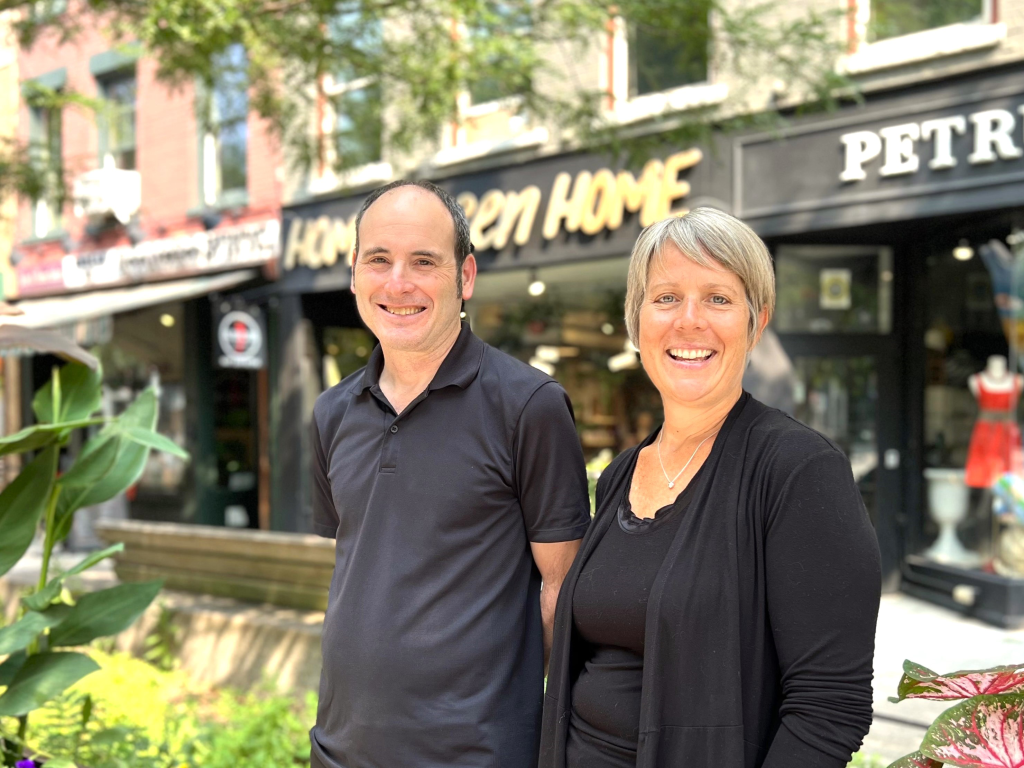
Michael J. Berne, president of MJB Consulting, with Nan Rohrer, Downtown Ithaca Alliance CEO, on the Commons in downtown Ithaca. Berne has been working with the alliance and city officials to conduct a retail study and develop a strategy that will boost Ithaca’s retail scene.
On a recent morning in downtown Ithaca, Nan Rohrer, Downtown Ithaca Alliance (DIA) CEO, and Zoe Zrini, DIA project coordinator, climbed through the dark, dusty interior of a vacant downtown storefront within a block of the Commons pedestrian plaza. Accompanying them as they stepped around the stacks of chairs and tables piled high with restaurant equipment was the building’s landlord, along with Michael J. Berne, president of MJB Consulting, whom the DIA and the city of Ithaca hired to develop a strategy for filling empty retail spaces like the one they were surveying that day.
Rohrer and the landlord agreed that an interested potential tenant could be a great fit for the space, and Rohrer explained that she hopes to increase efforts that will help facilitate fruitful connections between landlords and small business owners. This is Berne’s area of expertise, and a day earlier he’d detailed a study he conducted about the retail scene in Ithaca and gave a preview of some of the efforts to be made during the implementation stage of the study, Phase 2.
Ithaca: A city of high potential, full of unique challenges
“For those of you who aren’t familiar with the work that we do, we are the business improvement district for the city of Ithaca and for downtown,” Rohrer explained at the presentation, “And that role for us is being an advocate and an ally for our 160-plus property owners, our hundreds of business owners, our residents, et cetera. We are there to focus on being clean, green and welcoming, but also providing events and marketing opportunities and advocating with things like this study to ensure that we are providing an environment that is business friendly, that is driving the economic development of downtown and of the city as a whole.”
The pandemic has not been easy on downtown, which seemed to be firing on all cylinders as recently as 2019, Berne said during the presentation Aug. 6 at the Ithaca Downtown Conference Center.
It was the COVID-19 pandemic that sparked MJB Consulting’s partnership with the city. “We knew that the retail sector was one of the most heavily impacted sectors,” said Thomas Knipe, city of Ithaca deputy director of economic development, the afternoon after the presentation at the DIA’s Center Ithaca offices.
The city worked to align some of its American Recovery Plan Act funding, which came directly to the city as state and local resilience funds, with an economic recovery strategy that the city created. Downtown Ithaca Alliance approached the city about doing a retail study.
“It’s taken a little while, but I think it’s still highly relevant,” Knipe said. “We are still seeing some of the follow-on effects of COVID, and retail is shifting. We did a full RFP for procurement of services from a retail consultant, and Mike [Berne] bid on that.”
The downtown area has the appeal of new development, Berne acknowledged.
“I think anyone arriving here who hasn’t been here in 15 years will be blown away by what this downtown looks like today,” he said.
But in terms of foot traffic, the data shows a contraction since 2018 of about 12.5%, and it is 6.3% less this year than it was last year, according to Berne.
The median household income of the people providing the foot traffic has also diminished considerably, he added.
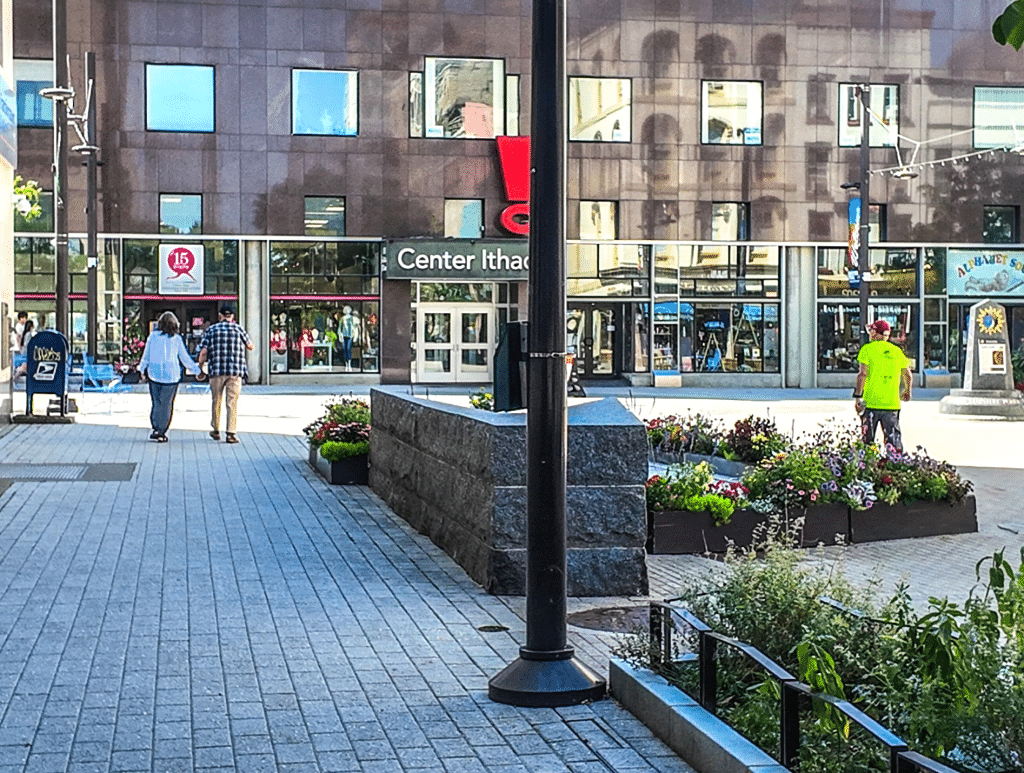
The Commons pedestrian plaza on a recent morning in Ithaca, with Center Ithaca, the home of Downtown Ithaca Alliance, in the center.
Enlivening downtown Ithaca
One of Berne’s simplest pieces of advice regarding one good investment that can change the way the public perceives a city: “Add more trees.”
“It’s amazing how the way you view a place, a street, a block, is tied to the greenery,” he said.
In his study, Berne focused on what he calls “informal entertainments,” which he said can bring a sense of excitement to a city center.
In contrast to formal entertainment like staged performances or movie showings, informal entertainments are ones that pedestrians can watch and/or participate in, facilitating interaction and socializing, Berne explained. They can happen spontaneously without the need to adhere to a schedule or buy a ticket in advance.
These activities tend not to require more than a few individuals, and they do not need the funding for a dedicated facility.
“In other words, they have far fewer user frictions,” Beren said, citing examples such as ping-pong tables, mini-golf, three-on-three basketball and group quilt making.
“And lest you think this only for warm weather climates, other cities like Minneapolis and Ottawa have shown there are also such activities for the winter, like curling sheets or cabin saunas complete with outdoor minibars and marshmallow firepits,” Berne said. “We’ve been creative about this.”
Keeping West End positives intact
The West End is the home of “neo-hipsters,” members of the creative class that tend to be “a little less edgy and abrasive” and more “earnest” and “optimistic” than what most people think of when they picture a hipster, said Berne. He described neo-hipsters as “overly mobile knowledge industry professionals and graduate professional students who celebrate creativity, fetishize craftsmanship and skew socially progressive.”
To the extent that there is overlap between neo-hipsters and what is commonly called the creative class, the West End is a critical district to keep intact because “it signals to that tribe that there are others like them here,” Berne said.
The data show that when it comes to the presence of the creative class, Ithaca comes in third in small and medium-sized communities across the country, just below Boulder, Colorado, and Ann Arbor, Michigan, ranking above peers such as Madison, Wisconsin, and Burlington, Vermont.
“Ithaca is a creative class destination, and West State Street is a part of that ecosystem and that appeal. We mess with it to our peril,” Berne said, adding that he believes this is important to point out because some parts of the vision for West State Street might undermine its current appeal.
“There’s an emphasis, for understandable reasons, on building more and more and more housing and higher and higher and higher density,” Berne said.
New construction retail space tends to be priced higher than retail in an existing second-generation building, he said, raising the question of whether it will continue to draw in the kind of independent businesses that have fueled West State Street’s rise in performance.
“Merchants [in the West End] are furious about the social challenges that they’re facing,” Berne added. “They feel beleaguered, ignored, undervalued, and a lot of them are renters. And so I am worried that some of the highest-profile ones, even, could skedaddle.”
Perceived ‘anti-social behavior’ and the increased police response
“But then, there’s also the widely publicized set of issues, which I aggregate as antisocial behavior, for lack of a better expression,” Berne added. “Obviously, I’m not someone who can provide guidance on how you reduce that, necessarily. That is above my pay grade.”
“What I can say,” Berne said, “is without the reversal of the perception on that issue, traffic will probably continue to decline. Sales volumes will probably continue to erode. Vacancy rates will probably continue to rise, rent levels drop, property assessments decrease. … That’s not meant to cast judgment on previous policies or priorities, but merely to shed light on the possible implications and trade-off.”
Another piece that Berne said should be kept in front of mind is the perceived willingness and ability of the public sector to address those concerns.
“That sends what the retail industry views as clear signals about how much or how little they are truly valued,” Berne said. “Now, again, it’s very perception driven, but that can, in turn, diminish merchant morale, depress investment.”
Rohrer said that the DIA is well aware of these issues.
“It’s why we worked very closely with the city and the county to ensure that the Community Outreach Worker program was reinstated, as that was a major missing piece in working with all of our constituents and stakeholders in downtown. It’s important that we’re able to provide services for individuals as well as support our businesses and our retailers.”
Business and property owners, who are important stakeholders in many ways but especially in regard to tax revenue, Berne said, have their own lived experiences that are important to take into account.
“The mere fact that this is troubling them is itself a reason to take it seriously, because you don’t want your merchants to have dampened morale,” Berne said. “You don’t want them becoming bad ambassadors for other would-be merchants, telling them, ‘No, this is not a business-friendly climate.’”
In an effort to combat these issues, the city of Ithaca and DIA have partnered to bring a community outreach program to downtown that will give those who observe concerning behavior on the Commons a number to call when that behavior does not appear to require a police response. The community outreach workers can be contacted by call or text message at (607) 317-0100 or by email at commonsoutreach@reachmed.org.
The city also recently announced the Ithaca Police Department will be increasing its enforcement of citations on the Commons for offenses such as smoking, vaping, playing amplified music and riding a bicycle in the pedestrian area.
“I think what we have are shared spaces in our community that are intended to be positive, welcoming, inclusive spaces that we share, and that is a key function of them,” Dominick Recckio, deputy Ithaca city manager, said Aug. 7. “The Commons is a perfect example.”
“It’s almost as much of a park as a pedestrian mall,” he said. “People use it as a place for leisure, and socially, and there is shopping and economic activity; it’s the center, the very heart of our community. … I think when it comes to the antisocial behaviors, it becomes an issue when someone’s actions detract from how it feels as a shared space.”
“Genuinely, I think the police, the outreach workers and the downtown stakeholders working together has contributed positively to the downtown environment,” he added.
The next phase: Getting tenants in retail spaces
Phase 2 of the project will begin around September or October and will involve a more strategized implementation of some of the work that the DIA has already begun doing with the hiring of project coordinator Zrini, who joined the DIA in January.
This work will involve the creation of marketing materials and hitting the ground running with robust retailer recruitment, Rohrer said, adding, “It’s all about matchmaking.”
The efforts will also include the creation of a comprehensive database of available retail spaces, as well as a continued partnership with Berne that will include leveraging his connections and contacts with retailers, brokers and regional restaurants.
“We know that there are a fair number of vacancies, and we really want to see those filled,” Rohrer said. “And those don’t just get filled by happenstance. You have to make a concerted effort.”
Author

Related Articles
Holiday traditions bring community cheer
Tompkins County holiday traditions light up homes, farms, and schools with festive cheer and community spirit.
The gift of an experience: Local businesses offer hands-on holiday fun
Holiday experience gifts in Tompkins County include candle making, gourd crafts, and pottery workshops for creative seasonal fun.
Code Blue shelter opens amid praise, concerns and ongoing debate
Ithaca’s Code Blue shelter opens with larger space, showers, and case management to help residents during cold weather.