
New downtown Ithaca senior housing project receives site plan approval
Ithaca senior housing project with 56 affordable units and daycare receives site plan approval, led by Ithaca Neighborhood Housing Services.
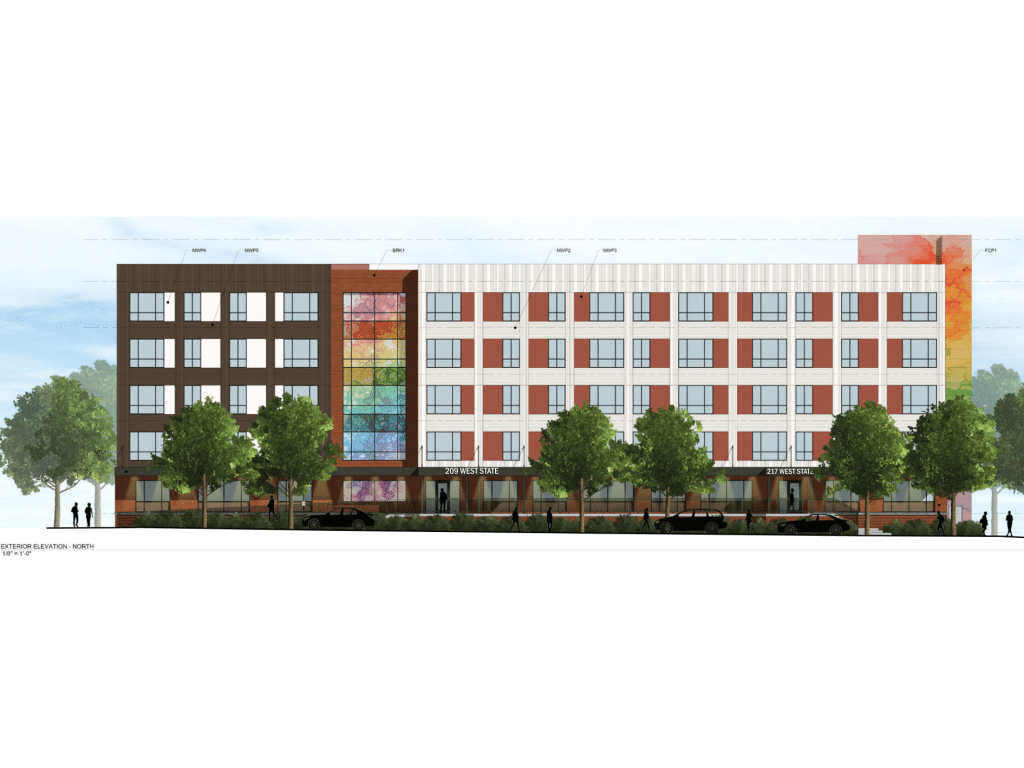
A rendering of the new affordable senior housing/daycare facility on West State Street in Ithaca. The Ithaca Neighborhood Housing Services project recently received site plan approval.
A five-story, 65,500-square-foot building that will provide 56 units of affordable senior housing, as well as a day care, gained unanimous site plan approval by the members of the City of Ithaca Planning and Development Review Board Aug. 26. The project, located at 205-217 W. State St. in downtown Ithaca, could break ground by the end of next year.
The $27.6 million Ithaca Neighborhood Housing Services (INHS) project relies on tax credits and grants that INHS will apply for this fall, said Kate de la Garza, INHS executive director. She added that sometimes INHS has to wait several rounds to win the necessary funding to get the project off the ground.
“Best case, if we find out we’re funded in, say, March, we will break ground by the end of the year and lease up by the end of 2017,” de la Garza said. INHS tapped Welliver, based in Montour Falls, as its developer for the project. HOLT Architects designed the building.
Filling a need in downtown Ithaca
The downtown location is ideal in many ways, de la Garza said. It enables a car-free lifestyle and allows INHS to provide two things that de la Garza said the city direly needs: affordable housing for seniors and 36 day care spots, which de la Garza said INHS is working very hard to keep affordable, as well.
The 3,000-square-foot day care facility will be funded with $1.6 million of the project’s total budget.
The new construction requires demolishing the existing one-story office building at the site. The proposed building provides services for the senior housing on the eastern side and common spaces for the day care on the western side.
The site, approximately .435 acres, borders South Geneva, West State and South Albany Streets.
The plans include a one-way parking lot for 12 cars along the southern edge of the site, a covered playground, site lighting and container planting along the northern side of the proposed building.
The applicants will consolidate the parcels at 205 and 209-217 West State St. for the project.
With this project, INHS hopes to put a dent in its long waitlist for affordable housing.
“Our longest waitlist is for one-bedroom [units],” de la Garza said. “There are a large number of folks over 50 that we serve in our buildings, and a good portion of those are over 60. … We do a lot of family housing and look at trends for Ithaca, as well, and it’s so cost prohibitive for families to live in the city that we see fewer and fewer in the city and more single adults.”
The housing units are categorized by target area median income (AMI). Six will have a monthly rent of $540, which is 30% of target AMI and the lowest rent available. Five will have a rent of $1,550, or 80% of target AMI, which is the most a renter would pay in this building, with rental costs for the rest of the 56 units falling in the middle.
“The number-one thing is that you can walk everywhere,” de la Garza said of the location. “We have a building around the corner, Breckenridge Place. It has, over time since it opened, grown to serve many, many seniors. It has almost become, by default, a senior property.”
Within the INHS rental portfolio, about 30% of the organization’s residents are over 60, and another 12% are between 50 and 60 years old.
“Aging in place is really important for us,” de la Garza said. “There is a critical lack of options, and many are cost prohibitive.”
The location is convenient for Gadabout pickup to the grocery store or quick Uber rides to the Ithaca Farmers Market, de la Garza said. “[Residents] can be car-free and live near everything that they love.”
INHS will open its application process to potential tenants about six months before the building opens.

Kate de la Garza, Executive Director of Ithaca Neighborhood Housing Services, said the West State Street project will fulfill critical needs for both daycare and affordable senior housing in Ithaca.
The new building on the block
Due to newly revised flood plain maps that put much of downtown Ithaca in a flood zone, the building will be raised 15 to 20 feet above the ground. The only elements of the building on the ground would be the drive aisle and the outdoor playground.
There will be a one-way entry and drop-off under the building itself, bike parking provided under the cover of the building, visitor parking and outdoor seating.
“There is going to be a robust amount of natural light, which is something that we think is very beneficial for senior housing,” Bear Smith, HOLT Architects project manager, told the board at its Aug. 5 meeting. “One of the features that we’re excited about is the community balconies that are down at the end that occur at every single level, providing some outdoor opportunity there.”
Plans for the building’s facade feature rainbow murals, which de la Garza said are designed to indicate that the facility will be an LGBTQ+-affirming community.
“Not purposeful exclusion saying that ‘only these people can live here’ — we will rent to everybody and anybody who qualifies. However, we will be designing our programming in a way that celebrates that community,” de la Garza said, adding that she is a member of the LGBTQ+ community herself. “The stark reality is that many LGBTQ+ folks in the generation older than me were not allowed, legally, to have children and were discriminated against on a number of levels. It’s critically important to support these folks, who often do fall into isolation as they age.”
By the time the project reached the Planning and Development Review Board’s most recent meeting, the board had little left to discuss.
The board added as a condition that any mechanical equipment on the roof will be reviewed by staff for screening requirements.
“I think this is just a wonderful project, and your selection of colors and so-forth” said Planning and Development Review Board member Max Pfeffer. “I agree it works really well, and I don’t have anything else to offer right now except encouragement.”
Passive House certified construction
“Passive House really focuses on energy efficiency, more-so than other sustainability areas,” Smith said.
For example, Smith said, the architects are targeting an average overall thermal resistance value of R-60 on the roof, nearly doubling the state requirement.
“I think Trumansburg, with the Village Grove project out there, is a really good example of how successful Passive House can be locally in the community,” Smith said, referring to a new INHS housing project in the new subdivision of Crescent Way.
“That building has performed like a gem in terms of energy efficiency and reducing the electric bills,” he said. “This will be an all-electric building, with the exception of the generator.”
The windows will have a “tremendous amount” of glazing, he said. “We are going with triple-pane glaze windows … and we’re trying to be very strategic about using the correct type of glazing to allow solar heat gain where it makes sense and trying to reject it where it doesn’t make sense.”
All of the mechanical systems will be heat pumps, which Smith said are relatively standard in the area.
“Passive House is the most aggressive certification that you can get, and all of our projects are shooting to be as green as possible,” de la Garza said. “We very much pride ourselves on that.”
Author

Related Articles
Holiday traditions bring community cheer
Tompkins County holiday traditions light up homes, farms, and schools with festive cheer and community spirit.

The gift of an experience: Local businesses offer hands-on holiday fun
Holiday experience gifts in Tompkins County include candle making, gourd crafts, and pottery workshops for creative seasonal fun.
Code Blue shelter opens amid praise, concerns and ongoing debate
Ithaca’s Code Blue shelter opens with larger space, showers, and case management to help residents during cold weather.