
Ithaca teachers ‘cautiously optimistic’ as contract negotiations progress
Ithaca teachers contract negotiations advance as the ICSD proposes step-and-lane salary system with raises, health benefits, and expanded family leave.
Ithaca City School District teachers began the academic year with a contract that expired in June
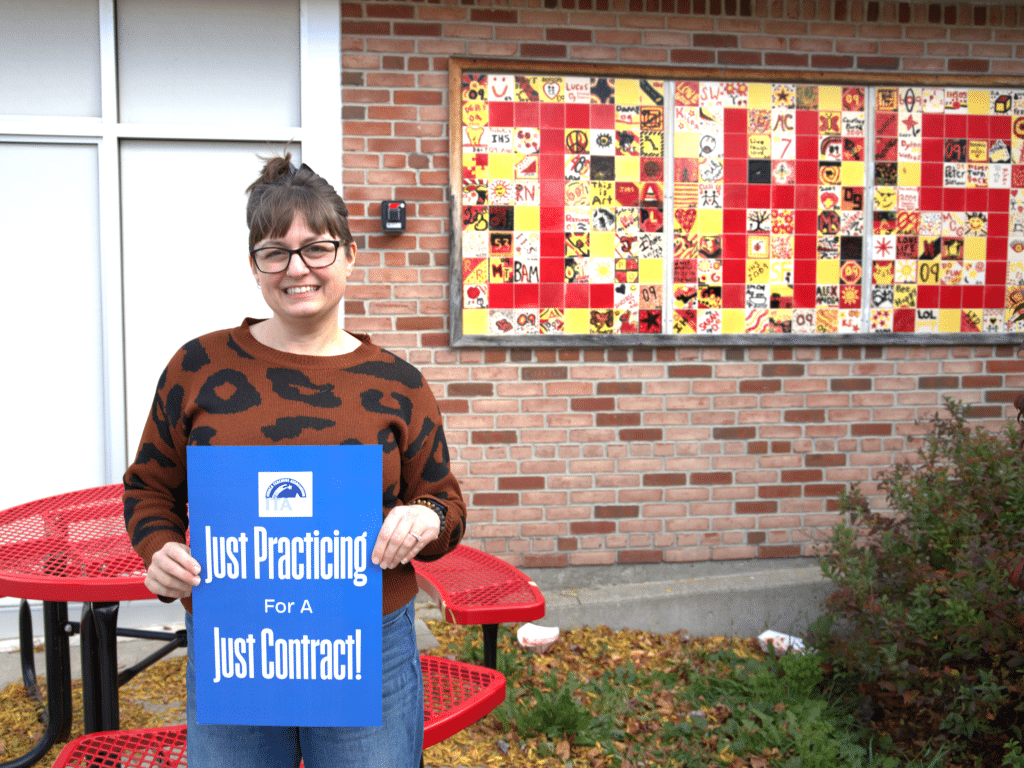
Ithaca Teachers Association President Kathryn Cernera stands outside Ithaca Senior High School. Cernera has played a key role in the months-long negotiations between the Ithaca City School District and the teachers’ union, which has called for a new contract with a step-and lane-system and higher salaries for all teachers.
The ongoing contract negotiations between the Ithaca Teachers Association (ITA) and the Ithaca City School District (ICSD) reached a turning point earlier this month when the county’s largest school district agreed to one of its teachers’ biggest demands.
The ITA, which represents nearly 600 teachers in the district, has been negotiating a new contract with ICSD leadership since January, before their last contract expired on June 30. Teachers returned to the classroom last month after summer break and are currently working under their expired 2024-2025 contract without annual salary raises this school year.
After failing to reach an agreement last spring, negotiations resumed on Oct. 9 with the last public bargaining session scheduled for Nov. 20. This comes after the district’s Board of Education received sharp criticism last month when members voted to extend Superintendent Luvelle Brown’s contract by one year to June 2029, while teachers remained without a contract.
One of the ITA’s central demands is for the district to adopt a step and lane salary structure, a common system used in school districts across the country. The system places teachers in “lanes” based on their years of experience, education level and professional development credits. Each lane comes with a set base salary and a schedule of raises, or steps, where more experienced teachers may be placed in faster lanes with higher pay increases.
In the spring, district leaders argued that implementing a step-and-lane system would create too much variation in teacher salaries and be fiscally unsustainable. However, at the Oct. 16 negotiation session at Ithaca Senior High School, ICSD leadership reversed its stance, bridging a major negotiation gap.
“We are moving into the final stages of negotiation and are very close to a tentative agreement that is transformational,” ITA President Kathryn Cernera told Tompkins Weekly. “We’re hopeful that this will really support our teachers and change the story of being a teacher in the ICSD.”
In a counterproposal presented by Brown, the district’s executive team proposed a three-year contract that includes a step-and-lane system with 7% annual increases to overall teacher salaries for this school year and next school year, as well as a 6% annual increase for the 2027-2028 academic year.
Not every teacher would see their salary increase by these percentages, as they represent increases in total allocated funding for teacher salaries, but Brown noted that every teacher would receive an annual salary raise of at least 5% under the district’s new proposal.
“This represents the most significant financial investment into teachers’ salaries that I’ve been able to find in the history of our school district, hands down,” Brown said at the Oct. 16 negotiation session.
Teacher retention ‘crisis’
The ITA has long argued that ICSD underpays its teachers, resulting in many teachers taking their experience and talent to neighboring school districts.
“We have teachers who are struggling to buy groceries right now because they haven’t received a raise and the cost of living keeps going up,” Cernera said.
ITA leaders said that the district sees nearly 20% of its teachers leave every year, a turnover rate that outpaces state and national averages, with a large portion of them being new teachers who transfer to other jobs.
Brian Goodman, ITA treasurer and a fifth-grade teacher at Northeast Elementary School, said that about half of the ITA’s membership has changed over the last three years.
“Some buildings have many veteran teachers and other buildings have almost all new teachers, and that’s not right and that’s inequitable,” Goodman said. “It’s terrible that some kids have brand new teachers who don’t have any institutional knowledge while other kids have this wonderfully developed school culture.”
Goodman said that exit polling from outgoing teachers last school year found that 40% of respondents were leaving the district for another teaching job within an hour’s drive.
The ITA’s expired contract, which was in effect for six years, included uniform yearly salary increases of about 4%. Earlier this year, the district proposed a new contract that included annual salary increases of about 4.6% for two years, which the ITA rejected.
Nicholas Pemberton, a special education teacher who has taught in the district for about 17 years, said that he has always felt underpaid as an educator in Ithaca. He said that his annual base salary is about $66,400, with an additional about $11,000 that he earns for teaching an extra class every day.
“I live in Owego because I can’t afford to live in Ithaca, and that says a lot,” Pemberton said. “I’ve watched co-workers leave throughout the years and move to another school district and make $8,000 or $10,000 more, and all they have to do is leave Ithaca. They didn’t get any extra education, they haven’t worked any longer — it’s just that they left Ithaca.”
William Asklar, an English teacher who has taught in the district for 28 years, said he also can’t afford to live in Ithaca and that many of his fellow teachers feel undervalued by district leadership.
“When the median salary in a district in Western New York is $45,000 more than what we’re making in Ithaca, yet Ithaca is one of the most expensive cities in the entire country to raise a family, it’s very concerning,” Asklar said.
At the Oct. 16 negotiation session, Brown and other district leaders shared concerns about losing teachers to neighboring school districts, and said that their new step-and-lane proposal would put teachers “in the top tier” salary range in the county.
According to Brown’s counterproposal presentation, the average salary for a teacher in the district is about $67,300, a lower average than teachers make in towns like Dryden, Groton and Lansing.
The proposed step-and-lane system would raise the average teacher’s salary to about $81,700 by the 2027-2028 academic year, which district leaders estimated would give ICSD teachers among the highest average salaries in the county, while still lagging behind teachers in the Lansing Central School District.
“We’re trying to correct and shift a multi-decade-old issue. I hope you will hear that we’ve listened and we’re responding to what you’ve asked for,” Brown told ITA leaders at the Oct. 16 negotiation session. “It’s probably as good as our school district and community can do at this moment.”
The district is also proposing that the school board, upon recommendation from the superintendent, be allowed to give any individual teacher a pay raise above their scheduled step increase.
“At our last negotiation session, ICSD came back with what felt like a real offer,” Goodman said. “I feel like we’ve entered the negotiation phase of negotiations, 10 months in.”
‘Leapfrogging’ and payroll errors
Goodman said that another major issue in retaining ICSD teachers is leapfrogging, when a newly hired teacher makes a higher salary than a current teacher with similar or more years of experience.
“Hundreds of our members are being leapfrogged, some by $200 and some by a few thousand dollars,” he said. “We’ve had teachers who have said, ‘I can quit today, get rehired and make more money.’ That’s how crazy our salary system is.”
He said that a step-and-lane system would “instantly” end leapfrogging in the district.
However, during the last negotiation session before summer break on June 12, ICSD Chief Investigation Officer Robert Van Keuren, who was the only district official present at the meeting, said that he “fundamentally” disagrees that leapfrogging occurs in the district.
“The definition that you’re using [for leapfrogging] is a natural outcome of the contracts that you all voted for and collectively bargained,” Van Keuren told ITA leaders at the June 12 meeting.
Goodman also argued that not having a step-and-lane system has led to numerous errors in paying staff correctly and on time.
“Because our current salary system is so complex, over 50 teachers have been underpaid thousands of dollars, not due to malicious intent, but simply due to human error,” he said.
In May, ICSD teachers and education support staff reported that they did not receive their regularly scheduled payments on time, which a district official attributed to a “payroll issue.”
Improving health insurance and family leave
Along with higher compensation, ITA members have called for expanding health insurance benefits and a longer family leave policy.
District leaders previously proposed getting more teachers on a Medicare Advantage plan and off of the district’s current Medicare supplemental plan. Cernera said that ITA members prefer the supplemental plan because it gives retired teachers lower out-of-pocket costs and no network restrictions, while the Medicare Advantage plan has had teachers, instead of the district, paying higher premiums.
District leaders are now proposing to keep both plans and allow teachers, upon retirement, to choose which plan they want, instead of defaulting retirees onto the Advantage plan.
Pemberton said that health insurance premiums have risen for him and other teachers, and that he is earning about $50 less per paycheck this school year than last year since a new contract has not been approved.
Cernera said that teachers are paying about 22% of their insurance premium, while the district covers the rest.
District leaders have also opposed expanding health insurance to domestic partners, which Goodman said hurts LGBTQ+ teachers.
“If we’re in a world where marriage for same-sex couples gets revoked — and in this political climate that wouldn’t be hard to imagine — that means that your life partner wouldn’t be on your health insurance the way your opposite-sex partner would be,” he said. “This is a really big issue because we have a lot of same-sex and nonbinary couples that are really afraid that their partner could lose their health insurance.”
Cernera also said that the union is calling for a longer paid parental leave policy of up to 12 weeks, a time she referred to as the “fourth trimester,” when the baby and birthing parent bond and heal together. The district currently allows teachers to take up to six weeks of their sick leave for a vaginal birth and up to eight weeks for a C-section birth.
“Once those six to eight weeks are over, that teacher then needs to make a choice in whether to go on unpaid childcare leave and stay home with their baby, or come back to work and find something to do with their six- to eight-week-old baby during the school day,” Cernera said.
ITA leaders argue that the district’s current parental leave policy makes teachers exhaust their sick days and then have no paid time off remaining if their child gets sick afterwards. The ITA proposed that teachers in need of more days use the union’s sick bank, which could be used to recover after childbirth or care for ailing parents. ICSD leaders initially said that teachers would need to work for six years before getting reimbursed for sick bank time used in lieu of personal sick days.
However, after ITA pushback, district officials have tentatively agreed to let teachers access the sick bank without restrictions for one year after childbirth, but only for “qualifying medical conditions” of the child.
District leaders have also agreed to ITA’s proposal that a non-child-bearing parent may use up to 30 accumulated sick days following childbirth for family leave.
Extending teacher hours
District leaders are proposing to extend the school day for elementary school students by 15 minutes and for secondary school students by 30 minutes to align with neighboring districts.
But one of the district’s more controversial proposals is having teachers stay at school for an additional hour after student dismissal four days a week to provide time for lesson planning, professional development and other school-related work.
Brown said that the intent is to give teachers “more time to work at work” while students aren’t present, but several ITA members argued that the district should achieve this goal by reducing teacher workloads, rather than extending the time they spend at work.
“The proposal would extend teachers’ time at school by more than 10% when we’re only getting a raise of 7%. To me, that’s not a raise because it’s a little more money for a lot more time and I think that it’s insulting,” Asklar said. “The majority of teachers are spending way more time than they’re contractually obligated to already, and I think adding even more time to that is a slap in the face.”
Pemberton echoed these concerns and said that district leaders should create more opportunities for Professional Learning Communities — teachers who collaborate on lesson plans — to meet during the school day.
“If that [ICSD proposal] went through, I wouldn’t get home until 6 p.m. at night,” Pemberton said. “I enjoy spending time with my kids, and I coached their little league team last year — and if I have to stay longer at school then I can’t do things like that anymore.”
Cernera said that both parties will further discuss this proposal at their Oct. 30 negotiation session.
Community support amid negotiations
The ITA has been very public in its demands this year and has used a variety of tactics to rally its members and the community to support higher teacher salaries. This has included writing op-eds, posting on social media and staging protests, such as one outside of the district’s main offices last month that drew dozens of ITA members, as well as local elected officials, including Ithaca Mayor Robert Cantelmo and Tompkins County Legislators Shawna Black and Deborah Dawson.
Cernera said that many of the ITA’s strongest supporters have been students. Last month, The IHS Tattler, Ithaca Senior High School’s student-run newspaper, published an editorial in support of higher salaries for ITA members, writing that “teacher working conditions are student learning conditions.”
Julia Kleinberg, an IHS junior and The Tattler’s literary editor, said that teachers leaving the district has led to larger class sizes at IHS, making it harder for students to receive individualized help. She added that the “great majority” of students she knows believe that ITA members should be paid more.
“As students, we’re very devoted to some of our teachers, and it’s really frustrating to watch them be mistreated and taken advantage of. So, I think all of us on The Tattler’s board felt that it was a high priority to take a stand on this,” Kleinberg said. “We see our teachers being overworked, tired, grading things at 2 in the morning, and it’s frustrating not only to see that happening to them, but to see the effects on us.”
Cernera said that another concern that’s come up during negotiations is the role of artificial intelligence in education. The ITA and ICSD agree that AI has a place in the classroom, while generative AI and other technology will only be used to “supplement, support and enhance teaching and learning.”
Brown said that the district wants to form an advisory committee to study the potential impacts AI can have on teaching students in the district.
Cernera said that she was “cautiously optimistic” that the ITA and the ICSD will reach an agreement that satisfies both parties, but that “we will take as long as it takes to reach an agreement that works for everybody.”
Pemberton said that his salary concerns haven’t diminished his passion for teaching.
“The teachers in Ithaca truly love teaching and love all of their students,” he said. “There’s a good sense of family in the district, and we just want to see it reflected in our pay.”
Author

Related Articles
Cayuga Medical Center nurses to rally, alleging anti-union tactics by hospital management
CMC nurses plan a rally, alleging unsafe staffing and illegal anti-union tactics as the hospital highlights recent patient-safety gains.

Holiday traditions bring community cheer
Tompkins County holiday traditions light up homes, farms, and schools with festive cheer and community spirit.

Design details unveiled for new Center of Government
Design details for the Tompkins County government building in downtown Ithaca are now public, with a county survey open for feedback.