
Ithaca’s retail future: Experts give insights and lay out challenges
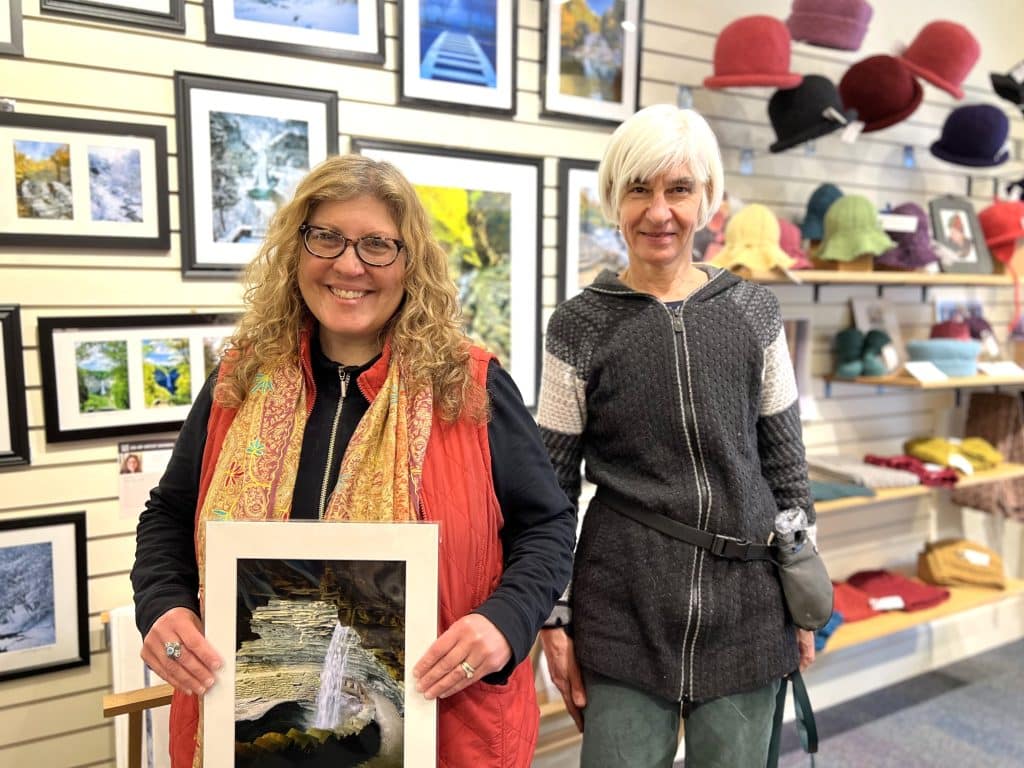
Photographer Jennifer Byrd Rubacky (left) and fiber artist Veronica Guiry, who are one of many co-owners of Handwork as members of the store’s co-op, said they appreciate the support of the arts that they have seen over the years. Retail expert Michael Berne said in a recent presentation that efforts should be made to capitalize on Ithaca’s reputation as an arts hub.
“You can’t sugarcoat things and expect them to get better.”
Those were the words of Nan Rohrer following a presentation about Ithaca’s retail market by Michael Berne of MJB Consulting. Rohrer, CEO of Downtown Ithaca Alliance (DIA), said she appreciated Berne’s candor. “You want those valid opinions and those very straightforward truths.”

In a study commissioned by the DIA and the city of Ithaca, Berne took a comprehensive look at local retail with the goal of developing recommendations for retail traction and small business development. Berne and his colleague David Milder, a downtown revitalization specialist from DANTH, Inc., presented their findings Feb. 25.
Berne said there will be a follow-up presentation in April that will provide the city and DIA with actionable steps they can take to help local retail thrive. “Today is not about what to do or who does it,” Berne said. “Rather, it is about … how it might be possible to steer the trajectory in desirable ways. The next and final phase will be the implementation plan.”
“We first started thinking about the need for a retail study and strategy back in 2022, thinking in terms of economic recovery from COVID and realizing that the retail sector was one of the sectors that was most heavily impacted by the pandemic,” said Thomas Knipe, Deputy Director for Economic Development at the City of Ithaca’s Department of Planning & Development.
Between the efforts being made toward COVID-19 economic recovery and the general need to understand the longterm effects of COVID, such as e-commerce, changes in buying patterns, and fewer office workers downtown, the city identified the need for a study, which was supported by city of Ithaca American Rescue Plan Act federal relief funds.
Storefronts account for 41% of the overall retail mix downtown. “That’s a pretty high percentage today,” Berne said, adding that, historically, visitors have accounted for more than half of downtown retail sales.
But, major retailers looking to determine if an area is a good bet are going to spot some “‘black eyes’ — some retailers that left the market, closed the store, and did not relocate within it, most notably Urban Outfitters,” Berne said. Ithaca is not an outlier in this regard — the clothing store has closed downtown college town stores in other locations — but Ithaca has also lost DSW, American Eagle and a few others, Berne pointed out.
“At the same time, there’s been some wins,” Berne added. “Trader Joe’s and REI, two retailers that normally open in much larger markets, have opened here which, again, speaks to other large national brands.”
“They are pack animals,” he said, “and they notice these things.”
A strong base with untapped potential
Ithaca performs well overall, Berne said.
“It’s a strong and relatively stable economy,” he said, “but at the same time, it’s a relatively small trade area.” He said Milder crunched the numbers, and Ithaca’s trade area, which is meant to define where the city gets most of its retail sales, is about 133,000 people.
“Not large,” Berne said. As a basis of comparison, Syracuse’s metro area is about 663,000, and Binghamton’s is 248,000.
In addition to the lack of freeway access, Ithaca lives in the shadow of one of the largest malls in the United States, Destiny USA, and Berne said this means a retailer looking to open a store in central New York would have to choose Ithaca over the mall. “From the perspective of this retailer, their choice is rather predictable,” he said.
Finally, Berne said, Ithaca holds a reputation as a liberal college town when it comes to large national brands. “That implies certain political complications that they wouldn’t necessarily have to deal with elsewhere,” Berne said. “I’m not saying that’s good or bad. I’m just saying that’s how they would see it.”
The Commons: a set of challenges to overcome
“It’s vulnerable, put bluntly,” Berne said of Ithaca’s pedestrian plaza.
The Commons has much potential but does face some challenges, Berne told Tompkins Weekly after the presentation.
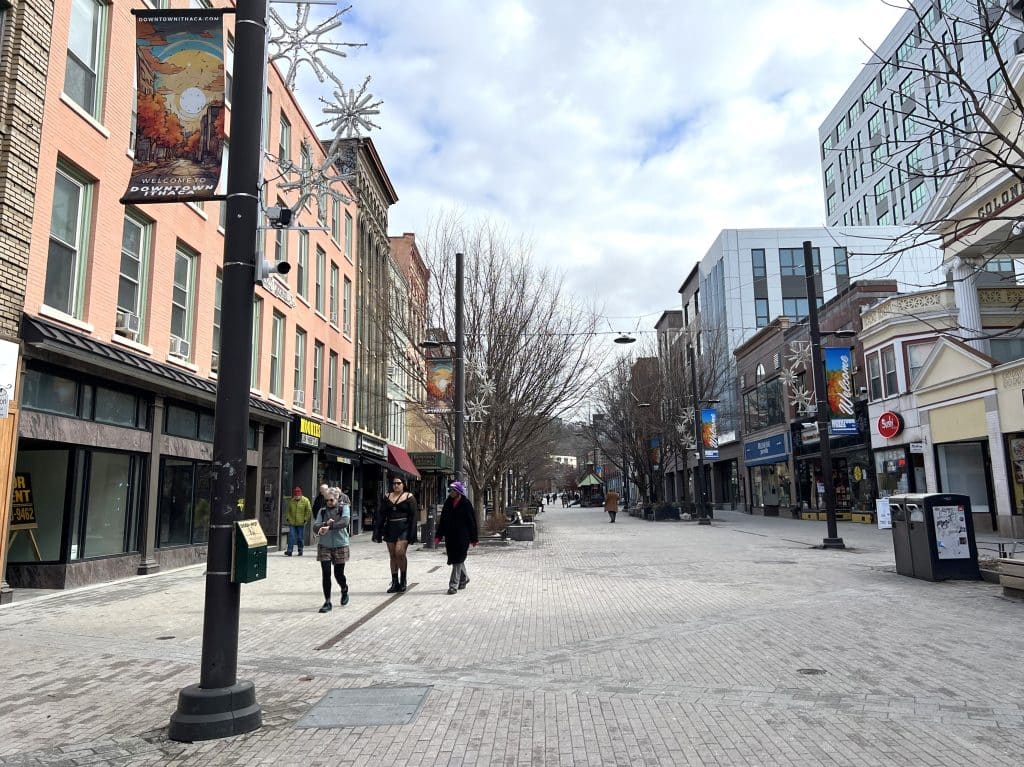
The Commons in downtown Ithaca on a recent weekday morning.
“It does underwhelm,” he said, “and can be especially grim in the winter months, but that can be a function of the weather, obviously.”
Berne’s research shows that the average number of visits per day to the Commons is about 4,400. “It’s not nothing, but it’s modest,” he said. “It varies monthly in a feast or famine fashion.”
Pedestrian malls were built all across the country during the same era when the Commons was constructed in 1974, opening in 1975, to varying levels of success.
“There wasn’t much that was working in cities and downtowns at that time, and the pedestrian mall was asked to do something that was too steep of a climb,” said Berne.
There is potential in Ithaca’s huge visitor and student population. “It can be overcome, theoretically,” he said of the Commons lack of visibility from a major thoroughway, “but you have to do everything else right. Even in the best of circumstances, it’s not easy.”
“It really puts a lot of the onus on the merchant, who has to be capable of building the Commons as a destination,” Berne said, adding that right now, the Commons is due for a change.
“One stakeholder described it as having no funk,” Berne said during his presentation. “That’s quite an insult to a community like this, which values funk.”
“It’s poorly programmed and activated,” he said. “There’s really not much to do or watch other people do.”
Downtown Ithaca also suffers from a lack of dilution to tone down its perceived negative aspects, Berne said.
“There are some social issues that have come up, but in a lot of places, those same social issues exist,” he said. “It’s just that here they’re not diluted by other things existing.”
“There are districts with the same amount if not more loitering, but you don’t notice it much because your attention is distracted by more things that are interesting,” Berne explained after the presentation. “When less going on, those social issues are going to leap out at you a lot more.”
“Putting the supportive housing in Asteri was an odd choice, I’ll be blunt, because that’s just adding, not diluting,” Berne said of the new housing units for previously unhoused people in Asteri, the new apartment building located next to the Ithaca Downtown Conference Center.
But, he added, most visitors don’t view the Commons in a negative light; that is, at least not until they talk to people who live in the area.
“Local Ithacans are downtown’s worst ambassadors,” Berne said. “When your locals are trashing the Commons and you’re a visitor, it certainly tears away any of the luster it might have had.”
The retailers on the Commons that are most likely to survive and thrive are the ones that can expand their skills beyond their traditional brick and mortar retail space.
Rohrer said retailers that do really well over time are the ones that are constantly able to pivot.
“They’re reading the trends of what’s going on,” she said, citing Megan Vidler, owner of Home Green Home, as an example.
“There are only so many environmentally friendly mattresses you can sell; they are made to last a long time,” said Rohrer. Given that challenge, Vidler pivoted to another product, and Rohrer said it has been a success.
“Their exotic plants business is going gangbusters,” she said.
Collegetown underperforms
As a college town, Ithaca underperforms in terms of retail, Berne said, particularly in the area of specialty shopping.
“Yes, it has the big and the medium boxes like Target and Old Navy. I’m not talking about those, Berne said. “I’m talking about smaller apparel, variety stores that you often find in university town settings, even ones with far fewer students.”
And that suggests opportunity, Berne said.
A prominent population of “yupsters”
Of the 61,000 people in the central greater Ithaca area, 14,000 are aged 55 and over, which is about 45% of the non-students.
“That’s one of the reasons you see pricey gourmet restaurants in downtown,” Berne said. He calls this demographic “yupsters,” which are “highly educated, well-off, baby boomers and Gen Xers who celebrate the artist and cerebral life, at least in certain manifestations.”
They enjoy traditional fine dining, wine bars, bookstores, and arts and crafts retailers.
“They might shop, if they have money,” and enjoy reading the New Yorker and shopping the clothing brand Eileen Fisher, Berne said.
“Better exploiting these sorts of psychographic features can enable us to transcend some of the limitations I described before,” Berne said.
More artsy than locals may think
“Ithaca is much more of an arts town than it’s marketed to be,” Berne said.
It was ranked the second-most vibrant arts town amongst medium-sized communities in the country, according to SMU DataArts rankings, only below Santa Fé, New Mexico, based on the number of independent artists, the number of arts businesses, and other criteria.
“They form what David [Milder] is describing as an arts archipelago,” Berne said. “It’s not concentrated in any one neighborhood or district, but rather in clusters of art production and sales that are arrayed around the region, like a group of islands, each with its own strengths or roles as part of a larger ecosystem.”
Even though Ithaca has the Ithaca Farmers Market, gallery night, artists co-ops and multiple downtown art shops, it is not being aggressively marketed as a hub for art, according to.
“We see that as an opportunity,” Berne said. “It is there to be tapped.”
One point that Berne said he often comes back to again and again when giving presentations is that niches, like the Ithaca art niche, tend to grow exponentially.
“If you invest more in them, you get more than an equal return,” he said. “That’s because the presence of, say, the arts, is a magnet to attract more artists to live, work and sell in Ithaca. It reinforces Ithaca as a worthy arts destination. If you have something already in certain categories, you want to double down on it because the more selection there is, the more variety there is within that niche, the reach grows disproportionately.”
At Handwork one recent morning, photographer Jennifer Byrd Rubacky and fiber artist Veronica Guiry were working behind the counter as part of their membership to the artists’ co-op that owns the longstanding art store on State Street across from the Commons.
“I feel like I’ve gotten a lot of exposure. It’s been welcoming,” said Rubacky, who started showing her work on consignment in 2022 and became a member in 2023.
“I’ve learned a lot by being around other artists and members,” she said.
Guiry, who has been a member of Handwork since 2007, said she estimates that the majority of sales are generated by people from out of town. “Student weekends are a lot of fun,” as are alumni weekends, she said.
David Kingsbury of Turtle Island Pottery, who has been selling his wares at Handwork for 40 years, said the community has been very supportive of artists. He said that if there is one simple thing that downtown merchants could do to improve the downtown retail scene, it would be to stay open later, an idea that he tried to generate interest in among the storeowners about 20 years ago that never gained traction.
“I vacation in small towns in Massachusetts, and they are just crawling with tourists in the evening,” Kingsbury said. “What do people do after their dinner? Considering how the tourist industry is growing in this area, I don’t know why more merchants don’t take advantage of it.”
Vintage and consignment shops are two types of stores that long ago shed their stigma as a retail category and very much fit with the sensibilities of Ithacans, he added. “Again,” he said, “they thrive on scale.”
Regardless of the type of store, retailers downtown need to be of a high caliber to succeed long term, said Berne.
“The businesses on the Commons have to be perfect,” he said. “They have very little margin for error.”
Author

Related Articles

Holiday traditions bring community cheer
Tompkins County holiday traditions light up homes, farms, and schools with festive cheer and community spirit.
The gift of an experience: Local businesses offer hands-on holiday fun
Holiday experience gifts in Tompkins County include candle making, gourd crafts, and pottery workshops for creative seasonal fun.
Code Blue shelter opens amid praise, concerns and ongoing debate
Ithaca’s Code Blue shelter opens with larger space, showers, and case management to help residents during cold weather.