Lansing’s $17M capital project advances amid construction challenges
Lansing Central School’s $17M BOBCAT capital project upgrades schools, athletic facilities, HVAC, and infrastructure.
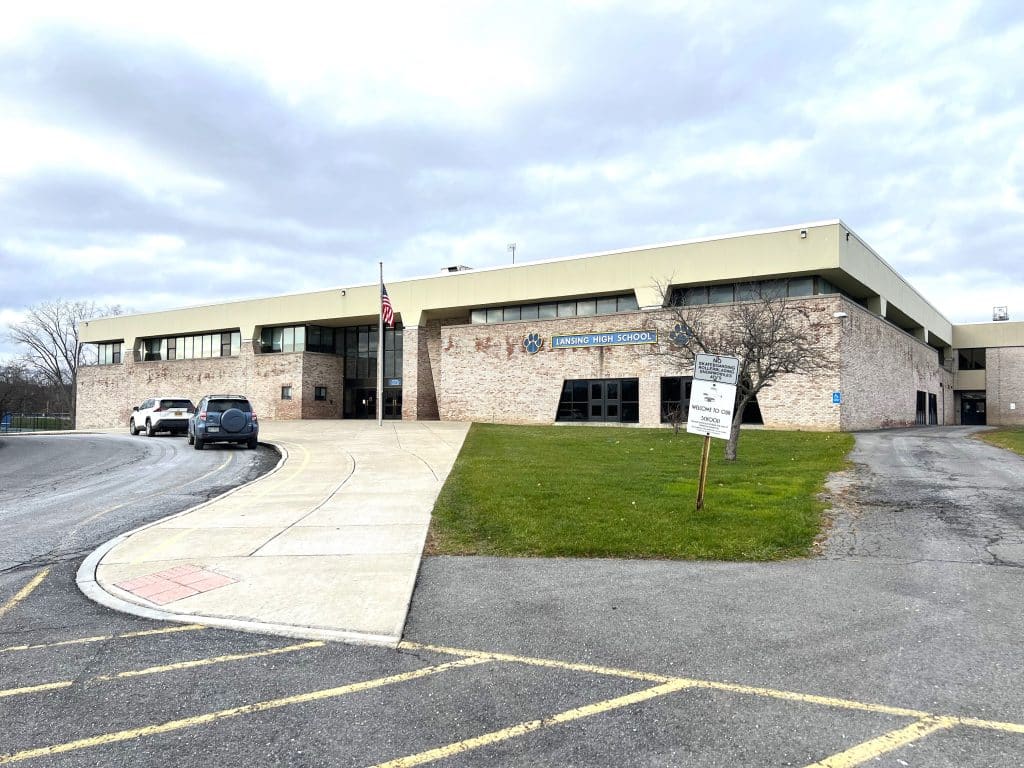
Lansing High School’s courtyard has seen the brickwork replaced this year, as well as the windows, as part of the district’s continuing capital project, dubbed BOBCAT. The high school’s gymnasium also saw improvements.
The Lansing Central School District (LCSD) capital project continues to take shape. The project, dubbed BOBCAT, was approved by voters in 2023 and has a price tag of about $17 million.
LCSD Assistant Superintendent of Business Administration Kathryn Heath presented updates on the project at the district’s board of education meeting Nov. 10.
First, Heath recapped a timeline for the project’s past two years, which includes significant upgrades to athletics facilities and overhauls to safety systems and infrastructure.
Slightly more than $10 million of the project’s funds were earmarked to infrastructure projects, including the replacement of the roofs of facilities across the LCSD campus — R.C. Buckley Elementary School, Lansing Middle School and Lansing High School. That pool of funds would also improve the middle school gymnasium’s padding and basketball hoops, as well as improvements to the interior doors of the middle school’s building.
For the high school, the project proposes parking and drop-off infrastructure improvements, as well as redone windows and lintels at the natatorium. According to the plan, the high school would see improvements to the courtyard walls and windows, as well as to the gymnasium floors.
BOBCAT also calls for improvements to the public announcement (PA) system at the elementary school, as well as upgrades to the generator.
Across the board, the project has also facilitated the installation of better heating, ventilation and air conditioning (HVAC) systems.
More significant improvements to athletics facilities include the new Sobus Field and track and new bathrooms near the varsity baseball field.
Heath said at the meeting that the new HVAC controls, the roof replacement projects and new nonpipeline alternative heating infrastructure have all been installed.
“We also did the high school gymnasium floor and the middle school gymnasium equipment,” she noted. “The bulk of that work happened in the spring and summer of 2024. In spring and summer of 2025, work began on the Sobus Field. But we also replaced the PA system in the elementary school.”
The courtyard at the high school has this year seen the brickwork replaced, as well as the windows.
“There is no more plastic hanging from the walls of the courtyard. It looks quite nice,” Heath said.
Heath said that the interior doors at the middle school have been replaced. Up next on the schedule for improvements at the middle school is the auditorium’s lighting, Heath said.
Contractors have run into issues with some portions of the project, like the chiller at the middle school.
“Unfortunately, we ran into cooler weather before they could sort all those out,” Heath said. “So we need to wait for it to heat up again so they can finalize all that work and the commissioning of that. There are three rooms upstairs on the second floor of the middle school that did not get AC replaced due to some piping issues and some of the some issues related to the interior of the wall.”
Those AC units will be replaced in the spring, Heath added.
The Sobus Field and track have also seen some challenges.
“[On] the far side of the field, there’s some standing water on the rubber,” Heath noted. “So, you can see if it rains a lot, there’s some puddling. So, we are aware of the issue. We have the contractor on it to remediate that in the spring. They’re pretty confident they’ll be able to kind of finesse that and stabilize that.”
The drainage under the field is another issue, Heath said.
“We’re looking at the field drainage. We’ll be doing some testing, making sure that that drainage rate is on par with what was designed, and looking at some remediation if it is not so,” Heath said. “Part of that is just settling when you put in new soil and new rocks and … all the stuff that they put underneath the field; some of that just needs to settle out.”
LCSD Superintendent Chris Pettograsso also used part of the meeting to thank families for coming together to help community members in the district with food security at a time when the government shutdown that unraveled through October and November threatened Americans’ access to food.
During the shutdown, which turned out to be the longest in U.S. history, food benefits through the Supplemental Nutrition Assistance Program (SNAP) were delayed for the month of November. Families and advocates of social welfare said during the shutdown that up to 7,200 residents of Tompkins County could have gone without benefits in November prior to the reopening of the government on Nov. 12.
In Lansing, organizations such as the Lansing Food Pantry at the Rink, located at 1767 E. Shore Dr., and Lansing Lunchbox, an organization helping families of LCSD children secure food, stepped up to fill the void.
“I just wanted to thank the community for really rallying around food security in light of some of the loss of benefits and support,” Pettograsso said at the Nov. 10 meeting. “I know the pantry has been very busy. The district sent out a survey; we had about 100 responses that showed there is a need for support. But between the businesses, Lansing Lunchbox, the pantry and others, we have a lot of support for families. So, if families are finding difficulty getting support for whatever reason, the school can be a liaison to those services.”
Author

Related Articles
Village of Lansing wins more than $500K for new sidewalks
Lansing sidewalk funding exceeds $500K as the village earns state support through New York’s Climate Smart Communities program.
TeraWulf AI data center wins zoning appeal in Lansing
TeraWulf’s proposed AI data center at the former Cayuga Power Plant site in Lansing moves forward after winning a key zoning appeal on Dec. 22.