
Lansing Town Board could opt into shared emergency medical response program
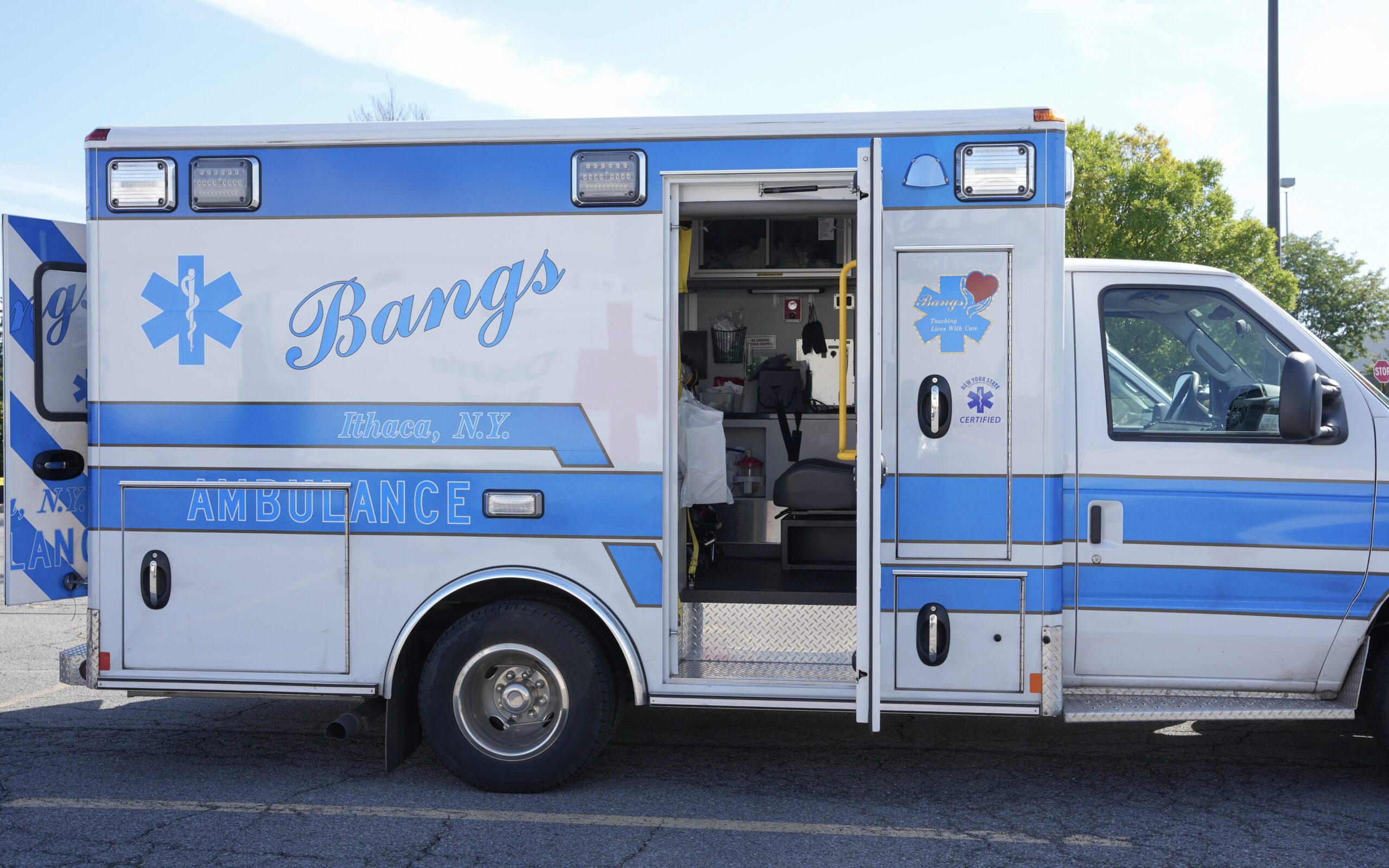
A new Tompkins County shared service program, included in the county’s 2024 budget, may be able to shorten response times for medical emergency services in the town of Lansing.
The new program would cut medical response time for emergency situations, such as heart attacks and strokes, in the town of Lansing from 14 minutes and 30 seconds to about 7 minutes, town board members and county officials say. The proposed county Rapid Medical Response Team would be a two-year pilot program that will help dispatch trained emergency medical technicians all over the county, but would primarily consist of three units. One would mostly serve the Lansing area, another would serve the town of Caroline and a third would be stationed in either Enfield or Newfield.

By Eddie Velazquez
Michael Stitley, Tompkins County’s director of emergency response, spoke about the program at the Lansing Town Board’s October meeting.
“The basis of this program is to support the community-based medical services that currently exist, many of which are struggling,” Stitley said. “The [new teams] would serve in a role where they respond as the first responder to a medical emergency while the affected residents wait for transport.”
Stitley said that he expects the program to be flexible. He noted that the county’s emergency response arm will look at data from medical emergency calls and where they originate to decide how to best deploy the medical response team.
“The data shows [Lansing, Caroline and Newfield/Enfield] have the biggest need for the program,” he said. “As we evolve through the program, we will be paying attention to the data so those units may move around as the body of calls changes.”
The unit in charge of Lansing would deploy out of the emergency response headquarters at 82 Brown Rd. in Ithaca.
“If there is a more strategic location that the data shows it would be more appropriate for that unit to be stationed at, then we are certainly open to that,” Stitley said. “We want this to be very fluid.”
Town board member Joseph Wetmore, a Democrat, said that medical response services in Lansing have seen some challenges in recent years. Wetmore cited statistics that measured response times between 2017 and 2021.
“The response time rose from 12 minutes and 30 seconds to 14 minutes and 30 seconds,” he said. “Those minutes count when you are talking about those serious health problems. I am also seeing something I really don’t like, which is a 37% nonresponse in Lansing, where they just don’t come at all. With those kinds of numbers, I don’t see this program as a luxury, I see this as a necessity.”
Wetmore said the current system of emergency response does not have the capacity to handle Lansing’s needs.
“We need this to fill in the system’s missing spots,” he added.
County Legislature Minority Leader Mike Sigler, R-Town of Lansing, said during the meeting that the county would foot the nearly $700,000 bill for the first year of the program, as shown by a proposal included in the town board’s agenda. The legislature will then look for a cost-share model that municipalities will enter to fund the program, to the tune of about $505,000. The first year of the program is more expensive because there are one-time startup costs that include the purchase of three rapid response vehicles and other equipment.
The county plans to request state funding from New York state’s Local Government Efficiency grants and Countywide Shared Services Initiative.
“The conversation is going to begin in earnest about how we are going to pay for this going forward,” Sigler said.
Sigler noted that Lansing could be paying anywhere from $20,000 to $58,000 in subsequent years of the program, depending on the cost-sharing model adopted by the county.
At the meeting, officials also noted that the proposed medical emergency program approach with rapid response vehicles would be cost effective. If the county decided to pay for three transport ambulances, costs for the first year of the project would balloon to $1.58 million. The annual operating cost in the subsequent year would rise to $861,475.
“We would be getting people on the scene right then who can administer drugs and certain tests to stabilize someone at a quick response, and then we can take some more time to transport them if needed,” Wetmore said. “That is the critical time. If we get someone there within 7 minutes, which is where we are trying to get it down to, we can save a lot of lives that way.”
Lansing at Large appears every week in Tompkins Weekly. Send story ideas to editorial@vizellamedia.com. Contact Eddie Velazquez at edvel37@gmail.com or on X (formerly Twitter) @ezvelazquez.
In brief:
The Town of Lansing is hosting a public open house for its open space conservation plan on Nov. 9 from 5:30-7:30 p.m. at the Lansing Town Hall. The purpose of the open house is to provide attendees with the opportunity to review and comment on the draft plan. More information can be found at https://www.lansingtown.com/bc-cac.
Author

Related Articles

Lansing’s Katie Bruno: From local stages to ‘Stranger Things’
Katie Bruno Stranger Things appearance marks a major milestone for the Lansing native, whose career spans local theater to global stages.
Village of Lansing wins more than $500K for new sidewalks
Lansing sidewalk funding exceeds $500K as the village earns state support through New York’s Climate Smart Communities program.
TeraWulf AI data center wins zoning appeal in Lansing
TeraWulf’s proposed AI data center at the former Cayuga Power Plant site in Lansing moves forward after winning a key zoning appeal on Dec. 22.