Leaders share next steps after public safety reform passes
Late last month, the Tompkins County Legislature and the City of Ithaca Common Council passed an amended version of the Reimagining Public Safety draft plan released by the Reimagining Public Safety Committee in late February (full article at https://t.ly/REc8).
The final report was submitted to the state just before the April 1 deadline Gov. Andrew Cuomo set last year when he issued Executive Order 203. To view the full plan submitted to the state, visit the county’s website at www2.tompkinscountyny.gov/ctyadmin/reimaginepublicsafety.
The changes made between the draft and final plans address many of the concerns voiced by a broad spectrum of sources in the community, and now, leaders are setting their sights on what’s next to make the promises a reality.
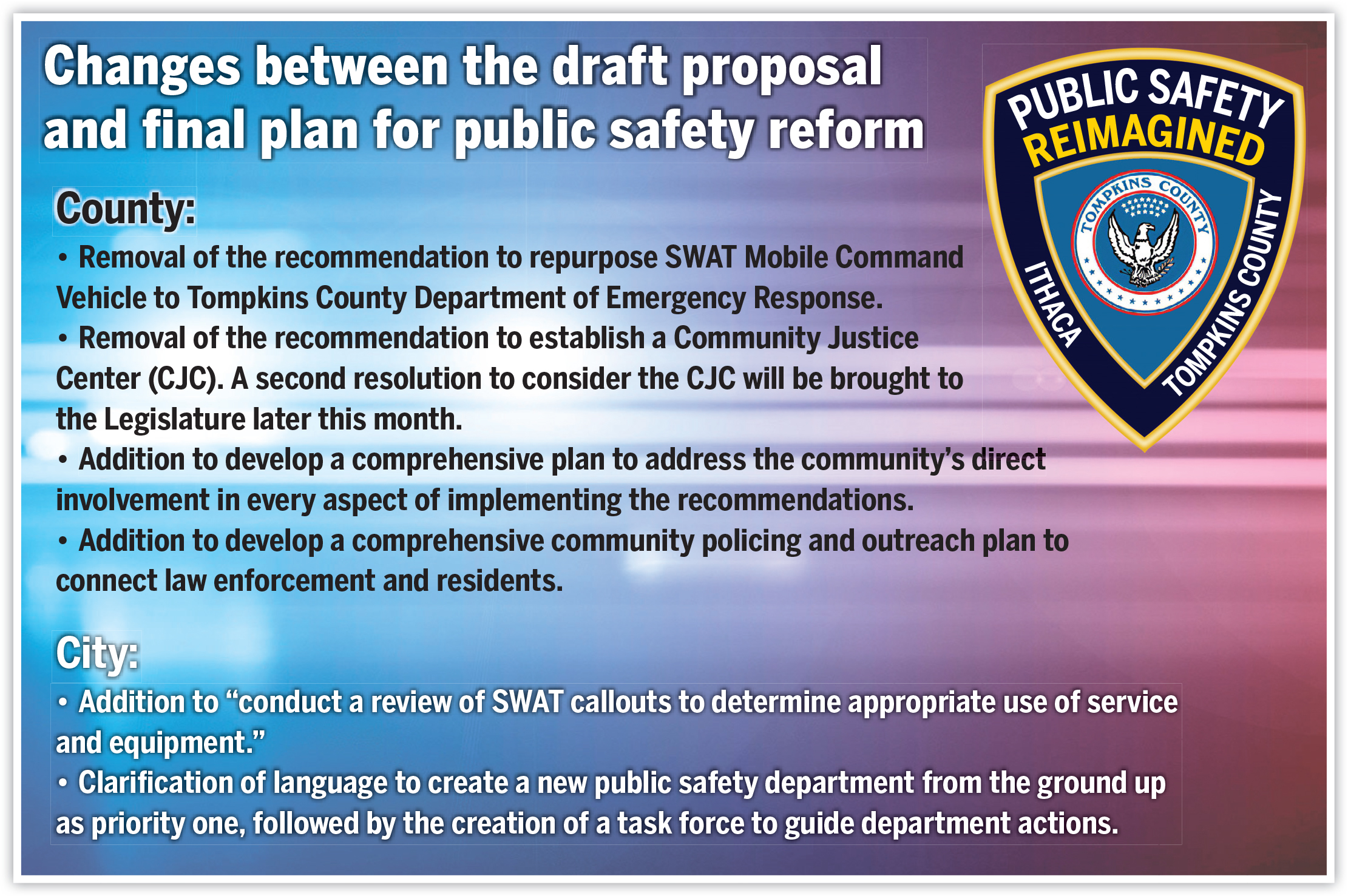
While most of the proposals in the draft plan stayed consistent in the final plan, there were a few notable changes.
First, the Legislature made several amendments, including the removal of the recommendations to repurpose SWAT Mobile Command Vehicle to Tompkins County Department of Emergency Response and to establish a Community Justice Center (CJC), as well as additions to develop both a plan to address community involvement in reform implementation and a plan to connect law enforcement and residents.
Legislator Rich John, who is also the chair of the Public Safety Committee and a Reimagining Public Safety working group member, explained that the removal of the SWAT proposal was after considerable backlash from law enforcement and residents.
“Having that emergency response tool in the toolbox is really important,” he said. “And while there’s been a lot of contention around that issue, I’m happy that we’re going to take a good look at it. And there did seem to be a consensus around the idea that it’s good to have the capability, that you don’t want to just stop it, which I think would just diminish our public safety, rather than reevaluate it.”
Regarding the CJC change, John clarified that while the CJC isn’t a part of the final plan submitted to the state, a second resolution to consider the CJC will be brought to the Legislature later this month.
The Common Council added “ to conduct a review of SWAT callouts to determine appropriate use of service and equipment” and provided some clarification of language surrounding the plan to create a new public safety department in Ithaca from the ground up to replace the current Ithaca City Police Department. The Council elected to establish the new department first and then create a task force to address department actions second.
City Alderperson Seph Murtagh, who crafted the amended language around the new department, explained the Council’s reasoning behind the decision.
“I think it’s important to say that we are looking at this as a fresh start,” he said. “Beginning with that resolve that we want to create the new department sends a signal. But at the same time, obviously, there’s a lot of work that’s going to be involved with this. So, that’s why the task force is necessary.”
The final plan was unanimously passed by the City Council but passed the Legislature with an 11-2 vote. For Council members and legislators who supported it, the most common area of support was regarding the recommendation to “Identify new curriculum, redesign and implement a culturally responsive training program that incorporates de-escalation and mental health components into a comprehensive response for law enforcement.”
Legislator Shawna Black, who seconded the motion to approve the plan, expressed her support for the hybrid approach.
“Whenever you’re dealing with people that struggle with mental health issues, someone walking in or the SWAT vehicle driving up doesn’t always— and in fact, almost never — solve the issue and [can], in fact, escalate it,” she said. “And so, if we take it from a different approach … that has trained individuals, trained social workers addressing people that are struggling with mental health issues, it really just makes the most sense, and it de-escalates the situation.”
Leslyn McBean-Clairborne, chair of the County Legislature, also voiced her support for that proposal, as well as the city’s efforts to build a new public safety department.
“We cannot expect the police to reform themselves,” she said. “Building something from the ground up, almost from the ground up, and putting in place what collectively both law enforcement and community would like and all the other stakeholders would like to see happen, I believe, is the best way to go about this.”
John also drew attention to the recommendation to “standardize data entry and review existing data sets for more actionable insights and allocation of public safety resources.” As he explained, the plan’s emphasis on data is important for ensuring good, lasting change.
“If you think about our public safety system as a system, you have to have data,” he said. “That you’re making decisions without data is dangerous, and you’re not necessarily making improvements. The Community Justice Center is going to be responsible for collecting that data for doing data analysis. I think that’s exciting because it’s going to allow us to make better decisions, hopefully.”
Tompkins County Sheriff Derek Osborne also expressed support for the plan, specifically the portion dealing with the allocation of financial resources and connections with the community.
“I agree with all parts of the plan that build upon what we are already doing and have a mindset for continual improvement,” he said in an email. “For the first time, the Legislature has taken notice that we need a larger training budget. Our law enforcement training budget is set at $10,000, compared to IPD’s $70,000+. They also seem to be recognizing that our community engagement efforts are a crucial part of our public safety response.”
While most of the sources interviewed for this story support the overall plan, all remarked on portions of the plan that they have some concerns about, mostly regarding the eventual execution of the proposals.
Legislator Mike Sigler, one of the two dissenting votes from the Legislature meeting, described some of the issues he had regarding three recommendations in particular — establishing a new department, the ownership of the SWAT vehicle and the CJC.
Regarding a new department, Sigler acknowledged the immense backlash the original draft proposal received, especially regarding Ithaca Mayor Svante Myrick’s handling of the proposal.
“I didn’t appreciate the way it was rolled out by the mayor and told him so,” Sigler said. “And it’s great that he apologized for it, but I kind of felt like the damage was done. And the damage continued past that. It went on to Facebook, where he was calling out the police union and other people were calling [out the] police union, and [said] it’s not union busting. But a lot of other unions looked at this and said, ‘yeah, this looks like union busting us.’”
Regarding the CJC, Sigler voiced concern about a nonelected office — the CJC — overseeing an elected office — the Sheriff’s Department.
“If we want to make some changes to the Sheriff’s Department, we need to work in conjunction with him and his undersheriff and figure out how to make the changes that we want,” he said. “But the idea that we’re going to put somebody underneath an unelected executive? … I don’t believe that we should put somebody underneath the county administrator who then is going to dictate what the sheriff does and does not do.”
That concern is shared by Osborne, who said he’d like to see the Legislature “get on board with us, rather than seeking ways to oversee us somehow and limit our operational capabilities.” He added his concern regarding the push for a separate response mechanism for mental-health-related calls.
“Due to only [having] three to four deputies on the road for the entire county at one time, this would be logistically difficult and potentially dangerous,” he said. “Separating the two and dispatching mental health professionals independently will lead to them ending up in a situation without support. Much of the time, they may be fine, but there will come a time when they need our help and it will take too long for us to respond.”
Response from residents has been rather mixed, as all sources described.
“We have folks that … see it as the biggest thing this community has done in 30 years in terms of looking at public safety reform,” said Deanna Carrithers, chief equity and diversity officer for the county. “We have folks who don’t believe that there’s a need for Executive Order 203, who don’t think there’s an issue, and then folks who don’t think we’ve gone far enough. And there are those folks who don’t trust the process.”
Carrithers added that what’s been heartening to her is seeing how the creation of this plan has sparked vast community conversation, an opportunity she and others don’t want to waste. With the public safety reform plan now passed, Carrithers and other local leaders are currently focusing on making the proposals a reality and making those changes in a meaningful way that involves multiple stakeholders.
“We’re committed to policy, process, procedure and practice,” she said. “We have to get to the root of the issues, and so, that takes time. … The system is like with a car — you don’t just take all the parts out at once. You have to diagnose, understand what’s happening and then move forward. So goes with this process. How do we make sure we get it right? That’s through really embedding, looking at the actual structure.”
The Public Safety Committee will be one of the main legislative bodies looking at how each of the steps is rolled out, as John explained. He and others are looking to reach out to the community throughout the process to continue to receive public comment on implementation. He said that communication is especially important when it comes to financial decisions.
“We have to be very careful about that — it’s taxpayer money — and that we’re doing things in a way that are open and that increase trust,” he said. “That’s really what this is all about is that we want the people who have been complaining about this issue to feel confident that it’s moving in a good direction. And at the same time, we want police officers to know that they’re supported and that a key element of this is to make their jobs safer and easier to do.”
McBean-Clairborne and others encourage residents to get involved with the process of implementing the reforms. McBean-Clairborne said she’s been on the receiving end of bad policing, so she understands community members’ skepticism regarding turning the proposals into actions.
“We think about managing people, and what we need to be thinking about is managing power. How do we manage and disseminate power so that there is equal control?” she said. “In order to do that, everybody has to be at the table. And so, I want to assure this community that that is our goal, to get as many representative voices at the table so that we can come out with implementing a plan that has buy-in from everyone, everyone can feel good about it, and people can see their input in action.”
Related Articles
Quantera’s new tech promises faster, safer chemical testing
Quantera Analytical is developing faster, safer chemical testing technology in Ithaca with roots at Cornell University.

“A Silent Force”: Gail Belokur brings creative leadership to the United Way
Gail Belokur, a Hometown Hero, brings compassionate and creative leadership to the United Way of Tompkins County.