
Local cideries win big, look to future

Last month, Black Diamond Cider of Trumansburg and Finger Lakes Cider House in Interlaken celebrated their wins in the 2020 Great American Cider Competition, welcome news in what has been an uncertain few months for those in the cider business.
Black Diamond won six awards, including the highest award given: the Grand Award Winner Medal. And Finger Lakes Cider House in Interlaken won three awards.
The overall winning cider, Black Diamond’s 2018 Golden Russet/Porter’s Perfection, is a varietal, which means it’s made of three kinds of apples, unlike most ciders, which are usually blends of six to 20 or more.
The two main varieties lend themselves to the name and the taste: a bit of spiciness from the Golden Russet and acidity from the Porter’s Perfection. The result is a golden-colored, dry, full-bodied, food-friendly, balanced cider, with just a perception of sweetness.
“Porter’s Perfection brings acidity, tannic complexity and depth of finish, while Golden Russet lends spiciness, honeycomb sweetness and its own subtle russet bite,” said head cider-maker Chris Negronida.
This is the third year of the competition, and the wins were not a total surprise — as local ciders have claimed many of the top honors each year — and, the Finger Lakes region has a good climate, great soil and a long history of apple production. Amid a pandemic that’s slowed business for months, the competition news served as a morale boost, according to Negronida.
“It’s an affirmation that we’re on the right path and doing the right thing by growing our own fruit and all these varieties of apples because they’re not the easiest thing to grow,” Negronida said.
Black Diamond owners Ian and Jackie Merwin have been growing fruit in Trumansburg since 1986 and making cider almost as long. There’s a small “cider-shack” on-site for special events and tastings by appointment only, and they sell fruit and cider at the Ithaca Farmers Market.
They specialize in heirloom apple varieties and have more than 100 kinds of apple trees on their property. They make estate ciders, which means all the fruit is grown on-site. Ian, a retired professor from the Cornell horticulture department, taught classes on orchard management to students for years while he cultivated his own farm and made cider. Nowadays, Ian and Negronida work together with a very small team to keep things running.
“I see my cider-making role as a steward of the fruit,” Negronida said. “We want the fruit to shine through. We want the fruit character to differentiate and define the cider. We want to enhance the quality that is already there. But I don’t see this award as a sign that we’ve made it and now we can relax. The cider industry is very competitive, and it’s growing.”
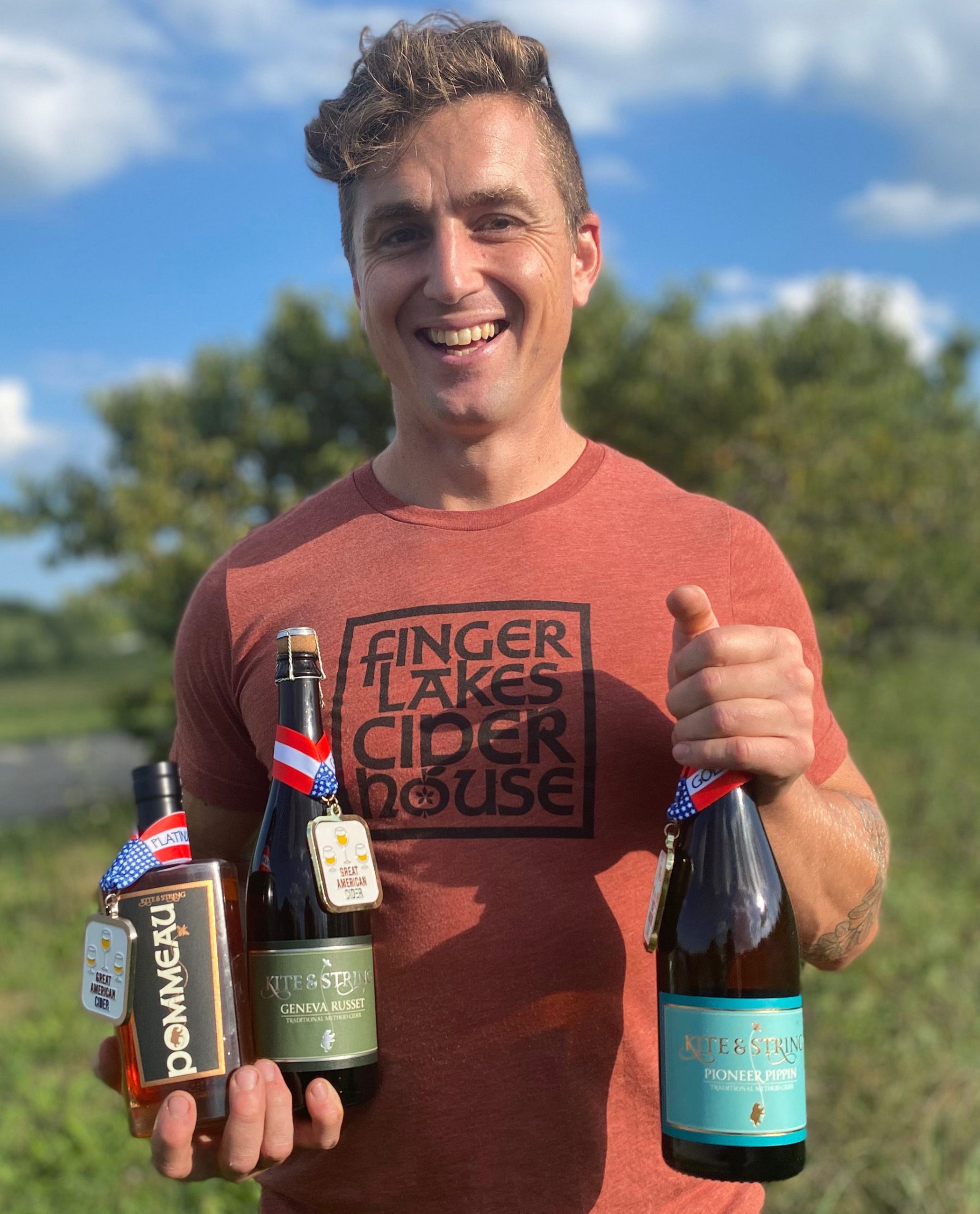
In this town, competition is right around the corner. Finger Lakes Cider House relinquished its two-time stint at the top for the first time to Black Diamond. Owner Garrett Miller said that the winning streak for area ciders confirms what he’s known for years about the quality of its beverages.
“It means there’s a hub of really high-quality product here and an interesting apple and cider culture emerging in this area. And it’s not just in our minds anymore; it’s actually a thing,” Miller said.
The competition gives out medals in platinum, gold, silver and bronze, with one grand award winner. Finger Lakes Cider House, whose bottles are sold under the Kite and String label, took home golds for its Geneva Russet and Pioneer Pippin as well as a platinum award for its 2018 Pommeau.
Otherwise known as fortified cider, pommeau is a brandy that’s been blended with fresh-pressed cider. Miller said it’s aged in barrels for 1 1/2 to two years, and the finished product is 20% alcohol. It’s a sweet, velvety, smooth drink that smells like vanilla and baked apple, and it’s meant to be consumed cold.
Finger Lakes Cider operates certified organic Good Life Farm and produces some of its own fruit for cider as well as u-pick crops. Its production and distribution runs on a bigger scale than Black Diamond, and its farm is younger, so management buys fruit from other local farmers to keep up with demand.
Miller’s brother is the head cider maker, with a small team running the rest of the operation. The property has a tasting room and a farm-to-table restaurant, usually open seven days a week, that was hit hard by the pandemic.
“For the three months of total shutdown, we had to go into a really low staffing mode,” Miller said. “We ended up pivoting to do a delivery service where we made meals and delivered food, groceries and cider to people’s houses.”
Miller said that as soon as they were able to open the restaurant, they put health precautions into place like reduced capacity, sanitizing, masks and distancing. He aims to connect with people while keeping things safe.
“We opened again in mid-June, and it’s pretty wild how many people are coming out,” he said. “We’re not necessarily having more people than usual, but they’re going to one place and staying at a venue longer, instead of jumping around to a bunch of wineries. It’s been a really strong sale season, so we’re recovering from a ton of lost income.”
While cider making and farming has been mostly business as usual — with both businesses able to do most of their work outdoors or responsibly socially distanced — cider sales have taken a big hit across the board. Restaurants aren’t ordering kegs, and for Black Diamond, it’s been harder to make in-person sales at the market with rules against sampling and tasting products still in effect.
“I think the cider industry is slightly more challenged than the wine and beer industry because people know what they like more with wine and beer,” Negronida said. “Offering tastings of cider is a big way we sell our product because people are unsure what it is, or they’re not sure they’re going to like it. Now, all of a sudden, we have to sell our product just from describing it.”
While cider sales are down, fresh fruit sales are steady for Black Diamond, even with less traffic at the market.
“I’m glad that we’re a diversified farm,” Negronida said. “If we were relying solely on cider sales, I would be a lot more worried. I think local produce is having a really good year because more people are wanting to buy local food.”
Community support has helped sustain the cider businesses during this trying time, but both businesses cite the cooperative spirit of other local cider makers as a huge reason behind their overall success.
“Most of the cider makers in the Finger Lakes know each other,” Ian said. “For years, we’ve gotten together to do brown bag, blind tastings of each other’s cider and share what we know. I hope we can keep that culture because we all compete with each other, so it will be a delicate balance going forward.”
Related Articles
Dryden Fiber looks back on another year of service
Dryden Fiber reflects on a year of growth as the municipal internet provider expands service across Dryden and Caroline.

Cayuga Medical Center improves patient safety score
Cayuga Medical Center Leapfrog Grade rises to “B,” showing improved patient safety and nursing care quality.

Local startup Seen Nutrition wins $500,000 prize in GROW-NY competition
Seen Nutrition wins $500,000 in the GROW-NY prize to expand sales, marketing, and global reach of its bone health product.