
Local development projects face rising costs, supply shortages
Editor’s note: A previous version of this article listed West End Heights as a project under Ithaca Neighborhood Housing Services. The project was actually managed by Lakeview Health Services.
This summer, many local developers are celebrating significant progress on their projects, some of which have already finished. Despite this, plenty of projects are facing a wide range of challenges, and unlike in our past development coverage (see tinyurl.com/29kmgpr7), the biggest hurdle isn’t the pandemic — it’s rising costs.
We spoke with local leaders and developers behind some of the county’s recent and ongoing projects to see what’s changed in the past few months.
Progress
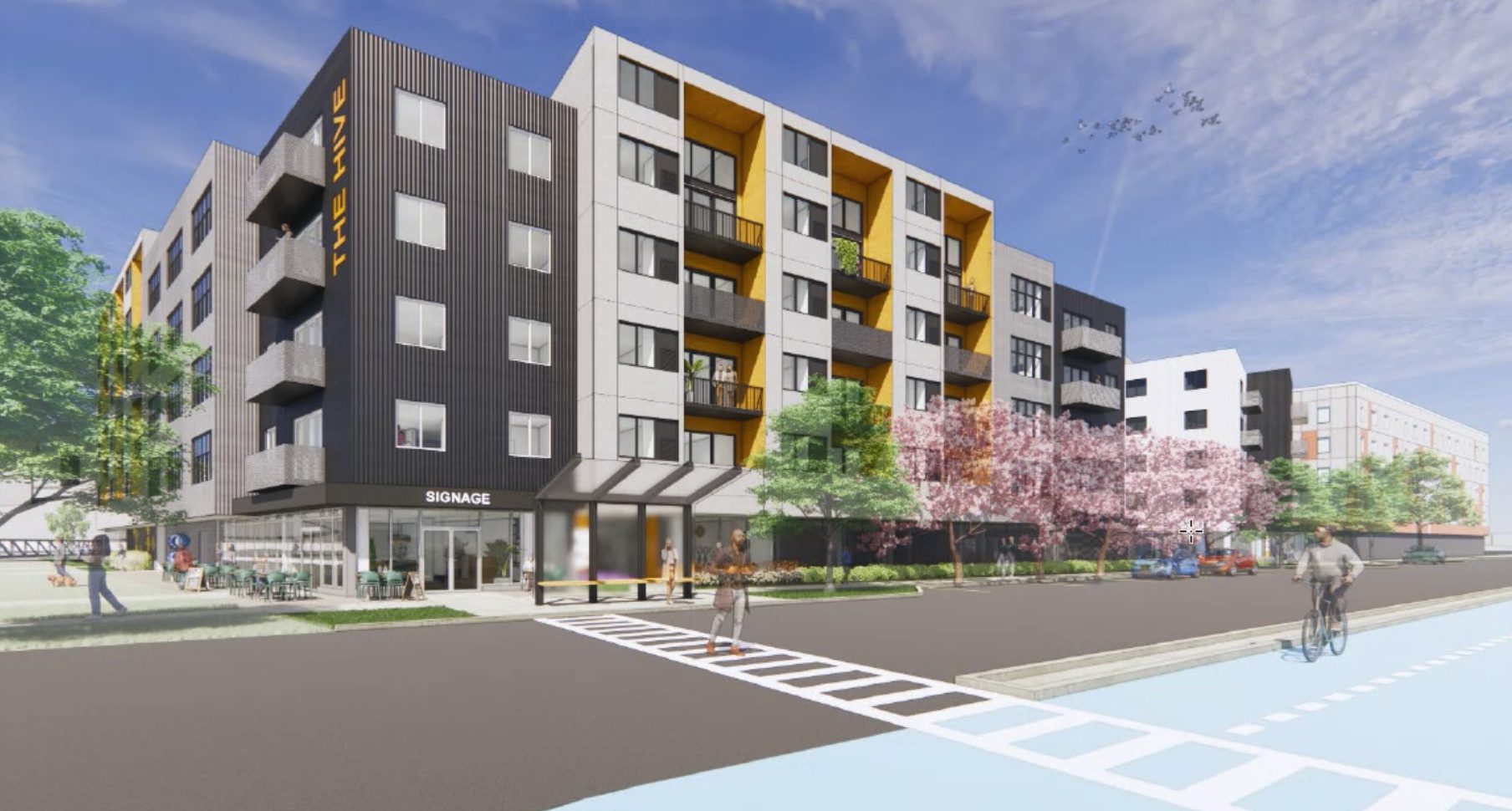
The most recent success in regard to the county’s development projects is the opening of West End Heights, which was celebrated with a ribbon cutting held June 21. The project, managed by Lakeview Health Services, consists of a five-story building at the corner of Court Street and Meadow Street in Ithaca that includes 60 one-bedroom apartments and office and storage space.
More affordable housing development projects are in the works by Ithaca Neighborhood Housing Services (INHS, ithacanhs.org), including Founder’s Way, which Tompkins Weekly covered last year (tinyurl.com/y9oz6c54). INHS Director of Real Estate Development Lynn Truame explained that Founder’s Way, which will transform the former Immaculate Conception School in Ithaca, has made great progress in the year since.
“We’re working with a general contractor called Hamilton Stern Construction out of Pittsford, New York, and they’ve been just fantastic to work with,” she said. “We couldn’t be happier, and it’s going along really well. … There’s a group of townhomes and duplexes on the corner of North Plain and West Buffalo Street, which are part of this project. Those are going to be complete and ready in July. And then the main building, which is the former school building itself, and the new wing that we constructed attached to it, that’ll be ready we think in November, which is a month ahead of schedule. It’s pretty remarkable.”
Not long before West End Heights developers celebrated its opening, developers behind the Dalai Lama Library and Learning Center also celebrated their project’s completion at a ceremony held April 29 (see tinyurl.com/25wt4n3u).
HOLT Architects (holt.com), one of the developers behind the Dalai Lama project, is also behind the ongoing City Harbor project (see tinyurl.com/2csjz89w), which HOLT’s Steve Hugo said is moving along well.
Hugo, a principal architect and vice president at HOLT, explained that the project will be going out to bid around the end of this month, and the development team “wants to break ground on it as soon as possible.” He broke down some recent changes to the project’s construction plan.
“Originally, it was going to be constructed in two phases, so it’s three major buildings, and it was going to be what we call the Point East and Point West building,” he said. “And then there’s a third building, which we’re calling Point East Two. All of that construction is going to be constructed at one time, which is sort of a new and exciting change, which I think the city and owner development team were all very happy about.”
The last piece of development news since our most recent coverage is the restarting of Visum Development Group’s (visumdevelopment.com) The Hive, consisting of two market-rate apartment buildings at 132 Cherry St., each five stories tall, with a total of 143 units and 190 beds. The Hive, like Ithaca Arthaus (tinyurl.com/24tz8rgo), is part of Cherry Street’s shift from an industrial area into a mixed-use and residential district.
Visum Vice President of Development Patrick Braga explained that Visum started working on The Hive in 2019, with the original plan including a “single, five-story building shaped roughly like a capital letter J.”
Then, the pandemic hit, making the future of the project uncertain. After that, the project continued to hit snags related to zoning changes in the area, until Visum finally decided to redesign the project, submitting its new plan to the city in March.
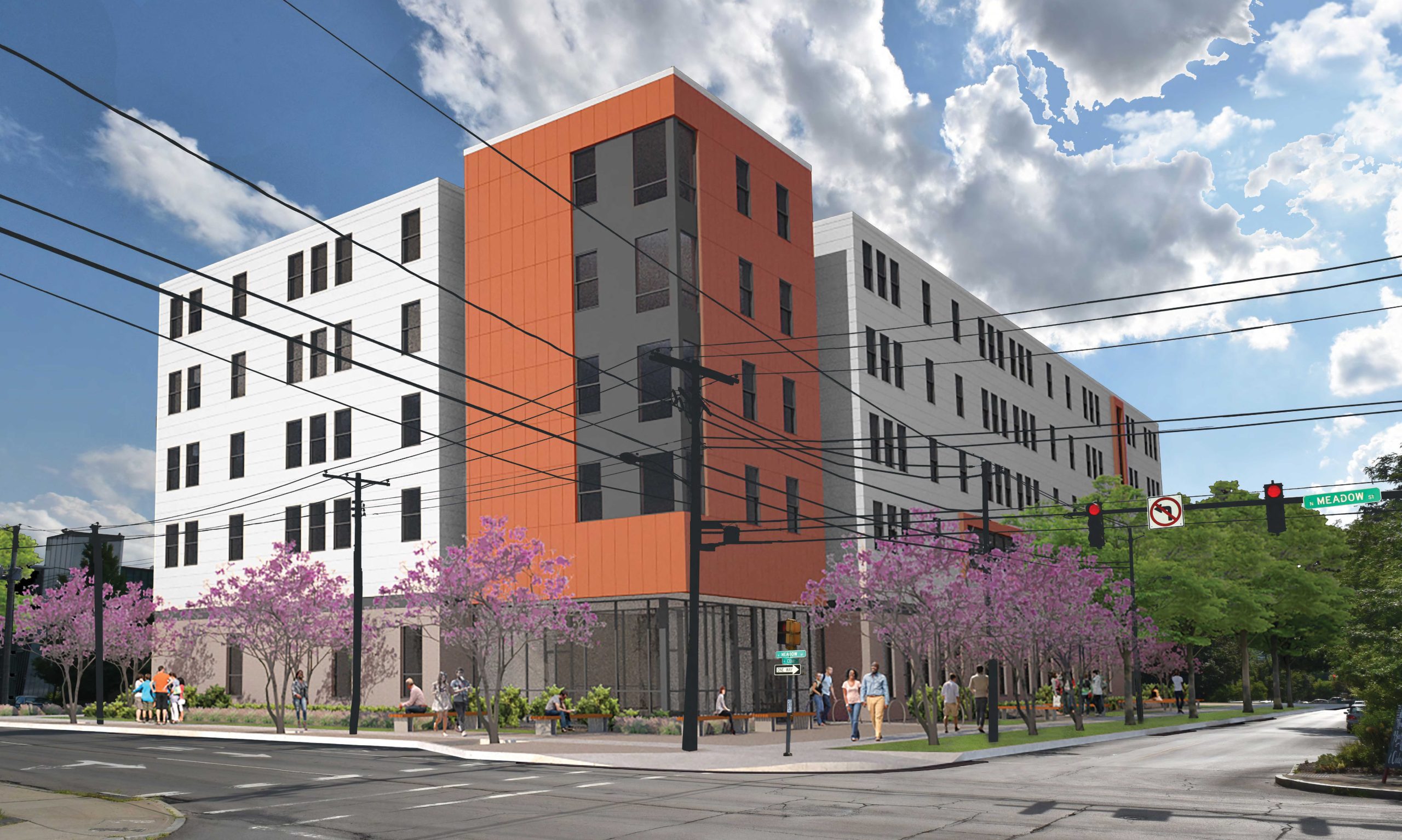
“We settled on a two-building design to open up a courtyard and create more dynamism with the design of the building,” Braga said. “We’re actively moving through the city standard planning approvals process, and we’re looking forward to receiving approvals by mid-fall. And then, as soon as we get our building permit, we plan on beginning construction on one of the two buildings slightly ahead of the other. So, both buildings will be built more or less concurrently.”
Challenges
As alluded to previously, the biggest struggle many developers are facing right now is increasing costs, especially regarding materials and supplies. In addition, supply shortages continue to affect projects’ planning and construction.
“I’d say on all the projects across the board, everyone continues to be concerned about the market and escalation and impacts of material costs,” Hugo said. “We’re hearing about shortages in concrete, shortages and long lead times in steel. And I can’t say that we’ve actually changed construction techniques on buildings. But on other projects, there have been considerations like, ‘Do we build out of wood because it’s more readily available?’ Or we’re making decisions on major construction components. … Scheduling and long-lead items are having a larger impact on some of those decisions.”
Braga said that Visum has also felt the strain from rising costs.
“What’s most affected the [City Harbor] project has been the supply chain and pricing shockwaves of that initial economic pause that happened at the start of 2020,” he said. “We’re still seeing much higher material prices than we had in previous years. A wood-frame building nowadays costs much more on a per-square-foot basis than what we were able to build it [for], say, around 2018, 2019. So, that’s been primarily the long-term impact of what happened in 2020.”
Steve Flash is one of the developers behind The Stays, an Inlet Island project planned along with developer Jeff Rimland that includes 78-to-90-bed extended-stay “hometels.” Currently, Flash is still working to acquire the property from the City of Ithaca, but he said he expects many of the challenges others are facing to affect him when the design process begins.
“If you’re down the road, costs have quadrupled, well, then that’s going to have a pretty significant bearing on what we actually do,” he said. “But we’re not stopping now because of any fear about the future. We’re keeping our nose to the grindstone, and we’ll make it work as best we can. Not much we can do. It’s an exciting project, and I think it’s an important project and there’s a lot of community interest in it and we recognize that.”
Heather McDaniel, president of Ithaca Area Economic Development (ithacaareaed.org), explained that increasing interest rates are also driving up costs for developers and contractors.
“In terms of the supply chain, there’s the structural steel issue,” she said. “I understand that there just isn’t enough supply to meet demand. So, that’s impacting things, but then interest rates as well. If projects have pulled construction financing, but they haven’t secured permanent financing, the interest rates are being impacted. And I would have to imagine that, if the interest rates go up, the project costs essentially go up. Your payments are going to be higher.”
Some projects under construction are also facing workforce shortages. Lisa Nicholas, deputy director of planning for the city of Ithaca, explained why so many projects continue to face issues related to workforce despite the county’s significant recovery from the pandemic.
“We have a lot of construction; we have a lot of big projects,” she said. “So, even without some of the pandemic issues, I think, just to build all the things that we have going on in the city would potentially cause a workforce issue because there aren’t that many companies in the region.”
McDaniel said she does expect that organizations like IAED that work with developers and employers will likely have to adjust their methods to meet some of these challenges.
“Workforce, workforce, workforce — that’s going to be our big challenge,” she said. “My guess is that over the next three to five years, our organization will shift more of the business services from helping companies to access financial resources and incentives to assisting and collaborating around workforce, workforce development, right-sizing companies, reimagining the way companies do business and how they utilize their work force. I just think that, fundamentally, things are going to shift.”
Looking Ahead
Going forward, developers and local leaders alike are excited for more progress this summer. While challenges continue for many, sources indicated that those hurdles haven’t slowed down development and aren’t expected to do so in the coming months, either. Adding to that positive view is that many are finally feeling the effects from the pandemic lessening.
“The pandemic, it’s kind of feeling like, professionally, it is behind us,” Hugo said. “It feels like our office, our studio is, for the most part, back to an in-person, 40-hour-a-week studio. And from a design perspective, a business that requires so much collaboration and the excitement of collaboration, we’re very excited about that.”
Nicholas explained some of the benefits she sees these and other development projects bringing to the area.
“The different projects that are under construction in the pipeline, nearing completion, they all are bringing, for the most part, an increase to our tax base, which is excellent,” she said. “But then beyond that, … some are bringing affordable units into our community, which is so important. Many of them are bringing housing of all types, so just increasing housing, that’s huge. Some of them are bringing some jobs.”
Those reasons are largely why Nicholas and others expressed optimism for what’s to come, despite any setbacks.
“I continue to just be really amazed at all the change and development that’s happening in our city that really is benefiting the whole community and the people who want to invest in our community, and I don’t really see an end to it at this point,” Nicholas said.
Jessica Wickham is the managing editor of Tompkins Weekly. Send story ideas to them at editorial@VizellaMedia.com.
Related Articles
Holiday traditions bring community cheer
Tompkins County holiday traditions light up homes, farms, and schools with festive cheer and community spirit.
The gift of an experience: Local businesses offer hands-on holiday fun
Holiday experience gifts in Tompkins County include candle making, gourd crafts, and pottery workshops for creative seasonal fun.
Code Blue shelter opens amid praise, concerns and ongoing debate
Ithaca’s Code Blue shelter opens with larger space, showers, and case management to help residents during cold weather.