Local farmer shares method of manuring
Dairy cows produce more manure than milk. That fact was brought home three weeks ago as Walnut Ridge Dairy employees David Nabinger and Amber Jackson oversaw the distribution of 50 truckloads of this valuable “by-product” onto a 56-acre hayfield off Buck Road.
Nabinger has worked at Walnut Ridge for about 15 years and oversees mechanical operations in the shop and in the fields. As he explained, manure begins where it begins.

Before it can accumulate in the dairy barn, a motorized scraper slides down the ranks of cow stalls pushing the muck into the channels that conduct it to a 10-square-foot holding cell outside. The holding cell stores less than a day’s worth of ordure. When the “water” is high, a float switch triggers a pump that propels the dung to one of four “lagoons” on the farm.
These storage basins hold between 1.5 million and 3.5 million gallons. All together, their contents represent about six months’ worth of “production” from the roughly 2,000 cows at Walnut Ridge. It has to go somewhere.
The solution is, of course, to reuse it to fertilize the fields and produce better crops. In the past, Nabinger said, a farmer would collect the daily output into a manure spreader, which would be driven out into the fields for distribution. Some smaller dairies still operate this way. Larger farms like Walnut Ridge distribute their cows’ output more systematically, he said.
“Daily spreading would be very inefficient for us,” Nabinger said. “We have to store it and use it when it can be used. Timing is everything. When the hay came off that field, we had to put the manure on very soon afterwards, before the plants started growing again. Manure would damage the young plants. It’s too strong.”
He “makes hay while the sun shines” and fertilizes when it shines too.
However, rainfall coming too soon after manuring creates runoff, reducing the impact of the operation and violating environmental regulations, Nabinger said.
“Hay would get harvested if a storm was coming while manuring would not get done,” he said.
Nabinger, Jackson and their crew spread about 500,000 gallons of excreta on the 56-acre hayfield in less than a day.
Here’s how they did it.
The lagoons’ contents tend to settle out over time like an immense septic tank. An agitator restored the balance as a pump loaded each tanker truck with about 10,000 gallons of liquefied cow chips.
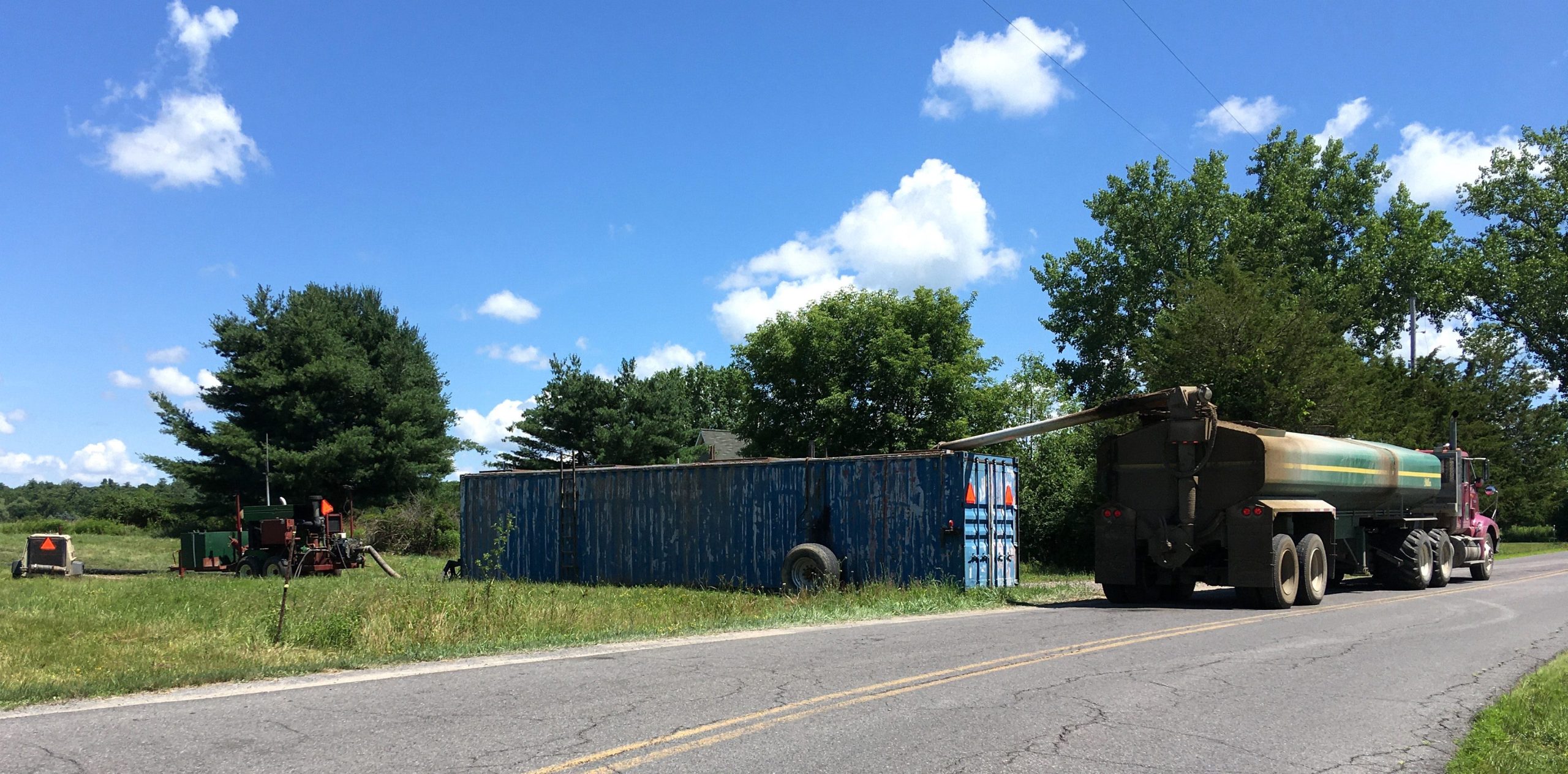
The trucks were driven to the field where they swiveled their “stinger” booms out from the top of the tank and pumped their cargo into a repurposed shipping container that served as the local holding tank. The shipping container tank holds several truckloads of liquid fertilizer.
Curious onlookers were encouraged to climb the ladder on its side to view the contents, though many regretted their choice to do so.
Behind the tank, a diesel engine drove two pumps. The first provided hydraulic pressure to a smaller pump inside the holding tank that started its contents on their way to the second, larger pump that drove the effluent out into a 6-inch-diameter hose.
This “mainline hose” ran north about 500 feet along a tractor trail before bending west for another 700 feet along the southern border of the hayfield. There, it connected to a 5 1/2-inch hose known as the “dragline.”
“We try to not move the mainline,” Nabinger said. “It’s very heavy. Cow manure weighs about 10 pounds per gallon. It’s heavy stuff.”
Two tractors worked in the field. The first actually applied the manure. Since this is a hayfield, the fertilizer was sprayed on whereas it would be injected under the soil for a crop field. Accordingly, the injectors were removed from the machine’s toolbar and replaced with small, flat “splash pans” that sprinkled the manure evenly over the ground.
The second tractor held the dragline on a large swiveling reel. It is known as a “hose humper,” and it attended the first tractor like a bridesmaid attending the bridal train, moving the heavy dragline around the field in accord with the first tractor’s movements.
The second tractor worked diagonally across the longest axis of the field. Its goal was to pay out the dragline to the first tractor evenly and to not let it twist. When the operation was complete, a hose cart came to reel up the now-empty and flattened hose.
The result, an evenly manured field, was obvious to everyone downwind for a day or two.
“We do get complaints,” Nabinger said. “The average person doesn’t know what is going on or how critical timing and weather are and what regulations we have to follow. It gets done the way it gets done because of that. Every gallon of manure produced has to be accounted for. We are not just a bunch of guys out dumping manure. There is a science to it.”
Related Articles

Village of Lansing wins more than $500K for new sidewalks
Lansing sidewalk funding exceeds $500K as the village earns state support through New York’s Climate Smart Communities program.
TeraWulf AI data center wins zoning appeal in Lansing
TeraWulf’s proposed AI data center at the former Cayuga Power Plant site in Lansing moves forward after winning a key zoning appeal on Dec. 22.