
Local fire departments look back on an eventful year
Tompkins County has 18 fire departments, 16 of which operate on a completely volunteer basis.
And they depend on one another to get the job done.

“We rely on those relationships and responses,” said Pete Tyler, Dryden assistant fire chief, adding that leaders in his department have phone conversations with neighboring agencies on such a regular basis that they have knowledge of when certain departments are down in numbers because volunteers are on vacation.
“Those types of calls are happening all the time, which is pretty miraculous,” Tyler said. “We’re pretty fortunate to have what we have.”
Mutual aid dates back to the 1940s and earlier, said Tompkins County Fire Coordinator Justin Vann. “That is something that the volunteer fire service has done for a long, long time,” Vann said. Neighboring counties even rely on each other for aid.
“Back when the sprinkler and advance warning systems were not as prevalent,” Vann said, “[fire departments] had to rely on their neighbors a lot, so there is a lot of history of working with your neighbors to get the job done.”
“They all do a really good job,” Vann added. “Some are a little more robust with their numbers and are fortunate to have that, and others, where they might struggle in some areas they really exceed in others, even if it’s just bringing in water to help.” Bringing more water so the firefighters can continuously work to put out the blaze is not an insignificant contribution, he said.
In recognition of Fire Prevention Week, we took a closer look at the ways in which volunteer departments serve our communities year-round.
Route 13 house fire
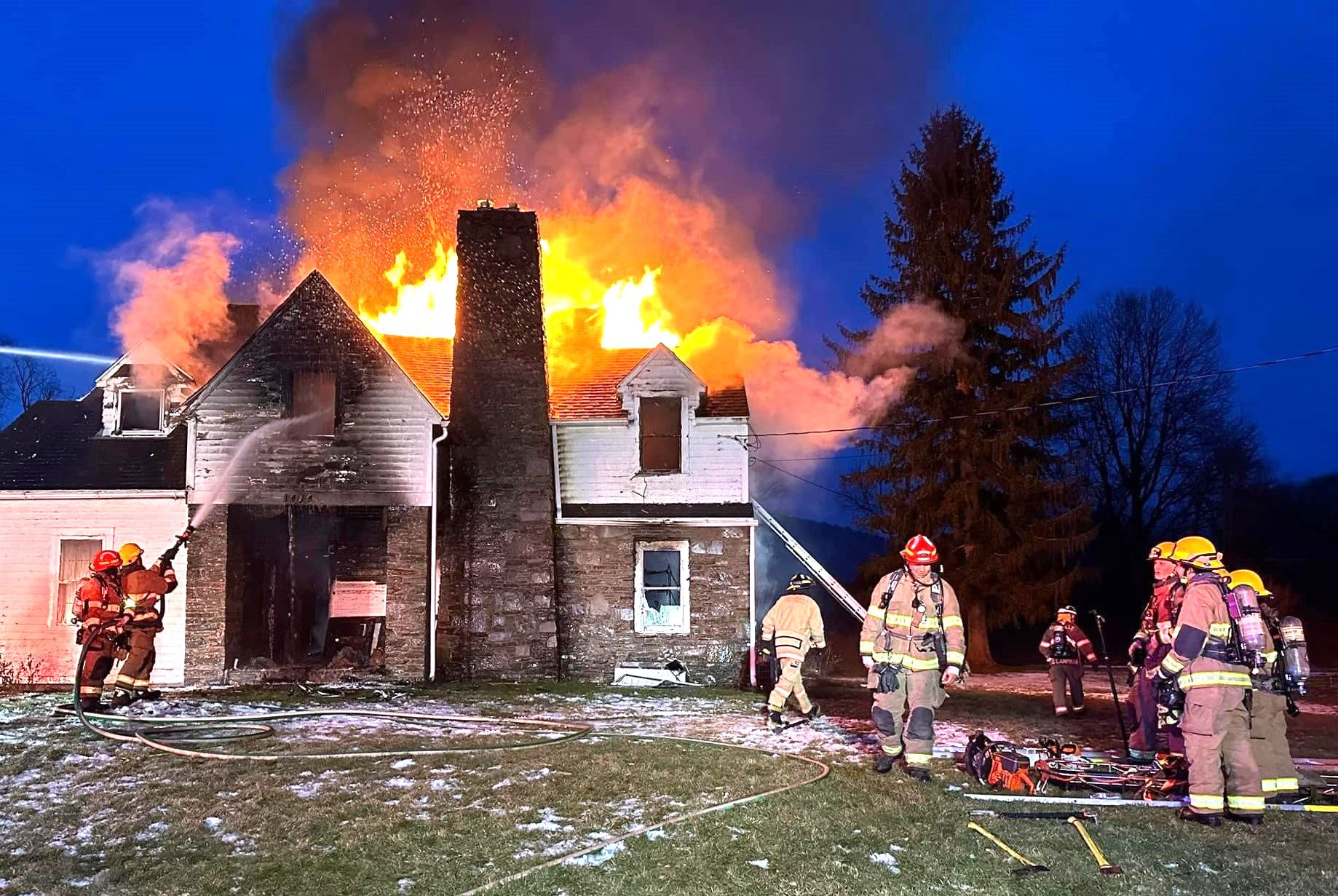
Earlier this year, a house fire at 1949 Route 13 in Dryden highlighted the departments’ need for teamwork.
It was also a great example of the quick calculus that goes into responding to a fire. Numerous decisions need to be made fast by multiple people in order to get ahead of the blaze.
If the fire is rural, where there are no fire hydrants available, water sources need to be identified and artificial ponds set up on the scene to ensure a steady supply of water.
For the Route 13 fire, which took place in February, firefighters tapped two water supply sites, one in Dryden and one in Varna.
“So, basically, we had engines putting water in tankers, coming in and dropping water into portable ponds that we set up, and ladder engines taking up that water supply and putting it on the fire,” Tyler said.

“There are lots of factors,” Tyler said, and these extend beyond just putting out the fire. In some instances, power company NYSEG must be called. In others, the Red Cross must be notified so that shelter and other resources can be provided for the victims.
In other cases, a suspected criminal element to the fire requires a thorough investigation.
Traffic has to be directed or rerouted, sometimes for multiple hours while the fire is being put out, which is especially challenging if, as in the case of the Route 13 fire, the affected structure is on a major thoroughfare.“It’s a lot,” Tyler said, “and these are areas where, generally speaking, volunteers are giving their time to do these things and are having to act professionally in very trying conditions.”
There are so many emergency situations wherein the fire department has become the public’s first call.
“If the community has an issue and they don’t know who else to call, usually the first thought is the fire department, whether it’s for strange odors, trees down or they see smoke coming from a certain area.”
If someone falls and is hurt in a gorge, local fire departments respond. “There are plenty of those around here,” Vann said. Fire departments are also called upon to help at the scene of car accidents.
“The volunteer fire service does a lot for the community that is not just firefighting,” Vann said.
“We’re a jack-of-all-trades,” he added. When they are not fighting fires, fire department teams are busy pumping out flooded basements or performing a long list of services that don’t require the police but are still emergencies for those who are in need of help.
“Usually, if someone doesn’t know who to call, they call 911,” Vann said, “and then 911 tones out the fire department.”
Many fire departments run rescue programs, as well. The Neptune Hose Company (also commonly known as the Dryden Fire Department) recently added an EMS team.
Prepared for anything — including rescues on the lake
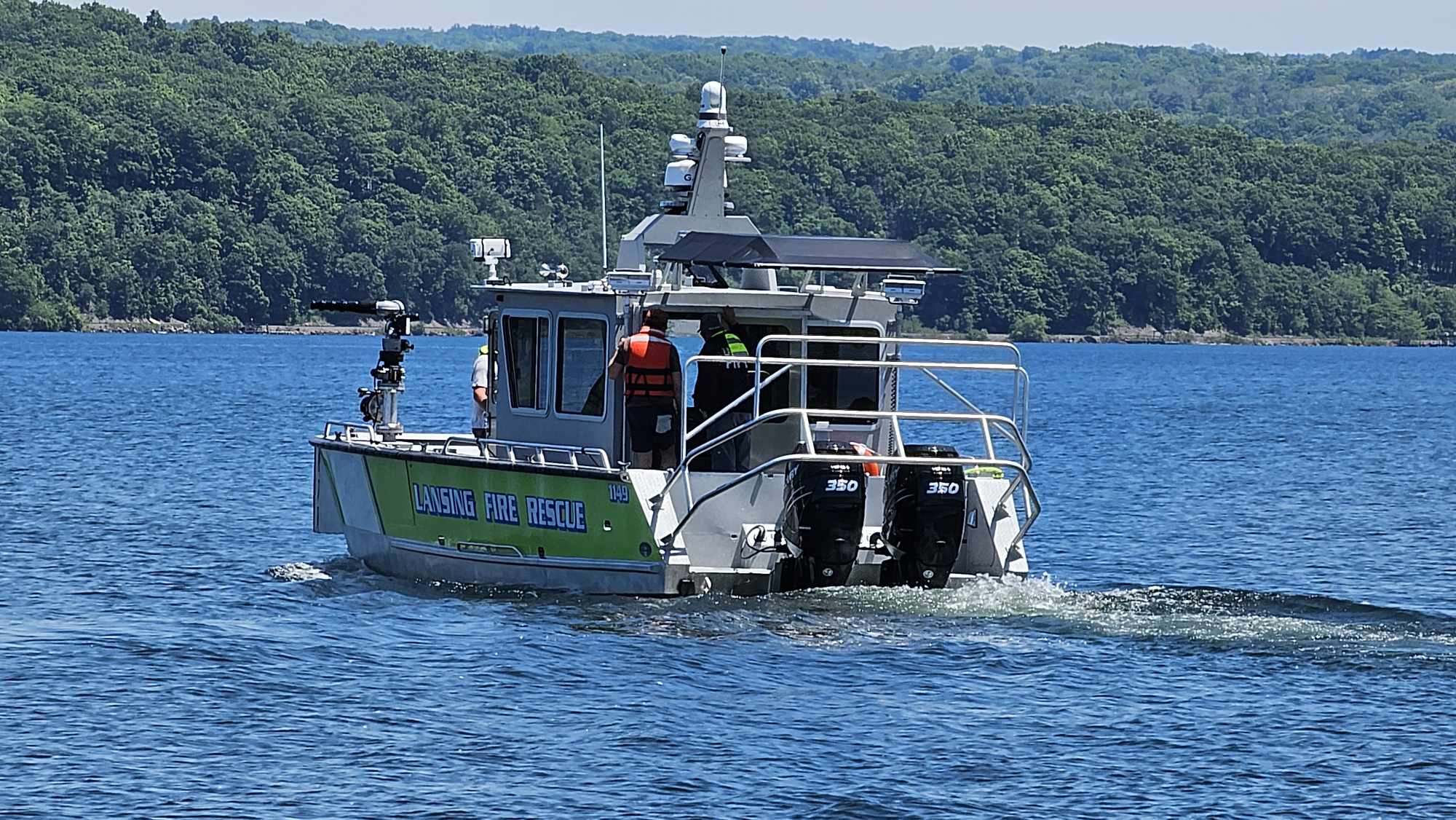
At the Lansing Fire Department, training sessions were conducted on Cayuga Lake this summer on the department’s new rescue boat.
The department has had a fire department boat since 2001.
“But we have outgrown it in size,” said Lansing Fire Chief Brad George. Two years ago, the department put together a committee that was in charge of purchasing a new fire rescue vessel, and recently the $500,000 purchase was made.
The 32-foot watercraft is capable of fire suppression and can reach cottages and other shoreline properties that are not accessible by land.
It is equipped with a thermal imaging camera, which is helpful for nighttime searches on the water, as well as a sonar system that can help locate objects under the water. The boat has a beacon that allows for visibility on the lake and the ability to spot other vessels on the water while responding to emergencies.
This past summer, the boat was used to rescue a kayaker and a jet skier, George said.
Emergencies on Cayuga Lake lead to the deployment of an emergency lake rescue task force, a group consisting of the Trumansburg, Lansing and Ithaca fire departments; the Tompkins County Sheriff’s Department; the New York State Park Police; and the U.S. Coast Guard Auxiliary.
Another big event for Tompkins County this year was the recent opening of the Groton Fire Department’s new fire station. “That station has been a long time coming,” Vann said. “For years and years, they have been working out of a very small department, so this year they finally moved in and are able to spread out and have some room they desperately needed.”
Always a way to help
“There’s such a wide variety of ways to help, especially in volunteer service,” Vann said. Not everybody wants to run into a burning building or rappel off a gorge, but that does not mean they cannot drive vehicles to emergency calls or help in other ways. Departments are in need of apparatus operators and traffic control.
Those who are interested in firefighting can start out by being an external firefighter, which means they basically do everything except go into burning buildings.
“They still help pull hose and spray water from the outside,” Vann explained, “and that’s where a lot of people start and dip their toes into the fire service to see if it’s something they want to get involved in.”
Certain departments have different specialties that volunteers may wish to work within. Trumansburg Fire Department, for example, has a robust rope rescue team that devotes a lot of time to practicing for potential gorge incidents.
Other departments, such as Dryden and Groton, host firefighting summer camps for children.
A new stipend program that went into effect in August of last year authorizes training stipends of up to $2,000 for volunteer firefighters to increase recruitment and retention of the volunteer fire service.
“Stipends for new firefighters are something that are very new in New York state, not just Tompkins County, and something that shows the state recognizes that volunteer firefighter numbers are going down, and a way to help boost that and give some incentives to join the local fire department,” Vann said.
The Office of Fire Prevention and Control (OFPC) is authorized to administer a state-funded Fire Training Stipend to volunteer firefighters for completion of certain firefighter training courses.
Fire companies are also authorized to administer a local fire training stipend program, subject to authorization by the governing board of their city, town, village or fire district.
“If anyone has the desire to join the department but they don’t know who to contact or who serves them, they are always encouraged to contact our department, and we’re happy to be that in-between to direct them to the local department they live in,” Vann said, adding that anyone who wants more information about volunteering can email him directly at jmvann@tompkins-co.org.
Those interested in finding out more information can also visit Recruit New York at recruitny.org.
As always, fire departments are reminding the public that common fire calls can easily be prevented with the proper use of carbon monoxide sensors and smoke detectors, a regular check of appliances and using caution when turning on HVAC units at this time of the year for the first time since the spring.
Author

Related Articles
Holiday traditions bring community cheer
Tompkins County holiday traditions light up homes, farms, and schools with festive cheer and community spirit.

The gift of an experience: Local businesses offer hands-on holiday fun
Holiday experience gifts in Tompkins County include candle making, gourd crafts, and pottery workshops for creative seasonal fun.
Code Blue shelter opens amid praise, concerns and ongoing debate
Ithaca’s Code Blue shelter opens with larger space, showers, and case management to help residents during cold weather.