
Local leaders consider TIDES proposal as homelessness worsens

This past spring, Tompkins Weekly covered a then-new proposal to address homelessness in Ithaca, The Ithaca Dedicated Encampment Site, better known as TIDES (tinyurl.com/2ohogckt). Since then, more local leaders have been brought into the mix, with many having in-depth conversations on how effective TIDES would be if applied.
With homelessness becoming an even greater issue now than the spring, and with cold weather quickly approaching, many stakeholders are hopeful for swift action, so we’re tackling TIDES once again to see how the situation has evolved and what’s being done on a variety of fronts.
Worsening problem
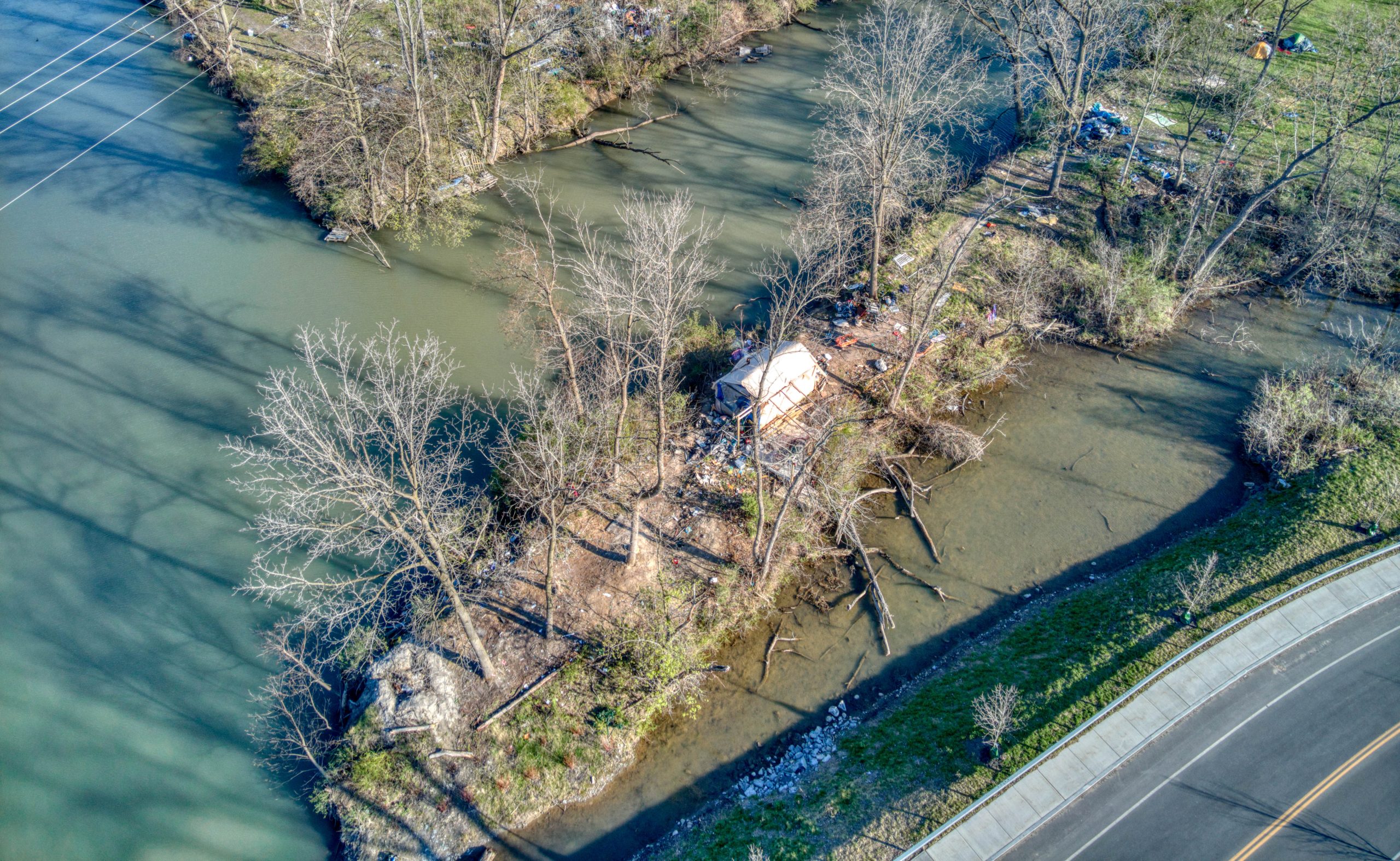
Almost universally, sources interviewed for this story attested to the worsening homelessness situation in and around Ithaca. Legislator Mike Sigler, for example, was among a group of local leaders who recently took a trip to Ithaca’s largest homeless encampment site, colloquially known as “the Jungle,” located behind Wal-Mart.
He said in his trip, he encountered dozens of people living in encampments, and he knows there are more in other areas.
“It’s surprising that there are so many encampments; it’s not just the Jungle anymore,” he said. “You may have four or five encampments now that are all separate and are different from each other.”
Other sources explained why this issue has continued to grow, especially in a relatively short amount of time.
“I think it’s a lot of things,” said Chris Teitelbaum, regional director of St. John’s Community Services. “You’re seeing the effects of the eviction moratorium being lifted. And so, I think you’re seeing more people being evicted, which probably speaks to underlying issues with [where] the rental and the income is because eviction is symptomatic — it’s not really a cause; it’s symptomatic of other issues.”
Second Wind founder Carmen Guidi added that worsening economic conditions are also at play (tinyurl.com/2kwmsnf2).
“We’re running into a lot more people that are homeless because of economics, not just what we’ve seen in the past, [which] was mostly homelessness due to either addiction problems or mental illness,” Guidi said. “And I think it’s going to get worse because of our economic situation.”
Legislator Dan Klein spoke to those factors as well as how Ithaca’s welcoming nature affects the situation.
“I also believe that because Ithaca is known as a tolerant place and a place with a lot of services that we are attracting a certain number of people regionally who are homeless that think Ithaca’s a better place to be homeless than Auburn or Elmira,” he said.
TIDES progress
As covered in our last report, the TIDES plan proposes 25 individual camping cabins for homeless individuals, with 24/7 on-site management, support by homelessness professionals, and central facilities with toilets, showers, kitchen, locked storage and gathering spaces.
A working group of local leaders and stakeholders — including Guidi, Teitelbaum, city alderpersons Cynthia Brock and George McGonigal, Legislator Rich John, developer Jerry Dietz and others — created the proposal and first presented it to city leadership in the spring (document available at tinyurl.com/y4gy8ykc). Members of that working group explained what has happened since.
“In the spring meetings, we were invited to put together a proposal to present to the city and the county,” John said. “And we spent a good part of the summer doing that, trying to provide a much better detailed outline of, what would TIDES look like? And how could it be funded, where it would sit, but making clear that real development, and particularly the rules of operation, would await appointment of an entity that would run it.”
John explained that he and others in the original TIDES group “suggested the city should put out [a request for proposals] for likely a not-for-profit agency that would operate TIDES on land owned by the city.”
This suggestion was included in the working group’s presentations to the city’s Planning and Economic Development Committee and the county’s Health and Human Services Committee. The group presented twice to each committee, with the most recent presentations being Aug. 17 for the city (tinyurl.com/2qbsdr23) and Aug. 15 for the county (tinyurl.com/2z6bcj39).
“The city had a good discussion about it,” John said. “They were trying to determine whether they wanted to present an RFP, or a request for proposals, or an RFEI request for expressions of interest. And the RFEI process is more open. An RFP is, ‘Here’s what we want, tell us whether you can do that.’ And RFEI is, ‘Tell us ideas.’”
As of the writing of this article, city administration has not yet made a final decision on whether to issue an RFP or RFEI. However, the city has created a task force to address the TIDES question directly, which is separate from the already-existing Homeless and Housing Task Force.
During these various discussions, local leaders had the chance to voice their support and concerns regarding the TIDES proposal. When Tompkins Weekly asked these leaders for their thoughts, most expressed support for TIDES in general and recognized the need to address homelessness on a wide scale. Where some had concerns, these were largely centered around one aspect of the plan — enforcement.
As explained in the agenda packet for the recent Health and Human Services Committee meeting (tinyurl.com/2mpvxy3s), the TIDES report “encourages adoption of an explicit city policy prohibiting unsanctioned encampments on city property with enforcement of the policy prioritized only toward high-sensitive areas of the community until more shelter and housing alternatives become available.”
Brock explained further.
“We are encouraging the city and county to use its resources to assist people away from unsanctioned encampments towards safe and legal spaces for them to be,” she said. “And by that, I mean that there would be outreach, focused outreach and services, contacting and engaging with people who are living unhoused and encouraging them to be in a more supportive environment than in an unsanctioned encampment. And we recognize that both of these things, the sanctioning as well as supportive assistance, should go hand in hand in order for our overall goals to be effective.”
Sources interviewed varied greatly in their opinions toward this enforcement aspect.
Klein, for example, said that that portion of the plan was of particular interest to him when he first heard it.
“I don’t see how [TIDES] would make any difference, will make any impact at all, if we don’t link it to that because if we build 25 cabins, but we know there’s hundreds of homeless people, … it’s not going to go too far,” he said. “It’s going to make a dent, but it’s not going to even come close to solving the problem. And then if everyone just continues to camp where they will, yes, we helped 40 people or whatever it is, but we didn’t really solve the other problem.”
Klein and others referenced recent concerns voiced by Ithaca residents such as those at Nate’s Floral Estates regarding more frequent drug and crime activity in and around unsanctioned encampments, as was described in the public comments portion of the Sept. 7 meeting of Ithaca Common Council (tinyurl.com/2hntn648).
Whereas some support the no-camping enforcement aspect, others pushed against it.
“I think a lot of the impetus of TIDES is coming from the perspective of not wanting to solve homelessness or improve conditions for people who are homeless, but just not to see homelessness and to improve conditions for business owners who are worried about just theft and trash and things,” County Legislator Veronica Pillar said. “And I think some of the impetus is coming from, ‘I don’t really care about these people — the most important thing is that they get off my lawn.’”
While the TIDES proposal does not call for the legal prosecution of those living in unsanctioned encampments, sources said that some who heard the TIDES proposal saw the enforcement aspect as “criminalizing poverty.” Others pushed back against this perception, like Brock, who said that the city currently doesn’t prosecute people for unsanctioned camping, and it’s not going to start doing so if TIDES is implemented.
“We have a community that is currently so hands off in terms of this situation that the idea that it would go 180 degrees into the other direction is unfathomable to me,” she said. “That’s just not who we are as a society. We recognize that people who are living unhoused are struggling. We recognize that they are facing circumstances that oftentimes are beyond their control to navigate. And our focus is in providing assistance to that, not criminalizing them for things that are not their fault, frankly.”
Sources like District Attorney Matthew Van Houten shared Brock’s sentiment. Van Houten described his views to local leaders at a recent Health and Human Services Committee meeting (tinyurl.com/2n8pzzzx), which he later summarized to Tompkins Weekly as, “We’re not going to prosecute people who will continue to trespass or to camp on public property.”
“Incarceration is not a solution — it is a last resort — and public safety can be fostered and promoted by helping people in our community be healthier, be more stable, be more secure in their own lives and have better family connections and address their challenges,” he said. “We want people to take advantage of programs and opportunities to be involved and engaged with services that they need. So, our treatment court, our mental health court, our integrated domestic violence court, LEAD program, for example, those are all things that we are emphasizing.”
Van Houten clarified that while he doesn’t support prosecuting people for living in unsanctioned encampments, he recognizes that other crimes that happen within encampments — including the proposed TIDES — like domestic violence do need to be properly addressed.
“We would want whoever is working at TIDES to cooperate and to work with law enforcement so that we can enforce those violent crimes, even if those individuals are less likely to overall be trusting of the system,” he said.
Looking ahead
The original TIDES working group stopped meeting in late summer, and previous members said what happens next is now largely up to the city and, to a lesser extent, the county.
On the city side, the new task force had its first meeting late last month, with more meetings expected in the near future. While Brock said that the group is largely in the organizational stages right now, McGonigal said he’s optimistic about the group’s future meetings, particularly with the group’s makeup.
“One important thing this task force adds to the conversation is that senior members of city staff are part of the task force,” he said in an email. “Superintendent of Public Work[s] Mike Thorne, for example, brings a ton of practical knowledge and problem solving experience to the table. We need that.”
McGonigal added that “the direction this group takes remains to be seen, but I firmly believe that Mayor Lewis, Common Council and city staff all agree that we need to act.”
“Tompkins County, and perhaps private funding sources, need to be an important part of this effort,” he said. “It is not an easy problem to solve, but tacit acceptance of the current situation going forward would be blatant cowardice on our part.”
County-affiliated sources said that the county can’t do much until more actions are taken from the city. John, however, has decided to be proactive.
“I put together what’s called an over-target request in the county budget to put some money in contingency because, really, the first mover on this has to be the city,” he said. “And we don’t know what they’re going to do. But I don’t want the city to move and the county to not be ready. And the way I’ve structured it is the money could be applied to TIDES or to some other idea that comes out of the RFEI process if they follow that.”
County budget negotiations are still in the works, as we reported in last week’s cover story, so it’s unclear whether John’s request will be granted.
Several sources voiced frustration at the pace of this process, with some calling for more urgency.
“We’ve got a couple of people on the TIDES group that are frustrated … with this because it just there’s no action,” Guidi said. “It’s not rocket science to set aside a piece of property and build some structures. … But when you get the bureaucracy involved and the red tape, that’s where I get stuck in the mud. And that’s where I just struggle.”
Guidi and others who share his concern expressed current and planned efforts to address the issue of homelessness themselves, like Second Wind building “a multi-unit residential facility dedicated to house and walk with homeless and at-risk adult women and their children towards restored lives” in Dryden (tinyurl.com/2ztma55l), which Guidi said is set to break ground soon.
Dietz also voiced his plans to work with other previous TIDES group members to address the issue.
“I’m going to be working with some of the other folks that were on that TIDES group and hopefully to bring some private resources to bear on the problem,” he said. “The individuals who have taken the time to make their feelings known about this are being completely ignored. And so, when that happens, in the past, for me, if I’m passionate enough about it, I feel compelled to try to step in and impact the situation in a different way. And oftentimes, that means bringing private resources to the table.”
Other sources, while they’ve heard the expression of urgency from these and other stakeholders, said TIDES isn’t something to be rushed through.
“Even though I hear people saying that, ‘Well, no one else has a plan’ or ‘winter’s coming again, this is urgent, we should just move forward and do something,’ … it’s a huge undertaking that’s not necessarily going to help,” Pillar said. “So, urgency is maybe not warranted.”
Regardless of their feelings on urgency and pace, sources universally stressed that homelessness and the factors that cause it are only going to get worse if nothing is done, which is why the issue is so important to address. While lawmakers and stakeholders work to figure out where to go from here, sources encouraged readers to stay involved.
“Keep on top of those wonderful people that we elect to office, like, tell them, ‘The answer doesn’t have to be TIDES, but you have to come up with an answer,’” Teitelbaum said.
Jessica Wickham is the managing editor of Tompkins Weekly. Send story ideas to them at editorial@VizellaMedia.com.
Related Articles
Cayuga Medical Center nurses to rally, alleging anti-union tactics by hospital management
CMC nurses plan a rally, alleging unsafe staffing and illegal anti-union tactics as the hospital highlights recent patient-safety gains.

Design details unveiled for new Center of Government
Design details for the Tompkins County government building in downtown Ithaca are now public, with a county survey open for feedback.

Holiday traditions bring community cheer
Tompkins County holiday traditions light up homes, farms, and schools with festive cheer and community spirit.