
Local responders and police keep community safe while giving thanks
How do fire departments and other emergency responders find time to celebrate Thanksgiving at a time of year when community need is often at its highest?
Ithaca Fire Department holds a special dinner for its members on call, many departments make an effort to work around each other’s holiday schedules, and the Ithaca Police Department took the opportunity to connect with the community over a Thanksgiving meal.
Managing editor
Ithaca Fire Department
Some firefighters work a 24-hour shift on Thanksgiving Day, from 7 a.m. until the same time the day after the holiday.
“They are going to try to have a Thanksgiving meal,” which will include a traditional turkey with stuffing and all the sides, Deputy Chief Mike Moody said.
The Ithaca Fire Department has four stations, and crews from all four fire houses plan to gather at some point for a big dinner at the main station on Green Street.
“Normally, what happens is we toned out during dinner for some kind of emergency call, and we have to come back and pick up where we left off,” Moody said with a chuckle. “But, we have a traditional Thanksgiving celebration, even if it’s not with our traditional families but our firehouse families.”
“Most of us have been in this a long time, and normally around the holidays, whether you’re working Thanksgiving or Christmas or New Years, with your personal family you try to work around it. Whether it’s the day after or the day before, emergency responders who are on call plan to celebrate with their families in their own ways,” Moody said.
“But, traditionally,” he added, “you have a big meal at the firehouse with your firehouse family, covering calls between mouthfuls of turkey and stuffing.”
The Ithaca Fire Department’s annual call volume is 5,500 calls per year. “So, we average about 15 calls a day,” Moody said, “sometimes more and sometimes less, and unfortunately, holiday times are usually a busier time.”
“We try to remind people about cooking safety,” Moody added. “We have tons of people Wednesday night or Thursday morning who are cooking in their kitchens.”
From kitchen fires to accidents with sharp cooking utensils to burns, the fire department always sees an uptick in the number of calls throughout the holidays.
“Things can get hectic,” with grease fires and amateur cooks using knives, Moody said.
“It’s a time of celebration, and sometimes that involves alcohol — sometimes too much alcohol,” he said. “Mixing that with driving is going to result in something bad. Use good judgment and make good choices operating vehicles and using designated drivers.”
While most people who do not work in emergency services wind down for the holidays and relax, for most people in emergency services, “we kind of gear up and get busy for the holidays,” Moody said.
There is no special time to shoot for where the firefighters have the best chance of eating together, he said, so they just start cooking and do the best they can, knowing they may have to stop cooking and finish when they get back.
“We do the best we can with the hand we’re dealt,” he said.
So why have a meal together at all, with all the challenges and interruptions?
“I would offer that it’s exactly the same thing that makes it worthwhile for normal families,” Moody said. “It’s not their personal family, but it is their work family. You literally, if you think about it, have 24-hour shifts. You spend a third of your life with your firefighter family. That’s just how the schedule works out. There is a camaraderie amongst the shifts. Like any family, when a holiday comes, we try to celebrate in the traditional ways.”
At Dryden’s volunteer fire station, Neptune Hose Company, Deputy Fire Chief Pete Tyler said that the crew doesn’t hold a meal together so much as the department tries to accommodate everybody’s schedule so they can celebrate.
If a call does come in, though, families are welcome.
“Families could come and visit, and that happens often,” Tyler said. “So, even if you’re working, you’re not missing them.”
Dryden recently established its own emergency medical services (EMS) team.
“When paramedics and EMTs are working 12-, 24- or 48-hour shifts, family members visit them and their kids see them in between calls, and it’s no different on holidays,” Tyler said. “EMS is tricky because a call can happen any second, and we hope for the best and that no one experiences those types of incidents or tragedies on special holidays, but those things do happen.”
At the Trumansburg Police Department, Chief Joe Nelson said he coordinates with his officers to plan around meal times with family.
“Most of them work part time anyway, but policing needs to happen every day of the year. … So, we adjust the shifts so we have a presence,” Nelson said.
Ithaca Police Department
“It went very well,” Ithaca Police Department Chief Thomas Kelly said of a special event held in advance of Thanksgiving. “We got a lot of great feedback and participation.”
Community “Friendgiving” was conceptualized and turned into a reality all in the month prior to it’s being held Nov. 14 – it was just the latest in a series of public get togethers that the Ithaca Police Department held with the Community Justice Center (CJC) and Ultimate Entry Reopportunity.
“We’ve been having regular healing events with the CJC, and last month we were talking about where to do the event, and topics, and we thought, ‘Why don’t we do a Friendsgiving?’” Kelly said. “What better way to start the holiday season off than having a meal together?”
“It was a really good turnout,” Kelly said. The chief said about 50 people attended the event.
“People came and went,” he said. “For only a two-hour event, it was a good turnout.”
The event was a potluck; the turkey and a few elements of a traditional Thanksgiving meal were provided by the event’s organizers, “but then there were a lot of different dishes that people brought,” Kelly said.
“We had a ton of food,” Kelly added. “There were quite a few different dishes, but that turkey was really good. Somebody else made chicken that was really good, too, but there was definitely no shortage of good food.”
There were talking points to help spur discussion, “but it kind of became more organic,” Kelly said. “[The talking points were about] how could communities in law enforcement work to build trust, or something to that effect, and it was like, ‘Right now, that’s what we’re doing.’”
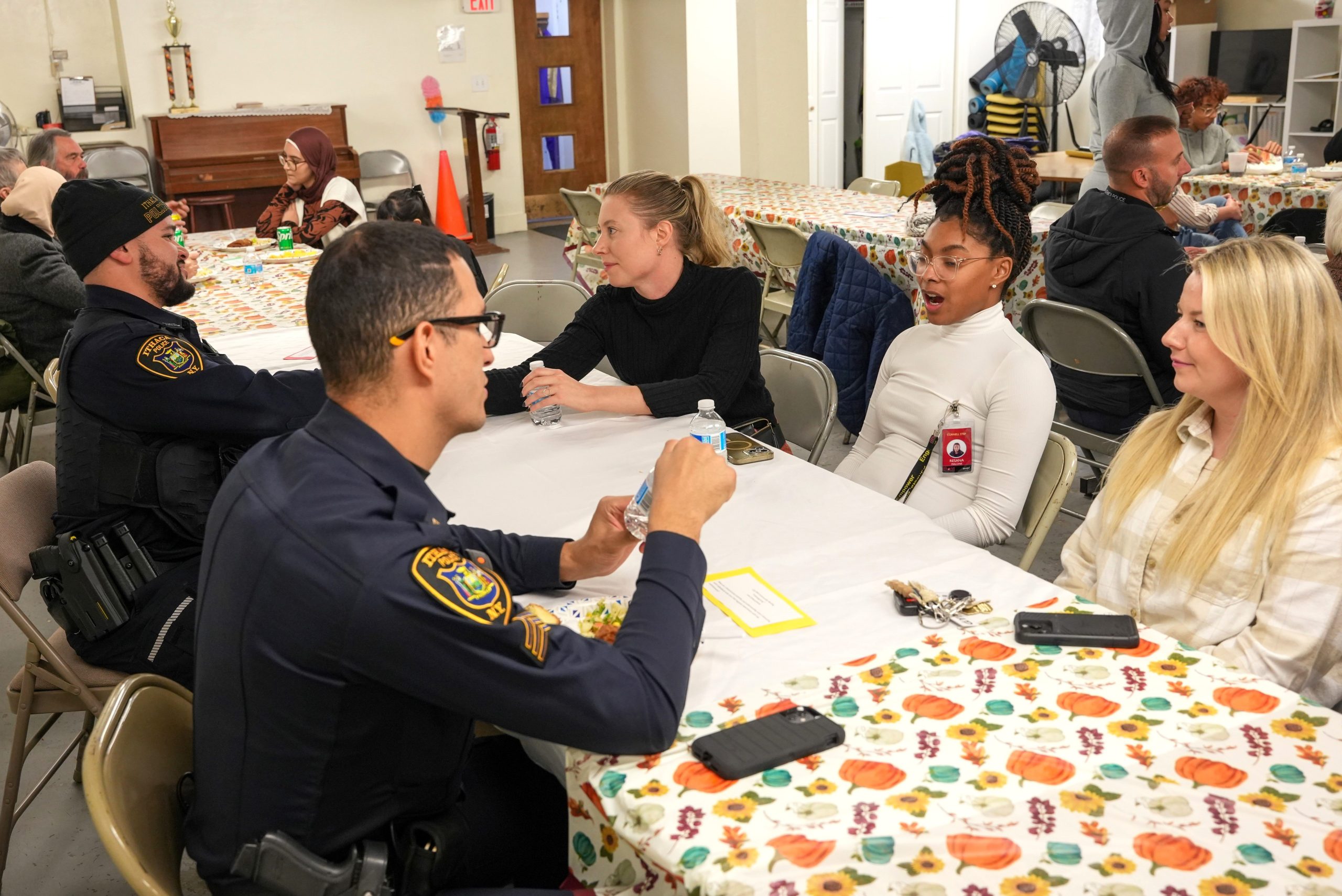
“The Friendsgiving dinner was a chance to further bolster the relationships between community and law enforcement,” agreed Amos Malone, a community member who attended the event. “Great strides have been made since the inception of the project. I’m extremely excited to see what’s next.”
The community meal, which took place at the Calvary Baptist Church in Ithaca, was the most recent in about half a dozen monthly meetings that the CJC has held in conjunction with the police at URO on State Street in Ithaca as part of the Reimaging Public Safety initiative.
“I think the biggest thing that we’ve learned at the events is really kind of humanizing each other,” Kelly said. “The officers and the community — we typically don’t respond unless there’s a crisis, and some of the traumas that we respond to, those also become our traumas.”
“There’s ways that people process trauma, and some of that is separating that humanity,” he added. “Just over the last two weeks we’ve had some horrific calls to work through.” He said the humanizing elements of the interactions he has had through the efforts of the last six months have been the most impactful part of the conversations.
“A couple months back, we went with the CJC to a youth shelter and met a number of youth that were at the shelter, and initially when we went into the room, they were like, ‘Why are they here?’” Kelly said. “After sharing a little conversation and getting to know one another, by the time we left, they were like, ‘When are you guys coming back?’”
Kelly said that the participating organizations plan to continue the series of meetings focused on community healing in 2025 and that one of the things he has realized throughout the whole process is that some people take a while to warm up.
“If they’re attending for the first time, they might not be comfortable asking a question or giving feedback,” Kelly said. “It might be three meetings in, getting to know somebody, before they feel comfortable.”
The chief recalled another event from earlier this year, a Stewart Park picnic.
“Some of the people that we talked to had police contact, some very positive and some not,” he said. “And I had an opportunity to answer questions … It was quite an experience.”
Author

Related Articles
Holiday traditions bring community cheer
Tompkins County holiday traditions light up homes, farms, and schools with festive cheer and community spirit.
The gift of an experience: Local businesses offer hands-on holiday fun
Holiday experience gifts in Tompkins County include candle making, gourd crafts, and pottery workshops for creative seasonal fun.
Code Blue shelter opens amid praise, concerns and ongoing debate
Ithaca’s Code Blue shelter opens with larger space, showers, and case management to help residents during cold weather.