
Managing invasive species: Woolly adelgids and the Hemlock Initiative
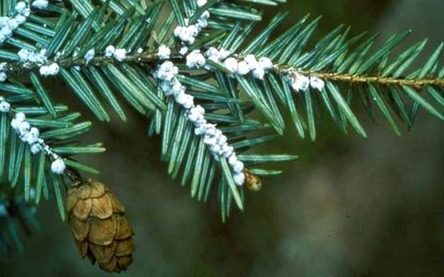
Earlier this summer, Cornell’s New York State Hemlock Initiative released 700 silver fles in the Fall Creek South Natural Area in hopes that the silver flies, along with a type of beetle released there in 2022, will offer a long-term natural solution to the hemlock woolly adelgid, which poses a significant risk for hemlock populations.
Since the release of the silver flies, Leucotaraxis piniperda, and previously the beetles, Laricobius nigrinus, Cornell has monitored the insect populations, hoping that the three groups will create natural predator/prey relationships to keep the need for pesticides minimal and the hemlocks healthy.
“One of the reasons that invasive species become invasive when they’re outside of their native range is because they haven’t come along with diseases that they’re susceptible to or predators that may control their populations back in their native range,” said Todd Bittner, Natural Areas Director for Cornell Botanic Gardens. “Once the invasive species kind of establishes within a new location, in the absence of those natural control mechanisms, they’re able to spread unchecked often. So, part of the strategy is to identify what predators can control the adelgid and push its population back in its native range.”

Both the flies and the beetles have been released in Cornell Botanic Gardens, but this is the first time they have been introduced in the broader Ithaca community, offering a new research opportunity. These two species are native to the American Northwest. Both hunt adelgids and are naturally suited for a colder climate. Similar to its prey, the silver fly also reproduces twice a year, meaning it can feed on hemlock woolly adelgids as the pests reproduce.
Woolly adelgids, an aphid-like species, cling to hemlock branches and pierce the twigs to feed on the tree’s sap. This disrupts the tree’s flow of vital nutrients to its canopy, ultimately leading to the tree’s death.
“It’s easy to see the waxy excretions that [the adelgids] create, which is the ‘woolly’ part, and that usually happens from late winter through early summer, so detection can be evident. However, this waxy excretion isn’t what hurts the tree. What is actually happening is the adelgid is inserting a feeding tube into a twig onto the hemlock tree, and they’re fairly small, so an infested tree could have tens of thousands or hundreds of thousands adelgids on it,” Bittner said. “The tree’s response to the insect, we’ll call it attacks from pests or pathogens, is to wall off the area that’s being negatively impacted. So, what the hemlocks are actually doing is trying to wall off the vascular system. By doing this, they are cutting off the circulation of nutrients to all of its limbs.”
“Just a few adelgids won’t cause a problem because the tree can heal itself from that,” said Caroline Marschner, an extension associate with the New York Hemlock Initiative. “The problem is when there’s a full infestation the tree is taking so much damage that it can’t push the nutrients out through the rest of the affected limb because there’s too much scar tissue cutting it off.”
The short-term goal is for the predators to remain for three years, marking their establishment in the area. Researchers hope that the silver fly, a strong flier, will spread in time and aid hemlocks in the surrounding area.
Because pesticide applications last five to seven years, many trees in Fall Creek will approach insecticide reapplication within the next few years. Currently, the team plans to reassess the area in 2024, which would allow predator populations time to establish a presence there; that will help the team determine if pesticides are still required after the biocontrol agents have been released.
“Pesticides are a great short-term solution. They can save your tree now. Biological control is a long-term solution. If there’s too many hemlocks on the landscape and you have to treat them every five years, then you have to do it every five years, indefinitely, unless there is a biologic solution,” Marschner said. “Pricing can be manageable, but it’s still planning and replanning treatment. That’s why we’re working so hard on biological controls, because they’re one of the few long-term solutions that seem viable.”
Marschner added that by using two biological control agents, the beetles and the silver flies, there will be consistent population control for both generations of adelgids. Adelgids have a summer-to-winter generation and a spring-to-summer generation, meaning they reproduce at an exponential rate. Introducing the beetles to control the fall-to-winter population and the flies for the spring-to-summer will create, hopefully, a year-round sustainable control system.
Deciding what kind of treatment is best can depend on the environment and the research that will come from the Hemlock Initiative. The Finger Lakes Partnership for Regional Invasive Species Management (PRISM) also collects data on invasive species in the region and works on education and outreach.
“We’ve collected a tremendous amount of data, and we’re actively working to decrypt that data and try to learn from it so that we can try a number of different options for control and generally addressing invasive species and ask all kinds of different questions to get to the answer,” said Sam Beck-Anderson, the executive director of Invasive Species Programs, Finger Lakes PRISM Coordinator. “When surveying and treating certain species, we have to look at what’s actually working, what’s not working, what’s the effect. Early detection is also an important part of what we do, and there are resources to help identify different invasive species. We have volunteers all over that can also help with that; they are a big part of what we do.”
Bittner concluded that with the release of the two predators, Cornell and the Hemlock Initiative entered into the observation and research stages.
“The goal is to get closer to equilibrium, that all species ebb and flow. As the prey increases, the predators start to become a little bit more abundant, and when the predators catch up they reduce the prey,” Bittner said. “It creates a rhythmic cycle that we hope will be sustainable and have a positive impact on the hemlocks. There’s a lot of research and time that goes into this since the insects operate in seasons, so time will tell and hopefully it’s positive.”
For more information on the Hemlock Initiative and Cornell’s role, please visit https://blogs.cornell.edu/nyshemlockinitiative/ or email nyshemlockinitiative@cornell.edu. For general information on invasive species, identification guides and more, visit https://fingerlakesinvasives.org/.
Related Articles

Holiday traditions bring community cheer
Tompkins County holiday traditions light up homes, farms, and schools with festive cheer and community spirit.

The gift of an experience: Local businesses offer hands-on holiday fun
Holiday experience gifts in Tompkins County include candle making, gourd crafts, and pottery workshops for creative seasonal fun.

Code Blue shelter opens amid praise, concerns and ongoing debate
Ithaca’s Code Blue shelter opens with larger space, showers, and case management to help residents during cold weather.