
Master Composters: A program not to be missed
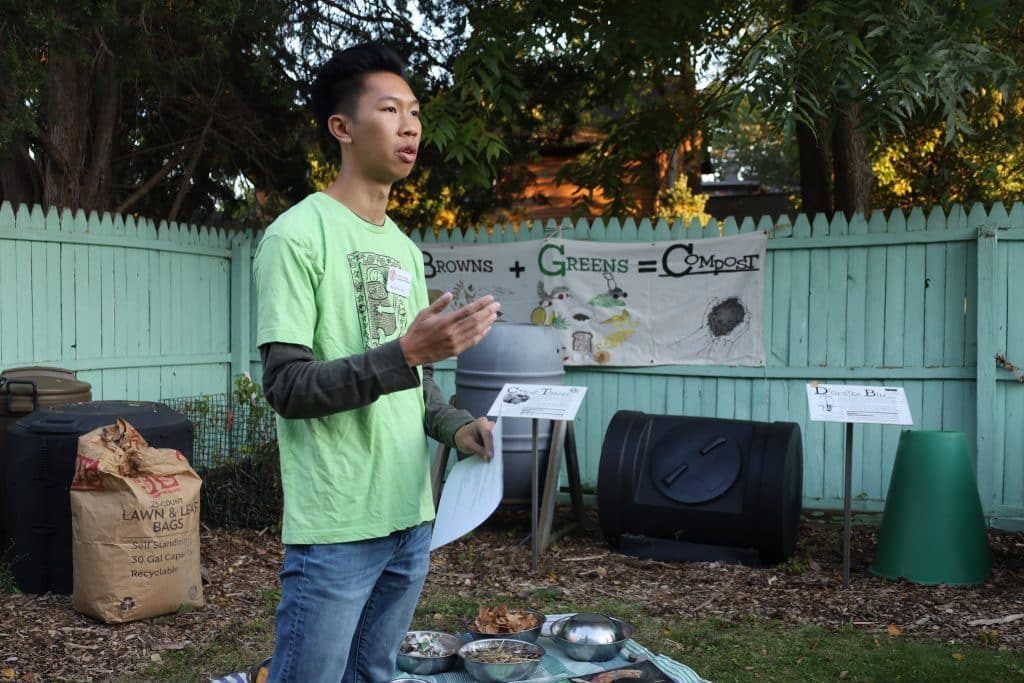
By Russell Kwong
Composting has changed my understanding of sustainability.
I’ve spent the past four years in Ithaca building my sustainability toolkit – learning about and engaging in practices to make the city and the world a healthier place to live. Some of these include a class in water management and working with the city to increase clean energy through distributed energy resources. However, the most impactful experience has been the Master Composter training program.
Each spring, the Compost Education Program at Cornell Cooperative Extension of Tompkins County trains a new cohort of Master Composters to actively promote composting in the County. This training includes ten 2-hour weekly evening classes and 20 matching hours of “practical internship.” The internship allows trainees to practice what they’ve learned in class and bring real-world experiences back to the classroom.
Coming from New York City, my only experiences with composting had been collecting kitchen scraps, leaving them on the curb, and watching them get hauled away by white collection trucks. After learning about the Master Composter program, I jumped at the opportunity to participate. My goals for this program were to learn about residential composting, and in turn, share this new knowledge. What I received exceeded my expectations. I am now confident in my role as a Tompkins County Master Composter. Below are a few insights from my participation in the Program.
Composting is a fun and collaborative way to learn about environmental stewardship. Master Composter training is more than just a series of classes; it includes many hands-on activities to build confidence in compost education. All Master Composters in training receive a take-home compost bin (a stealth bin, bokashi, or a worm compost bin) and share updates with the class. We were also invited to Dr. Janice Theis’ lab at Cornell to explore underground ecology and examine compost critters through microscopes.
By the end of the training, the cohort broke into small groups and gave mini-presentations on a shared topic of interest. Presentations for my class included compostable products, indigenous composting practices, and human waste composting. As new Master Composters, we continue to share volunteer opportunities and help each other reach our sustainability goals.
Composting fosters a network of local sustainability leaders. The Master Composter program introduced me to a variety of community organizations that are actively making a difference. I had the pleasure of meeting and speaking to composters from all corners of the County, including:
– The Soil Factory – a community hub where sustainability meets at the interface of art and science,
– Dish Truck – a team that eliminates disposable dishware at large-scale events, including at the Ithaca Farmers Market,
– Cornell Compost Facility – a large-scale compost facility that turns 4,000 tons of organic waste into nutrient-rich compost to be used on campus and in the community,
– Previously trained Master Composters, who share decades worth of experience and knowledge with a new generation of composters.
Composting creates an informed and environmentally conscious community. Working at the Compost Education booth is easily one of the most rewarding experiences in the Program. I’ve spoken to dozens of residents, families, and students and no two interactions are the same.
Initially, this position was intimidating, but I quickly found a passion for sharing best practices in composting. I am proud to have tabled at the Farmers Market and Cornell Ag Day. I even co-coordinated the Program’s efforts at the Apple Harvest Festival! I appreciated these events as a way to exchange knowledge. Local composters in the community shared their tips and taught me about cold-weather composting, getting rid of pests, and what they add to their compost piles.
Overall, the Compost Education program is a phenomenal way to join a network of environmentally responsible leaders and share sustainable practices with the rest of Tompkins County. I highly recommend the Program to anyone who is curious about the composting process and enthusiastic to share this knowledge with others. This is a program not to be missed, and I can guarantee it will make you rethink the value of composting and the meaning of sustainability.
The Compost Education Program is currently accepting applications for the 2025 Master Composter training until 11:59pm on Monday, January 27th. To find out more and apply, visit ccetompkins.org/mc. Once the deadline passes, qualified applicants will be invited for a short interview. Since there are limited spots, many applicants will mean a competitive process. All questions can be sent to the Program Manager, Adam Michaelides, via email acm1@cornell.edu or the “Rotline” (compost hotline) 607-272-2292.
Russell Kwong is a Cornell student and 2024 Master Composter from the Compost Education Program at Cornell Cooperative Extension of Tompkins County. Signs of Sustainability is organized by Sustainable Finger Lakes.
Related Articles
The Life and Legacy of Former Assemblymember Martin “Marty” Luster
The Marty Luster legacy includes lasting impacts on mental health, education, and environmental policy in New York.

Local mismanagement, statewide failures: A warning for the year ahead
Ithaca government failures expose financial mismanagement and raise concerns about leadership, accountability, and state-level governance.
Guest opinion: Why accessibility is not an option, but a responsibility
TCAT accessibility in Ithaca leaves disabled residents struggling. Community advocacy is essential to improve public transit for all.