
Mini-grants help support civic engagement
By Ken Zeserson
Sustainable Tompkins has a reputation for putting its money where its mouth is. One way this local nonprofit strengthens the fabric of our community is by awarding mini-grants to fledgling grassroots efforts. The grants are kick-starters that help fund worthy community-centered projects. Three of the most recent awardees well depict the scope and purpose of this ongoing program.
Gay Nicholson, President of Sustainable Tompkins, notes the theme of several recent mini-grant awards was civic engagement. “We are eager to support projects that invigorate and empower local people while also producing overall benefits for the larger community,” she says. Sound too good to be true?
Eco-Defense Radio, a weekly program about ecology and direct action which broadcasts on WRFI at 88.1 FM, received a mini-grant that literally got their project off the ground, says Ryan Clover who conceived and now manages the radio show. “Our mini-grant enabled us to purchase appropriate audio production software and also funded professional quality microphones and tape recorders which have enabled us to conduct field interviews, he says. “We are now producing original journalism, not just reading articles or discussing the environment on air.”
Clover, who has been heavily involved in the battle against fossil fuels for several years, admits that he started Eco-Defense Radio with no formal background in broadcast journalism. That’s just the way Sustainable Tompkins likes it. The mini-grant program is aimed at helping people with great ideas but not necessarily any experience in implementation get to the starting line, and that’s what happened in this case. Clover assembled a small volunteer crew eager to learn about broadcasting on a subject they hold dear. They received invaluable help from mentors at WRFI and started filling out the request for the Sustainable Tompkins mini-grant.
“The application process was probably more valuable than the actual money we received,” recalls Clover. “The experience of applying forced us to think long and hard about what we wanted to do long-term. It gave us a framework which will help us shape our future.” Clover and his colleagues now broadcast on Tuesdays from 4 to 5 p.m. Their programs can be accessed online at ecodefenseradio.org.
Nicholson also cites Hot Potato Press (hotpotatopress.org), the brainchild of local food activist and journalist Alison Fromme, as another worthy mini-grant recipient. This effort was originally launched in tandem with GreenStar Community Projects and, nurtured by Fromme, offers tips on how to find, grow, buy and cook local foods along with a forum for discussion of larger related issues such as food justice and sustainable food systems.
Like Eco-Defense Radio, the Hot Potato Press is still evolving. Fromme perceives the site as “an online space for community conversation driven by community members. Everyone is invited to participate. We invite the community to submit articles, photos and/or comment on existing articles.” Contact her at Alison@hotpotatopress.org for more information.
The mini-grant enabled Fromme to train (and pay) three editor/writers using the computer lab at Southside Community Center. In effect the money provided a learning stipend as this initial team wrote their own stories and encouraged others in the community to follow suit. “What we are trying to do here is to move away from the notion that local food movements are for only a certain segment of our community,” says Fromme. “But let’s face it, everybody cares about food every day in every way, where it comes from, what it tastes like, how to grow it, etc. The mini-grant has really helped us give voice to our community when it comes to thinking about local food.”
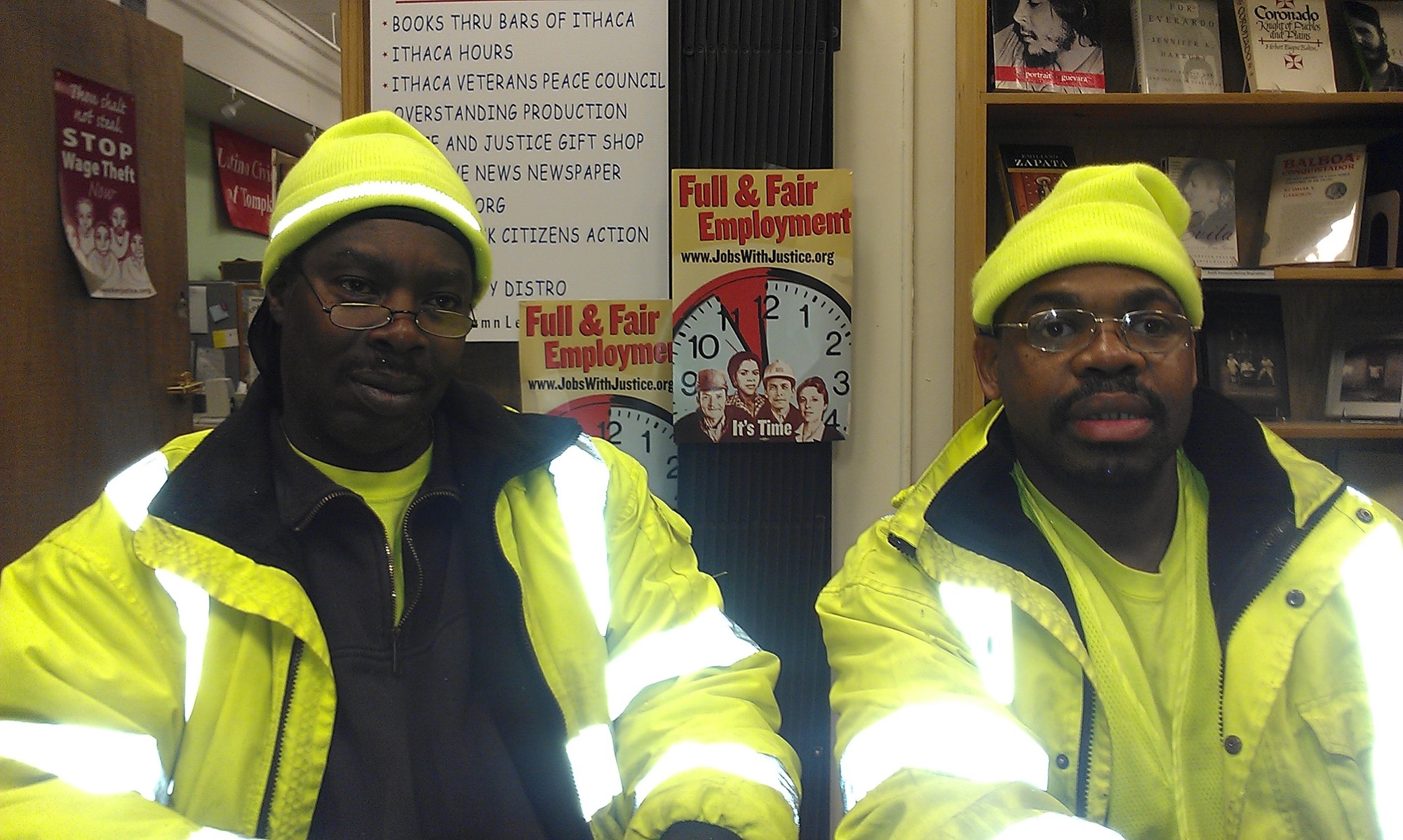
The Sustainable Tompkins mini-grant program is not limited to new projects such as Eco-Defense Radio or Hot Potato Press. “We are also eager to support established citizen-driven efforts that continue to need funding in order to achieve their aims, for example, the long-running campaign spearheaded by the Tompkins County Workers Center to insure that all workers in our area receive a sustainable living wage,” Nicholson says.
“Establishing the minimum wage as a sustainable living wage in Tompkins County would make a huge difference in working families’ lives and yield innumerable corollary benefits,” says Pete Meyers, who coordinates this effort at the Tompkins County Workers’ Center. Meyers and his colleagues applied for and won a mini-grant to fund a contest asking lower-wage members of the community to produce an original creative work that articulates their family’s need for a living wage. “In other words, we were soliciting works of art (including prose, poetry, music or a video) that express why a living wage would enhance their lives,” says Meyers, adding that in Tompkins County a living wage in 2015 would have been $14.34 an hour, or about $30,000 a year.
Like other projects awarded mini-grants, the benefits of this particular one are akin to the ripples created when a stone is tossed into a pond. It’s not just the art project itself that creates community benefits; it’s how thinking about creating a project can engender useful ongoing discussions in individual families and communities. “We expect that the individuals who submit entries and participate in our contest will be empowered simply by being involved and in some cases this may stimulate their further involvement in the larger effort to achieve a truly sustainable community minimum wage,” Meyers says.
The Sustainable Tompkins Mini-Grant program is now in its eighth year, having awarded more than $62,000 in 155 grants to local recipients like the ones described herein. But since money doesn’t grow on trees, Sustainable Tompkins is actively seeking ongoing business sponsors for the program. To get involved, email gay@sustainabletompkins.org. Community members who’d like to help can go to sustainabletompkins.org for more information on the group’s programs and/or to donate directly.
Nicholson says donors can also go to the GiveGab platform (givegab.com/nonprofits/sustainable-tompkins/campaigns/neighborhood-minigrants-program) for another quick and easy pathway for residents to contribute money—no strings attached—to worthwhile community endeavors.
Related Articles

The Life and Legacy of Former Assemblymember Martin “Marty” Luster
The Marty Luster legacy includes lasting impacts on mental health, education, and environmental policy in New York.

Local mismanagement, statewide failures: A warning for the year ahead
Ithaca government failures expose financial mismanagement and raise concerns about leadership, accountability, and state-level governance.
Guest opinion: Why accessibility is not an option, but a responsibility
TCAT accessibility in Ithaca leaves disabled residents struggling. Community advocacy is essential to improve public transit for all.