
Multiple organizations work in conjunction to fight food insecurity

Heading into 2024, two organizations are working together to help those in need of food in Tompkins County. The Food Bank of the Southern Tier and Friendship Donations Network work in very different ways to meet a common goal of food security for all.
Samantha Eck, interim communications manager for the Food Bank of the Southern Tier, said that there was a spike in donations during the COVID-19 pandemic, and now, three years later, that heavy giving rate continues.
Managing editor
The Food Bank of the Southern Tier, with its mission of “working together to build and sustain hunger-free communities,” serves Tompkins, Broome, Chemung, Schuyler, Steuben and Tioga counties, covering nearly 4,000 square miles.
As of Nov. 21, the Food Bank of the Southern Tier has served 1.2 million requests for food across all of its programs and partners. From January through September of 2023, that request number was 19% higher than those same months in 2022 and 33% higher than those months in 2019, Eck said.
“A lot of people are going back to normal. People are going back to work, things aren’t needed, but it just shows you a lot of the time people are buying groceries last. They have to pay for the roof over their head, electricity for heat and last comes groceries. Oftentimes they rely on food networks to meet that need. It just paints a clear picture that the need is not going away.”
COVID-19 perfectly illustrated how diverse the users of food banks actually are, because more people were coming out in higher numbers than ever. “You would have 500 people, and you would see all sorts of people,” Eck said. “They might have just lost their job, or the place they worked at closed, and they made really good money with tips but now need to put food on the table. Someone could be a former executive and is finding it harder than they thought to get by in retirement, or someone with a young family who is working two or three jobs.”
In 2024, the Food Bank hopes to be even more effective in its mission to distribute food across its service area.
“Our focus right now is that we are seeing a need across the community and an increase in demand from partner agencies,” Eck said. In most places, more people than ever are coming out to food bank events, she said in mid-December.
The Food Bank also supports backpack programs, where students take free food home from school with them.
“The need is not declining by any means, and with the holiday, kids are off from school and rely on the backpack program to bridge that gap because schools are so important for providing food as well as education,” Eck said.
Some schools have even implemented a food pickup area open to all students, where they can grab whatever they may need.
“It removes the stigma from kids,” Eck said. “Hunger can cause behavior problems; they can’t focus. And when you open it up to everyone, it reduces that stigma drastically.”
Older children are sometimes left to bear the burden of providing food for their family. “Some students get jobs or start taking things home to help support their younger siblings,” Eck said. “As hard as that is to hear, that’s the reality, especially with the cost of groceries.”
In the effort to take the pressure off of children by providing access to food for all, the Food Bank has been an avid supporter of universal school meals.
“Just to be able to ensure hot breakfast and lunch, and it also helps alleviate any stigma and ensures assistance for those families who don’t qualify for school meals but still need help,” Eck said. “It just makes it a lot easier for schools to serve families and get them what they need to show up and get ready for school.”
Eck encourages people who support the push for universal school meals to contact their state or local representative to make their opinion known. Those who wish to do so can visit foodbankst.org/advocate to look up contact information for their representative.
“Most of the legislators in our area are involved and understand this is important,” Eck said. “It’s just a matter of getting it through.”
For those who want to help in other ways, Eck said the Food Bank can always use more volunteers at its distribution center in Elmira. The Food Bank facility looks like what you might picture in the back rooms of a big box store, with giant freezers, forklifts and shelves and shelves of food.
“We’re calling on families or just individuals to help out when they can,” she said. “It is a huge help if they can unpack and repack food items. It can impact thousands of people in just four hours, or even an hour.”
Other than volunteer hours, which Tompkins County residents can also fulfill at local food shelves in their town (most of which partner with the Food Bank of the Southern Tier), the one thing the Food Bank of the Southern Tier needs most is monetary donations, which tend to go further than donated food. This is in large part due to their affiliation with Feeding America, a nonprofit network of 200 food banks leading the fight against hunger in the United States.
“Buying a can off the shelf, you might pay what is now probably a dollar, for something like canned peas, but because of the purchasing power of Feeding America, of which we are a partner, we can get many things at a lower cost,” Eck explained.
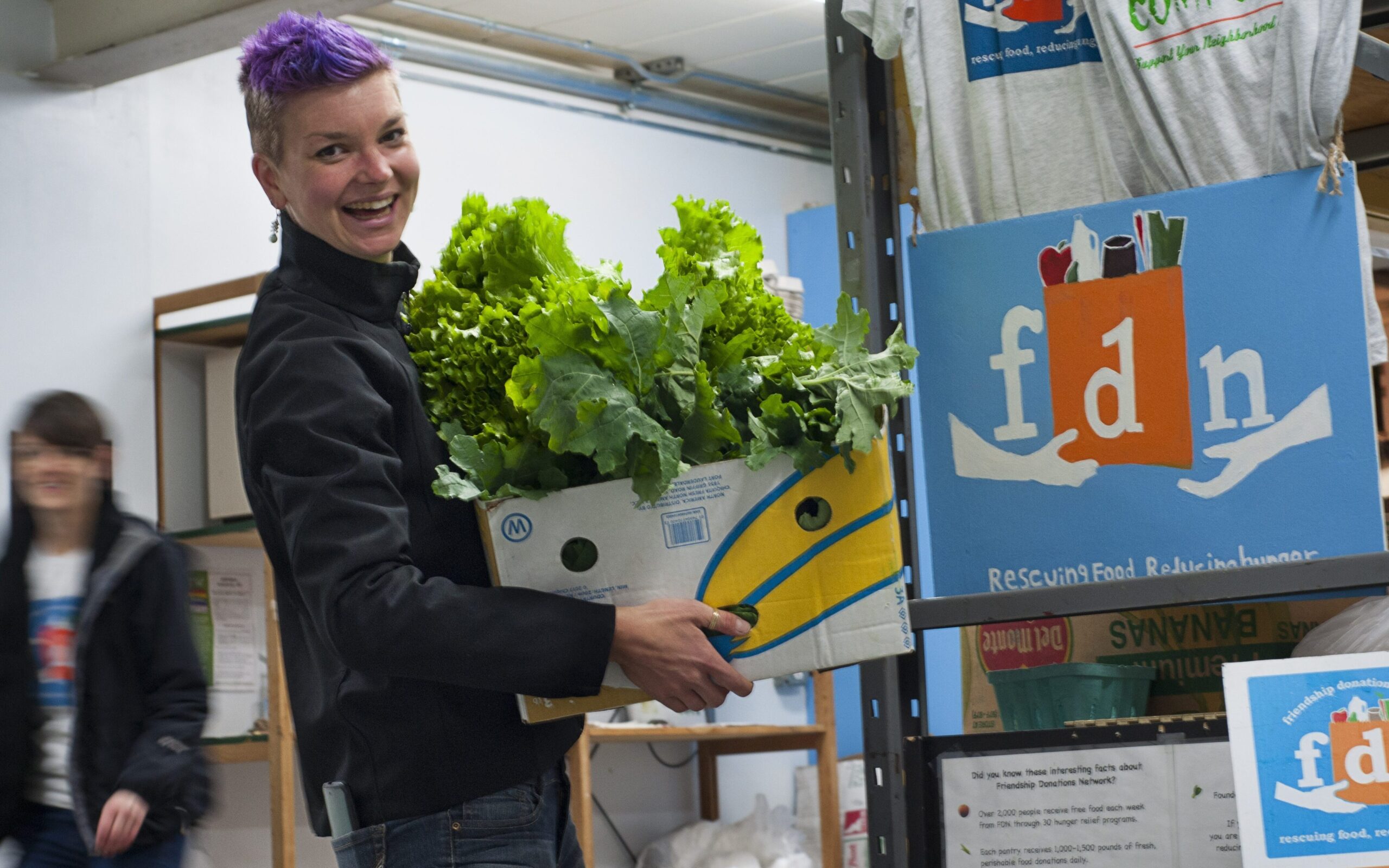
In contrast, one Ithaca not-for-profit has found a different creative solution for turning potential food waste into someone’s next meal. Friendship Donations Network (FDN) collects food that would otherwise be thrown away and delivers it to food distribution organizations (like local food shelves) across Tompkins County.
The organization works with farms, stores, restaurants and area colleges, taking perfectly good extra food off their hands and redistributing it to those in need. It just celebrated its 35th anniversary.
“It’s definitely a fun organization to be involved with,” said Art Pearce, FDN volunteer and board member. “Everyone is well intentioned and in good spirits. And most people are so happy to donate food, knowing it’s not going to go to waste and going to people who need it.”
John Martin of the Caroline Food Pantry in Brooktondale said his pantry receives food from both FDN and the Food Bank of the Southern Tier. While FDN is a great source of items such as baked goods, the Food Bank provides many other staples.
Unlike many other local food pantries, which saw a large increase in the number of patrons during the pandemic, the Caroline pantry saw its numbers go way down. Martin said that he is not sure why this occurred, but more people are starting to come back.
“During COVID, our pantry lost a lot of clients.… We went from serving like 80 households to 40, so we went to half when a lot of pantries said they were overrun with people and didn’t know what to do,” Martin said. “This fall, we were back to somewhere in the 60s or low 70s, so it’s never come back to pre pandemic numbers.”
He said the pantry is starting off the year with zero grant money from the Food Bank of the Southern Tier, when normally they have some money left over, so any monetary donations would be very much appreciated to help the organization get through the early months of 2024.
To find out more about the Food Bank of the Southern Tier, visit foodbankst.org.
For more information on FDN, visit friendshipdonations.org.
More information about the Caroline Food Pantry is available at https://carolinefoodpantry.org.
Author

Related Articles
Holiday traditions bring community cheer
Tompkins County holiday traditions light up homes, farms, and schools with festive cheer and community spirit.
The gift of an experience: Local businesses offer hands-on holiday fun
Holiday experience gifts in Tompkins County include candle making, gourd crafts, and pottery workshops for creative seasonal fun.
Code Blue shelter opens amid praise, concerns and ongoing debate
Ithaca’s Code Blue shelter opens with larger space, showers, and case management to help residents during cold weather.