
New organization operating Ithaca shelter
This past summer it was announced that Tompkins County and the Ithaca Rescue Mission would not be renewing their contract and the Rescue Mission would no longer be running the homeless services out of the shelter on West State Street. After a Request for Proposals (RFP) was put out looking for a new service provider the county found a familiar face in a new organization. Rich Bennett, former director of the Ithaca Rescue Mission, is back in the Ithaca vortex as the Chief Strategic Initiatives Officer for St. John’s Community Services (SJCS), the organization with the winning proposal for the shelter on State Street.
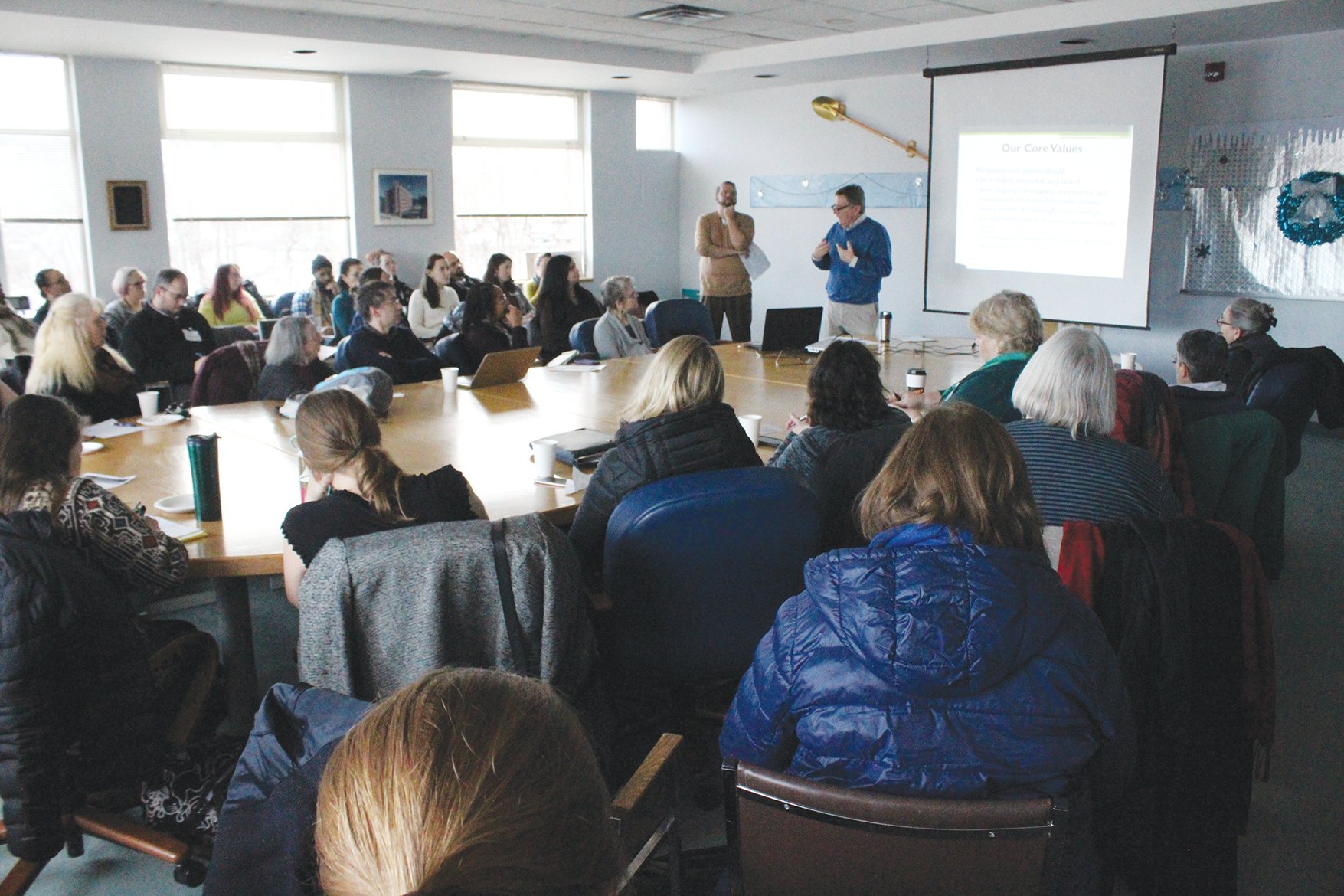
SJCS officially took over the operations of the shelter last month. Last week, Bennett and the new program director for the shelter, Roy Murdough, presented to the Homeless and Housing Taskforce to discuss the philosophy and vision of the new emergency shelter provider. Service providers and interested parties from across the county joined the meeting to find out more about the new provider and ask questions pertaining to operations and programming. So far, Murdough said, the transition at the shelter has been a smooth one from the Rescue Mission to SJCS.
Some might be wondering how Bennett found his way back to the shelter after leaving to join SJCS at the beginning of this year. Bennett explained to the room full of service providers, many of whom he worked closely with while at the Rescue Mission, how it came to be that he is once again involved with the shelter on State Street.
“When we heard that the Rescue Mission was leaving and that DSS was putting out another Request for Proposals I had gone to Alan [Thornton, former CEO of Ithaca Rescue Mission] and said ‘Is that too weird?’ and ‘What do you think?’ and the truth is, I don’t love the way we left,” Bennett said. “I feel like there’s still problems to solve, and I was very excited to put in a proposal, even more excited that DSS had accepted our proposal.”
Now, he said he feels that SJCS is the right organization, with the right mission and resources, to help make an impact in the local homeless community.
The presentation started with the deep history of the organization that for a very long time operated as an orphanage before expanding and shifting the mission to better suit the changing needs of society. The organization’s roots start in 1868 in Washington D.C. when the Women’s Guild at St. John’s church established St. John’s Hospital for “poor and invalid children.” From there, in 1878, an orphanage was formed after the Civil War left many children parentless. In the 1950s the orphanage had run its course and the board explored other ways to help children in the community, so in 1956 the board developed a child development center for children. It wasn’t until the 1980s that the organization started to work with adults, many with disabilities or other barriers to employment. Services began to expand services in the 1990s and now has a presence in six, soon to be seven, states and the District of Columbia.
Although the organization’s core mission, for many years, has been to assist people with disabilities, Bennett said they are always looking at the needs around them and looking for ways to meet those needs. Taking over the shelter turned out to be one of those needs that could be met.
Bennet and Murdough told the meeting attendees that all employees of SJCS will be paid a living wage and that at least three staff members will be at the shelter for every shift.
“Similar to Wegman’s, we try to hold a philosophy of ‘If you take care of your team, they take care of everything else,’” Bennett said.
While they had hoped that programming would start two weeks ago, the new goal is to get daily programming at the Friendship Center started this week.
“We’ll be reaching out to community partners to come in, let the clientele know what services are available,” Murdough said. “We’re going to do things such as music therapy and art therapy… I think it’s critical, and key, to the success of this program, the programming that we provide in the Friendship Center, and also working with DSS and community partners to make sure that we provide hope in the lives of the people that we help.”
At the meeting presentation, Bennett provided an overview of the SJCS best practices, which included a housing first approach. One thing they know, Bennett said, was that each day that being in the shelter longer does not make the clients lives better. The goal is to move them quickly into safe, stable housing. But the biggest barrier is having housing to move into. This approach isn’t done solely by the shelter but in close partnership with DSS.
But while they are at the shelter, Bennett explained that part of SJCS’s best practices is using the tools of Trauma Informed Care.
“Our population often is stereotyped as dangerous, but what we know about our population is they are the ones who are, most of the time, on the wrong end of abuse and violence,” Bennett said. “Most of the chronically homeless folks that we serve on a day-to-day basis, all have been victims of trauma.”
When SJCS’s proposal was chosen by the county, the county released $97,503 from the Contingency Account to help the agency with startup costs and upgrades and renovations to the facility. Of that amount, $62,250 was for certain critical start-up expenses. So far, according to Murdough, the money has gone to upgrading the shelter’s electrical system, painting, fixing a broken laundry vent, and inspecting the fire alarm system. Future upgrades include the installation of cameras, replacing carpets in the facility, and purchasing a van to transport clients. Cameras are expected to be installed later this month. Murdough does not expect any of these start-up projects to halt or impede services from the shelter. While there were a few bumps in the road during the initial transition, Bennett said at last Wednesday’s meeting, service at the shelter continued uninterrupted.
Related Articles

Legislature unanimously adopts the 2026 budget
Tompkins County 2026 budget passes unanimously, raising taxes 3.59% and funding key programs and community services.

From smartphone bans to building plans, Tompkins County schools adjust
As the school year begins, local districts roll out smartphone bans, major capital projects, attendance policy changes.
Groton Olde Home Days: Connection, fun and food
Groton’s three-day festival begins with the opening of the Playland Amusements Carnival Midway at 6 p.m. Thursday, Aug. 22 in the Speedway lot on Main St.