
New TCAT leaders look to solve driver and vehicle shortages
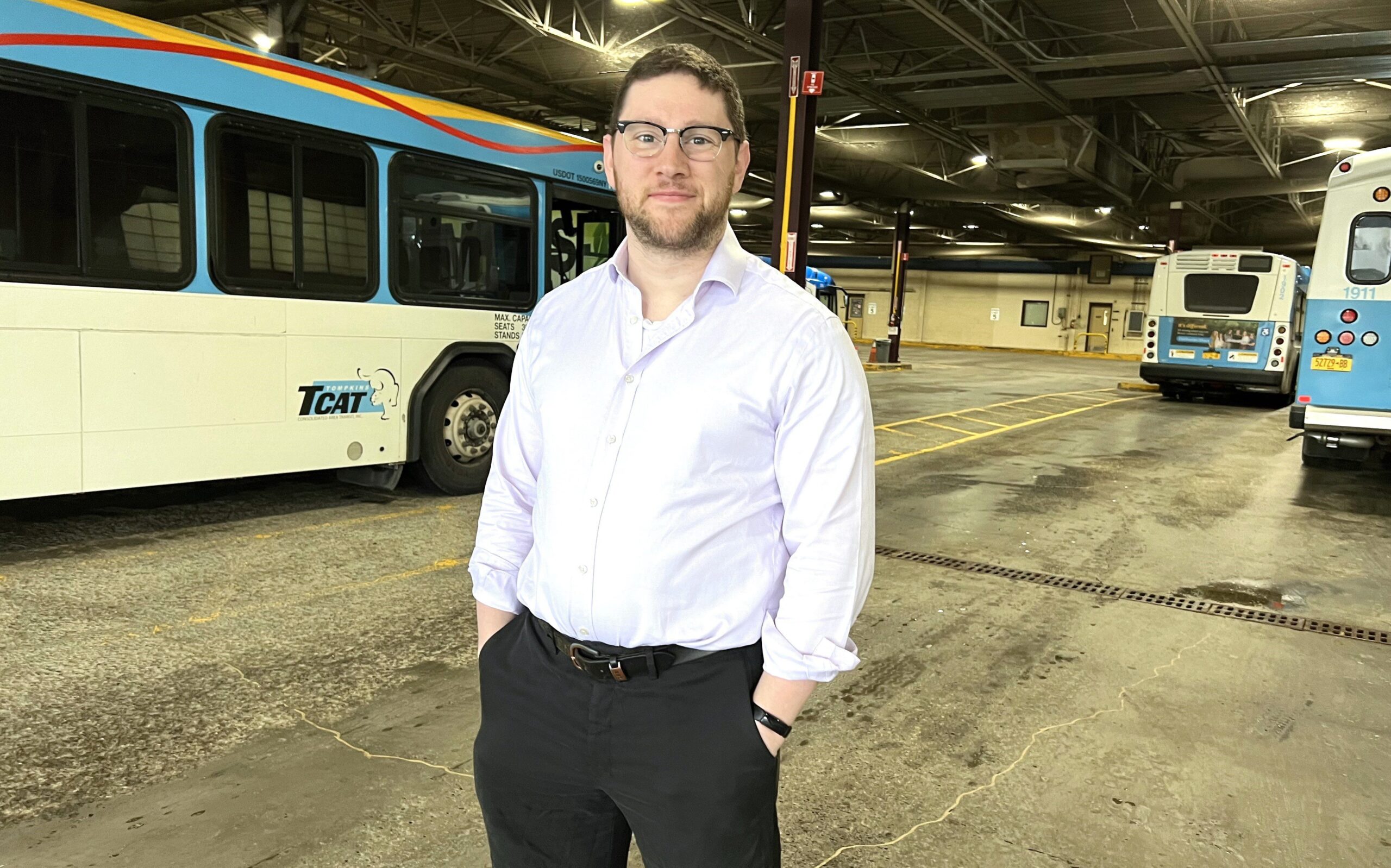
Driver shortages, the never-ending maintenance of an ever-aging fleet, the recent decommissioning of relatively new electric buses and the purchase of several new ones to replace them (estimated to arrive in up to two years), the purchase of new diesel buses to fill the gap in the meantime, changes in management and the planned expansion of service to keep up with a rising ridership — Tompkins Consolidated Area Transit has faced many challenges and changes of late, but members of its new leadership team say they are ready to take TCAT into the future.

Newly hired Tompkins Consolidated Area Transit (TCAT) General Manager Matthew Rosenbloom-Jones said Thursday that service levels, both in terms of scheduled service and TCAT’s ability to operate, are currently “below public expectations and below what the public deserves.”
“The goal is to get service to become more reliable,” Rosenbloom-Jones said. “We are running on a very reduced schedule compared to prepandemic, and the rest of the world has come back, and people are out and about again.”
Getting the fleet back in shape (electric is still a goal)
Organization around scheduling regular repairs and maintenance of buses is key to Rosenbloom-Jones’ strategy for getting TCAT back on track.
“We’ve had several years of underinvestment in our fleet,” he said. “We’re putting that investment back in, but we’re trying to catch up and backpedal. The pandemic made it very hard to find parts, but in the last few years we have not invested the actual amount of money needed to keep these vehicles on the road.”
It wasn’t that TCAT lacked the funding to stay on top of repairs. Rosenbloom-Jones said that previously the organization just did not make it a priority.
“We’re in good financial shape,” he said. “For whatever reason, the funding wasn’t really going where it needed to go.”
Despite both labor and vehicle shortages, Rosenbloom-Jones is committed to making a comeback.
“We need to get back to where we were because that’s what the public expects from us,” he said.
Last month, eight electric-battery buses that TCAT purchased in 2021 (one of which was already permanently out of service) were found to be unsafe, further complicating the problem.
The electric vehicles, manufactured by Proterra, were fairly unreliable from the start, Rosenbloom-Jones said. Some have as few as 15,000 miles on them.
Proterra has gone bankrupt since TCAT purchased its vehicles. “[Proterra was] one of the pioneers of electric buses, but unfortunately the quality was quite poor, and that was the primary factor that led to their bankruptcy,” Rosenbloom-Jones said. The issue had nothing to do with the buses’ propulsion systems or charging components.
“It was not at all related to them being electric buses,” Rosenbloom-Jones said. “It was just general quality problems.”
The issue was discovered while one of the vehicles was undergoing routine maintenance and prompted a closer inspection of the other electric buses. It was determined they were all suffering from the same problem: the axles, which are attached to the body of the vehicle with an adhesive, were debonding from the frame.
“The axle could have detached going downhill and caused an accident that could have been very bad,” Rosenbloom-Jones said.
To replace the electric buses, TCAT recently approved the purchase of five Gillig diesel buses for $547,000.
Rosenbloom-Jones said Gillig buses have proved to be dependable, and TCAT has an order placed for six electric buses that are also manufactured by Gillig.
The diesel buses should arrive in eight to 12 months, but it could take up to two years for the new electric buses.
“There’s a difference in the supply chain, and they’re more difficult to build,” Rosenbloom-Jones explained.
TCAT also recently approved a local funds match to support a grant application to help fund the purchase of two hybrid electric buses.
Rethinking the routes
One place where TCAT would like to improve is the Cornell University campus, where high demand has led to overcrowding on buses. In the short term, the problem should be alleviated somewhat by the return of 15-minute service this summer.
“Every year we have more students, more demand for transportation,” Rosenbloom-Jones said. “It’s an older campus, and a campus that is very aesthetically pleasing, but there’s not a lot of parking.”
Student enrollment is back to prepandemic levels, but TCAT is not, creating a larger problem. Rural trips have also been busy, and some have been suspended. “We need to get those back as quickly as possible,” Rosenbloom-Jones said, adding that TCAT has a very dedicated ridership from places like Dryden and Trumansburg. “Probably the busiest route is the one that goes to TC3 [Tompkins Cortland Community College] and connects to Cortland.”
Last week, a public hearing was held by TCAT regarding two routes that were suspended last fall due to driver and vehicle shortages. The hearing was required by state law because TCAT is continuing to suspend the routes, though TCAT intends that this will be temporary.
“Our intent is not to permanently reduce those routes,” Rosenbloom-Jones said.
The 14S is a west side route that serves apartment complexes on West Hill, connecting riders to the Walmart and Wegmans area, and the 83 is a Cornell-Cayuga Heights route. These routes were cut because they are the least productive routes in the TCAT system, but the 14S especially is important to those who rely on it.
“It is difficult to go shopping when you live at Cayuga Meadows,” said Pat Frazier, who resides at the same-named senior living apartments in Ithaca.
“You have to transfer from Green Street to Seneca Street to connect with bus number 15,” Frazier explained. “If the bus is late getting to Green Street, you might miss the connecting bus, as it also takes about 10 minutes to get to Seneca Street. If it rains or snows, it is a hazard to walk, as the residents of Cayuga Meadows are over 55 years old. It’s much easier to do some shopping with 14S than with the regular routes.”
Rosenbloom-Jones acknowledged that it is an older, more vulnerable population that rides the buses on the 14S route.
“They have very low ridership, but for the few riders that remained on that route, [removing it] had a major impact on their lives and their accessibility to grocery stores and medical appointments,” Rosenbloom-Jones said.
“Our intent is to get them back as quickly as possible,” he said, but he did not give a more specific timeline.
More drivers needed
The hiring of more drivers will be essential to TCAT’s future success, but it is a constant challenge, Rosenbloom-Jones said. “There are a lot of hoops you have to go through, essentially, before you are hired, and the training process itself can be quite long.”
Bus driving positions at TCAT start at $25.66 per hour, and it is a union position.
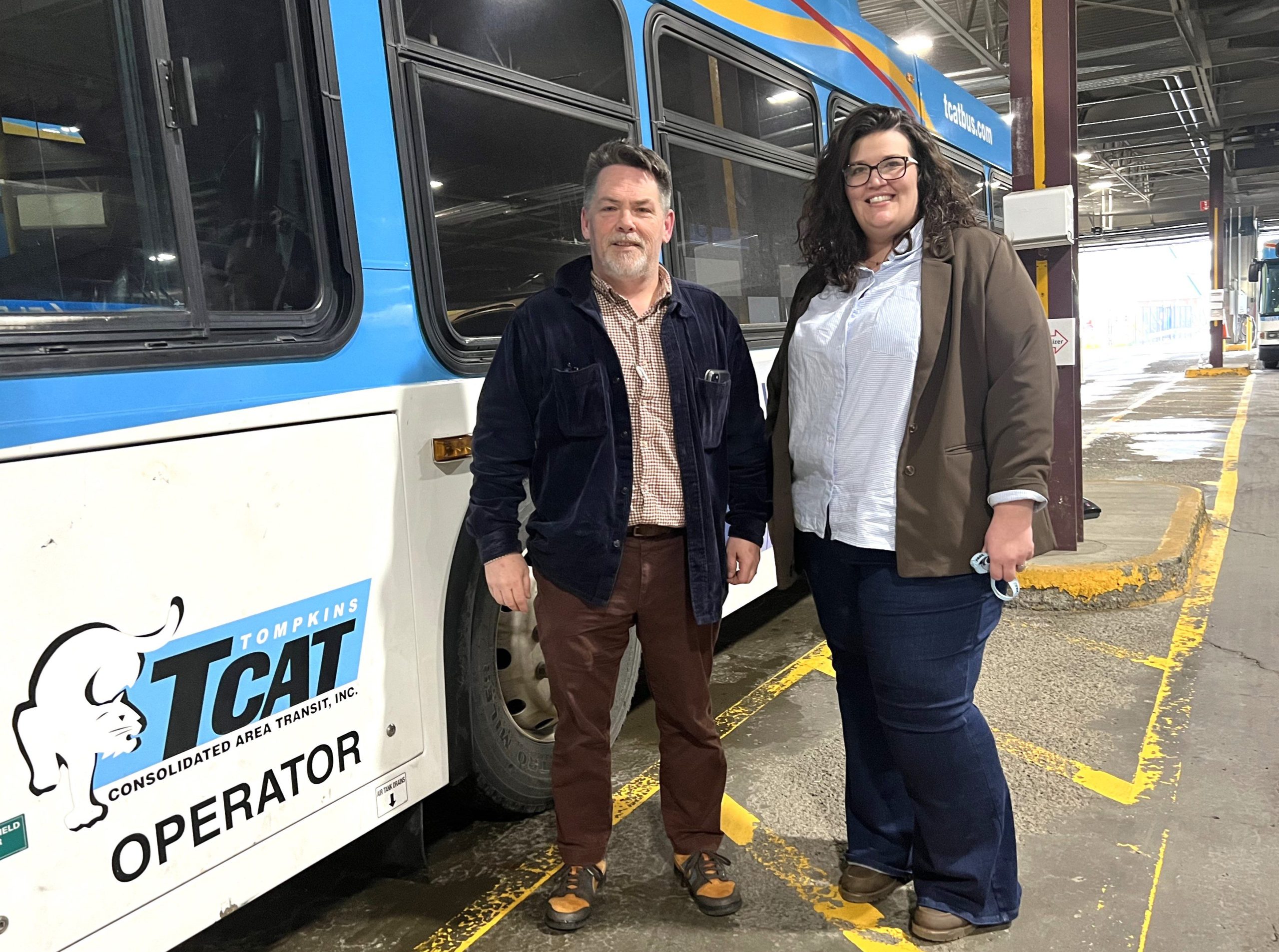
Training lasts eight weeks for those who do not yet have a commercial driver’s license (CDL), but the training is paid.
“A lot of folks think they need a CDL, but we have a great in-house training program, which is amazing,” said Tiffany Walker, TCAT human resources manager, adding that there are many advantages to TCAT’s training program.
“In-house, you can tailor it to company needs and the learning style of the employee,” she said.
Once hired, drivers can expect that their schedule will include a lot of nights and weekends, as drivers are able to choose their own schedules based on seniority.
Drivers also need to be in good physical shape and must pass regular drug screenings.
“With marijuana legal in New York, it creates an issue,” Rosenbloom-Jones said. “In New York, it’s legal recreationally, but federally it’s still illegal.”
Though TCAT recently hired several drivers, the organization is still well below its target number.
“If I had 20 more drivers, I’d be happy,” Rosenbloom-Jones said. “We need to hire at a rate higher than attrition to make headway, but we have a long way to go before we’re in a more comfortable position with staffing.”
Welcoming changes in management
Rosenbloom-Jones has 10 years of experience in public transit and started his career at TCAT in January, when he came on board as service development manager. His role was overseeing, planning and scheduling all of TCAT’s service. He then became acting general manager and was recently permanently named to the general manager position.
A large part of his strategy for TCAT’s future success is maintaining an effective maintenance schedule and a strategy for utilizing the buses to get the most use out of the fleet.
Walker started with TCAT March 4 in her position as human resources manager.
“I’m placing an emphasis on recruiting,” she said, “trying to increase the visibility of TCAT as a great place to work with great wages and really a place for a long-term career.”
Jeremiah Anderson has been with TCAT for 15 years and was promoted Friday from lead transit operations supervisor to operations manager.
Anderson’s main goal is “to keep working on the customer service aspects and a culture of kindness, going forward. We’ve been doing that, but I want to just really bring it to the forefront of how we deal with passengers and our employees. A happy customer is a happy community.”
Joe Stone was recently named TCAT’s new vehicle and facility maintenance manager, and Controller Meredith Stanton started in early January.
“With our new GM, who has some really excellent planning abilities, I think we’re well positioned with our leadership,” Anderson added. “I think we’re ready to move forward at a good pace in the right direction.”
Author

Related Articles

Holiday traditions bring community cheer
Tompkins County holiday traditions light up homes, farms, and schools with festive cheer and community spirit.

The gift of an experience: Local businesses offer hands-on holiday fun
Holiday experience gifts in Tompkins County include candle making, gourd crafts, and pottery workshops for creative seasonal fun.
Code Blue shelter opens amid praise, concerns and ongoing debate
Ithaca’s Code Blue shelter opens with larger space, showers, and case management to help residents during cold weather.