
Newfield votes ‘no’ on school district budget and purchase of electric buses
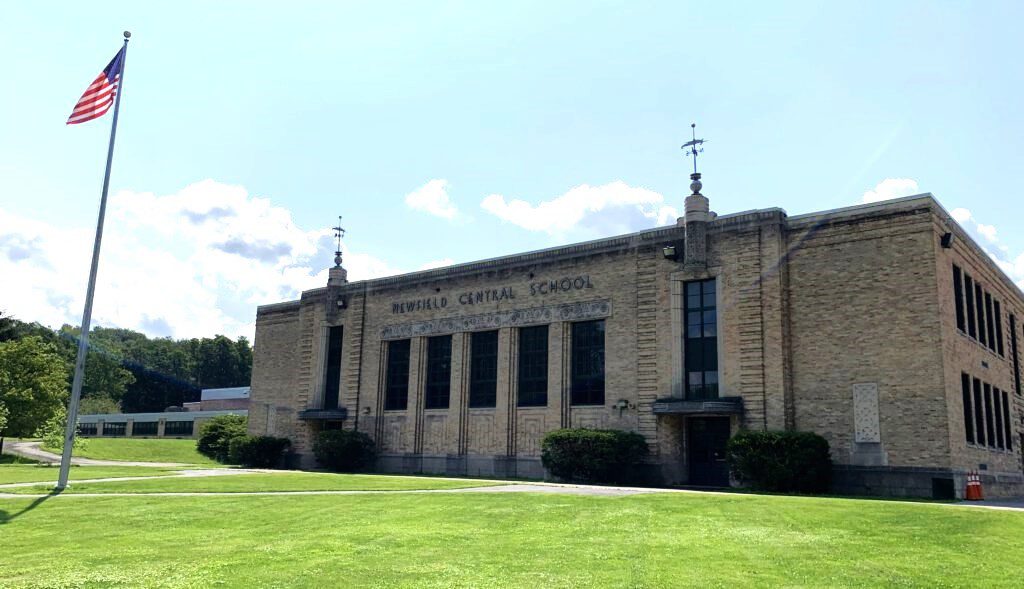
The budget for Newfield Central School District (NCSD) failed in a vote of 266 to 248 at a townwide election May 21.
“It only failed by 18 votes, and it was a good turnout — over 500 votes, including absentee and early ballots,” said Eric Hartz, NCSD superintendent.

“We really have been pushing hard for people to vote,” he added.
A second proposition regarding the purchase of several electric buses failed as well, though the third proposition — to authorize the board to establish a reserve fund in the amount of $5 million — passed, as did the library tax levy increase from $76,000 to $81,000.
The two available seats on the board of education will be filled by newcomer Kevin Berggren, who received 390 votes, and incumbent Timothy Payne, who got 304 votes. Candidate Shana Claar received 188 votes.
The budget proposition would have authorized the spending of $25,482,411. About 70% would be funded by state aid and other sources, and about 30% by the Newfield school tax levy. The tax levy would increase 3.5% compared to last year.
Hartz believes a number of factors could have contributed to the budget being voted down. He said he saw false rumors going around social media websites regarding Newfield’s school attendance. Newfield currently has about 54 homeschooled children and approximately 12 students attending New Roots Charter School in Ithaca, Hartz said. It is true that the Newfield student population has declined in recent years, but not to the extent that was rumored.
The school district has more homeschooled children than it did before the pandemic, but that number was never in the hundreds, as Hartz said he saw on social media. He estimated that the number of students who were homeschool when full-time, in-person classes resumed after the height of the pandemic was about 60, whereas in years prior to COVID-19 that number was in the high 20s to low 30s.
Hartz said people may have voted “no” because of an increased property tax assessment on their home. A record number of Tompkins County homeowners have seen their assessments go up over the last few years, and this year’s assessments were especially high, with the property values in Tompkins County, on average, increasing by 19.8%.
“If your assessment didn’t change, you would pay less [in education taxes], but I don’t know anybody whose assessment didn’t go up,” Hartz said. “We kept the levy low, but when your assessment goes way up, you pay more in taxes. If you want to be upset and vote ‘no’ because of taxes, you can vote ‘no,’ and I totally get it.”
“But it’s the kids who might lose because of this,” Hartz added. “If we revamp the budget, where are we taking that money from?”
The failure of the electric bus proposition was a disappointment, Hartz said, but he said he can understand why some voters might have been concerned.
“There is a lot of unknown right now,” Hartz said. Three years ago, the school district received a grant to purchase three electric buses, but the school district will still be responsible for the upkeep of the vehicles. With the widely publicized breakdown of a fleet of electric Tompkins Consolidated Area Transit buses, the public could be feeling a little wary of trusting electric buses right now, Hartz said.
Voters might also have been experiencing sticker shock, as the electric buses cost several times more than a traditional diesel bus, he added.
The board of education members now have a decision to make. The board can either move forward with the predetermined contingent budget, which would lower the education tax and be implemented without a public vote, or the board can develop a new budget and bring that to a revote, which would be held June 18.
If the budget fails on June 18, the contingent budget will automatically go into effect, though it would be a new contingent budget that would correspond with the newly developed proposed budget.
There are advantages to both options, Hartz said, adding that it would not be easy to cut the existing budget. “We would have to take a really hard look at our budget,” he said. “Any place we could tighten our belts we would try to do it without disrupting anything for our students.”
In some prior years, the contingent budget cost more than the proposed budget, but that is not the case this year, Hartz said.
The advantage to going straight to the adoption of the contingent budget would be the time and expense saved, Hartz said.
“You don’t have to have the community come out to vote, and there’s no expense to it,” he said. “You’re not taking up people’s time.”
As a newly elected school board member, Berggren said he would like to thank the voters for entrusting him to his new position.
“I was happy to see I got so many votes,” he said, “and I value that they trust my opinion.”
“The Newfield Board of Education has heard the community, and although we are disappointed that the proposed 2024-25 budget did not pass, we are appreciative of the big voter turnout,” said school board president Christina Ward on May 23. “The board is committed to providing the best programming possible for our students, and we will be deliberating, discussing and exploring next step options during tonight’s BOE meeting at 6:30 p.m. upstairs in the elementary school’s Weaver conference room. The board encourages the community to attend all of our regular meetings in order to view our decision-making processes. The board also provides time for public comment at the open and close of all of our regularly scheduled business meetings.”
Due to the Memorial Day holiday, Tompkins Weekly was not able to include details of that meeting in this article, but we will follow up with another story on this issue in our June 5 edition.
In brief:
Mind Over Body with Mitch Raymond May 30
Learn how to achieve improvement through movement and techniques aimed at strengthening connection between mind and body from Mitch Raymond, MSPT, CEEAA. The connection between the brain and muscles is essential to move without injury. The presentation breaks down how to improve strength, flexibility, stability, balance and skill through practices that enhance neuromuscular connection and physiologic well-being.
The introductory program, which began Feb. 29, establishes a foundation for “Mind Over Body” exercise classes. Each class starts with techniques to limber up, followed by exercises to work on stability, strength, balance and exploration of motion. Each session’s activities will largely depend on the needs and interests of attendees. It is highly recommended that everyone bring a yoga mat. Participants work with the library chairs and tables to help with stability.
Each class is a suggested donation of $10. The next class is Thursday, May 30 at 6:00 p.m. on the second floor of the library.
Author

Related Articles

Meinig Fieldhouse built to protect iconic red-tailed hawks
The Meinig Fieldhouse hawks project shows how Cornell protected Big Red and other red-tailed hawks during construction.

TC3 reaches transfer agreement with Hobart and William Smith Colleges
TC3 transfer agreement guarantees acceptance and scholarships for graduates entering bachelor’s degree programs at Hobart and William Smith Colleges.

AmeriCU proudly connects students with annual scholarship opportunity
AmeriCU scholarship program awards $1,000 to students pursuing college or vocational education. Applications are open through March 15.