
Non-retail business practices see lasting impact from pandemic
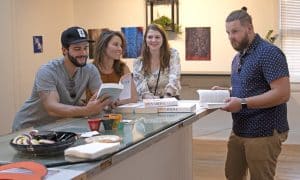
When the pandemic hit, many local non-retail businesses adjusted their practices to accommodate safety concerns, primarily through a widespread switch to remote work. Now that most pandemic concerns have subsided, owners are actively considering whether to return to pre-pandemic practices or keep some of the changes in place.
Tompkins Weekly spoke with non-retail businesses and those who support them to get a sense of how business is done differently since the pandemic hit, and as sources explained, it largely depends on the industry. Across the board, though, sources have learned that being flexible is essential for success in today’s world.
Of the sources working at businesses established before 2020, most said that there is a significant contrast in how business is conducted now compared to pre-pandemic times. At Tompkins Financial Corporation (tompkinsfinancial.com), for example, Senior Vice President of Commercial Banking Karen Parkes explained that while her department is largely back to its usual in-office format, the same cannot be said for several other departments at the company.
“From our whole bank perspective, absolutely, things are different,” she said. “I work in a department that’s very customer facing, so we need to be in our offices sometimes to meet with customers. But if you think about our operations team that’s really mostly behind the scenes, they don’t need to be in the office. So, a lot of those teams have gone to either fully remote, in some cases, or what we’re calling a hybrid approach, where they’re in the office three days a week and then remote two days a week. And a number of departments have gone to that.”
Eric Eisenhut has leadership roles at several local businesses, including KensaGroup (kensagroup.com), Jamex (jamexvending.com), iFyber (ifyber.com), NovaSterilis (novasterilis.com) and Lansing Market (lansingmarket.com). He said that at the non-retail businesses he’s a part of, he and others have “put in place tools that allow people to work from home and have more flexibility,” he said.
“By having the remote capabilities for a segment of what we do, it works out well because people can kind of keep up with their work task and still be appropriately present for their family,” he said. “Some of the things that we do, though, requires physically making stuff, whether that be in a lab or in a manufacturing environment, and there, it just comes down to who can cover for who.”
As displayed through Eisenhut’s and Parkes’ accounts, the current work format for non-retail businesses largely depends on the sector, the nature of the work and the position, with some industries being more conducive to remote work and others better suited to in-person work. At HOLT Architects (holt.com), for example, Principal Steve Hugo explained that he and others are working to bring staff back to the office because HOLT’s architecture work depends considerably on in-person collaboration.
“What we do in our office are social pinups, so everyone in the office pins up the work that they’re working on in our conference rooms and around the office and, on a Friday, we have some food brought in and beverages and we try to make it kind of a social hour where we share what we’re working on,” he said. “And those things … were very hard to do during the pandemic. …. We tried doing them online, but they were almost impossible on a WebEx to have a social hour and casually talk about your work with 30, 40 people online.”
A more recent business, Tubbs Tree Service (tubbstree.com), is also finding that having an office could be beneficial for some of the administrative work required to keep the business running. As owner Jason Tubbs explained, he largely works out of his car right now, but he’s working to build his own office.
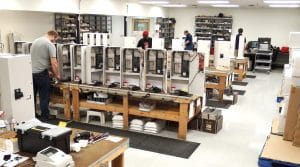
“For me, the office seems like a better place to kind of separate administration work and then actually working,” he said. “When I’m in the field, my focus is trees and safety and meeting clients’ needs. So, having a physical office will just kind of help separate the atmosphere — ‘Now, I’m in my office, it’s time to do administration things.’”
And there are others who are embracing a more hybrid approach, like Sciarabba Walker & Co. (swcllp.com, tinyurl.com/256bzlnz). Dave Iles, a managing partner at Sciarabba Walker, explained that most of the changes were originally made as a result of “survival mode” and have now transitioned to “improvement mode.”
“We have on-premise[s] people, hybrid (on-premise[s] and remote) people and fully-remote people,” he said in an email. “We’ve changed our processes and procedures to better align with off-premise[s] people. We’ve had technologies to support remote people for fifteen years but the use of the technologies has grown. … We’ll need to continue to adopt technologies that will provide our clients with a strong client experience and our people with the tools we need.”
Jennifer Tavares, president of the Tompkins County Chamber of Commerce (tompkinschamber.org), explained that many of these changes and decisions revolve around a challenge facing numerous industries that Tompkins Weekly has touched on numerous times — workforce shortages and recruitment issues.
“That, I think, is one of the single biggest reasons why you may see people shifting or making some more permanent shifts, if that is something that they could do — it’s related to attracting and retaining the workforce that they need,” she said.
Two newer businesses Tompkins Weekly spoke with also referenced the shifting demands in workforce as a large contributor to their business model. Psychotherapist Dr. Katherine M. Durrant, for example, started her business, Imperfect Parenting (tinyurl.com/26mlhpjo), in late summer of this year and said that the impetus of her business was seeing so many parents coping with remote work and at-home challenges, which is why she offers both telehealth and in-person options.
“During the pandemic, I just was meeting with so many parents who were feeling overwhelmed [because] their parenting norms were disrupted, kids who are home, there’s just so much chaos, and I found myself working much more with parents than with the children who they were bringing to me for help,” she said. “It was really just so much focused on parent work as a way to help the children. And that led me to wanting to do that more full time. … Having the option for telehealth is so convenient for parents.”
Another recently established business modeled around pandemic-related changes is Ithaca’s Covenstead Workspaces (covensteadworkspaces.com), which founders Audra Bartlett and Christine Brouwer established to support “women who are self-employed, remote working professionals, creatives, and entrepreneurs by creating an innovative and cohesive co-working space to share, collaborate and grow collective energy,” according to a recent press release.
Covenstead features private offices, a coffee kitchen, conference room, community room and shared working spaces, and Bartlett and Brouwer explained that they created the space to meet the current demands for remote work while also addressing some of the challenges working from home can bring.
“Your kid is in the background on a sick day, and you’re trying to get work done, or your laundry pile is staring at you or your dog’s barking in the background, whatever it might be,” Brouwer said. “I love stopping at lunchtime at home and doing a couple of chores. But when you do that five days a week, you realize you may be less focused on work than you’d like to be, and you’re socially isolated. And so, I think people are trying to strike more of an ideal balance in terms of how we do work and our personal lives.”
Bartlett added that while remote workers could also go to locations like a coffee shop to work, Covenstead is a space better suited to a full workday.
“Those are often places that people go, but [at Covenstead] you know that you have a concentrated workspace that it’s not going to feel awkward if you’re there for seven hours working with your coffee,” she said. “There’s not going to be a whole bunch of craziness happening around you. It’s a little bit more of a controlled space.”
As for the future of non-retail business, much remains to be seen, sources said. Those who work with developers and startups said that the county is seeing more vacancy in the commercial realty sphere, and some upcoming projects are prioritizing smaller office spaces, but there isn’t a huge shift to all-remote formats. Still, most agreed that the shift toward more hybrid offerings will likely stick around for a while.
“I think it’s going to be hybrid and it’s going to be a pendulum that shifts,” Eisenhut said. “I don’t think a whole-remote solution is the panacea or the ideal work environment. … We exchange a lot through the casual interactions of an office environment. And that shouldn’t be underestimated, especially as you’re bringing new people on and the benefits it gives all sides to share the institutional knowledge.”
Jessica Wickham is the managing editor of Tompkins Weekly. Send story ideas to them at editorial@VizellaMedia.com.
Related Articles
Holiday traditions bring community cheer
Tompkins County holiday traditions light up homes, farms, and schools with festive cheer and community spirit.
The gift of an experience: Local businesses offer hands-on holiday fun
Holiday experience gifts in Tompkins County include candle making, gourd crafts, and pottery workshops for creative seasonal fun.
Code Blue shelter opens amid praise, concerns and ongoing debate
Ithaca’s Code Blue shelter opens with larger space, showers, and case management to help residents during cold weather.