
‘Gigantic monstrosity’: Newfield residents speak out against NYSEG infrastructure project
Newfield residents raise concerns over NYSEG’s infrastructure project, citing property impacts, aesthetics, safety, and communication issues.
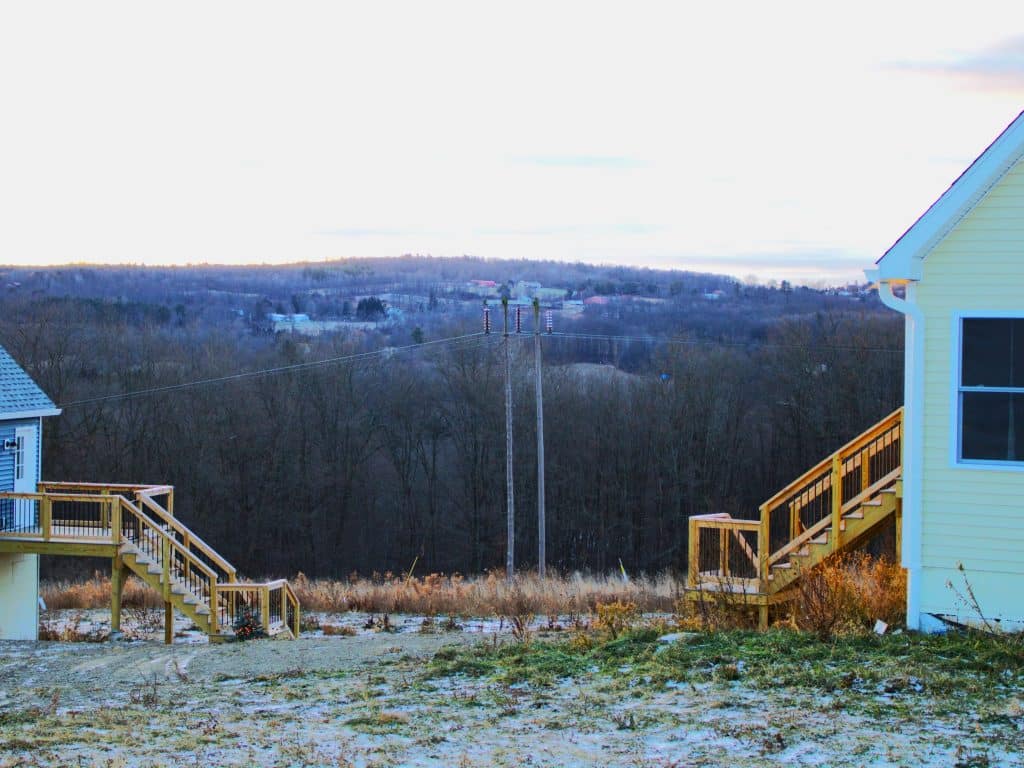
Kirsten Hamberg’s two chalets on Douglas Road in Newfield, which overlook power poles in her backyard. Hamberg, who moved to Newfield at the end of 2024, is one of over a dozen homeowners in the town whose property will be impacted by New York State Electric and Gas’ (NYSEG) ongoing Finger Lakes Area Infrastructure Reliability project.
More than a dozen people packed into Newfield’s Masonic Temple earlier this month to learn about a major New York State Electric and Gas (NYSEG) project that will impact their properties.
NYSEG representatives attended the Dec. 11 town board meeting to discuss the company’s ongoing Finger Lakes Area Infrastructure Reliability (FLAIR) project, which plans to reconstruct approximately 21 miles of electric transmission line between its Montour Falls and Ithaca-based Coddington substations. A substation converts electricity into different voltages, which is then distributed to homes, businesses and other buildings.
The 115-kilovolt transmission line, which is a common type of high-voltage carrier, is more than 90 years old, according to project outreach specialist Chris Brewster. A major part of the approximately $88 million project involves replacing wooden power poles with steel poles, which Brewster said are significantly more durable. Wooden power poles are designed to be used for 40 years, while steel poles can be used for about 60 years, he said.
“There’s a lot of wear on poles and other equipment along the project corridor,” Brewster said, noting that many power poles have become rotten or cracked, including by woodpecker holes. “Anyone who has trees or any wooden structure knows very well what that could do. … We’ve gone beyond what [the poles] are normally able to accommodate.”
NYSEG officials said that the project will increase the line’s power flow capacity by slightly over 150%, and that optical ground wire, a type of cable used in overhead power lines, will be installed to add new safety features, such as lightning protection.
The project will impact municipalities across Tompkins and Schuyler counties, including the northern part of Newfield and the towns of Ithaca, Enfield, Danby, Hector and Catharine.
“As your communities grow, your electric service should be able to grow with it, and this [project] will ensure that that can happen,” Brewster added.
NYSEG’s presentation came at the request of Newfield town officials after nearly a dozen residents raised concerns about the FLAIR project at the Nov. 20 town board meeting. Many community members who have power poles on their property objected to the proposed steel poles for a litany of reasons, ranging from safety to aesthetic concerns.
Power lines along the project are currently supported by standard H-frame wooden structures, which are approximately 50 feet tall, and will be replaced with steel monopole structures that will be an average of 100 feet tall, according to NYSEG officials. Brewster said that installing taller power poles is beneficial because additional poles won’t have to be added to support the line. He said that the steel poles will also lower the risk of outages caused by falling trees and minimize environmental and visual impacts on the natural landscape.
However, residents argued that the steel poles would infringe on their property’s natural landscape, with some worrying that the project would lower their property value. The project will impact at least a dozen homeowners in Newfield, including a mobile home park on Douglas Road.
“These H-poles were a concession for me, but I was fine with it because it blends in with the tree line. I cannot handle a ginormous pole in my backyard,” resident Kirsten Hamberg said at the Nov. 20 town board meeting. “We built two tiny chalets next to each other, and they have 36 windows facing these poles. The whole feature of these houses is facing the direction in which these lines are, and I got no notice that there’s going to be a change. That’s a major issue.”
Shaun Brown, who’s lived at his home in Newfield for more than 30 years, argued that the project goes against a goal in the town’s comprehensive plan to protect Newfield’s “valued resources such as clean water, air, soil, open space, and scenic hillsides for current and future generations.” About 63% of residents have said that Newfield’s “rural/scenic character” influenced them to live in the town, according to the 2013 comprehensive plan.
The FLAIR project began in late 2022 with initial fieldwork, and NYSEG filed its project application with the Public Service Commission, the state agency that regulates electric, gas and private water utilities, late last year. NYSEG first informed impacted land owners about the project at the end of 2024, but some residents, including Hamberg, said they only found out about the project from neighbors last month.
“I got no letter. I got no email. I got no phone call, and I pay NYSEG every single month,” said Hamberg, who moved to Newfield at the end of last year.
NYSEG officials hosted two public information sessions on the project in July, one in Ithaca and another in Odessa, as well as an October informational forum with the state Department of Public Service in Montour Falls.
Tompkins County Legislator Randy Brown, who represents the town of Newfield and part of the town of Enfield, has helped connect residents with NYSEG to understand where the new poles will be installed on their land.
“In the long run, [the project] is probably good for our community, but I’m really worried about the impact it’ll have on certain homeowners, and I think initially the communication from NYSEG could have been better,” Brown told Tompkins Weekly.
Brown also anticipated that the project could lower certain residents’ property values, noting that the presence of power poles can already lower a county resident’s property value by 5% to 15%.
NYSEG officials said that they would meet with concerned homeowners to evaluate the best location for the poles, which will be placed in close proximity to the current wooden structures. Brewster said that his team expects to receive project approval from the Public Service Commission in the spring, and that construction is slated to begin in early 2027 and conclude in late 2029. He added that the construction is expected to create job opportunities for people in the impacted municipalities.
Cynthia Henderson, another Newfield resident who described the proposed steel poles as a “gigantic monstrosity,” said she worries that her grandchildren will get hurt playing near the new structure. She also expressed frustration with NYSEG’s rising rates, as the company is currently seeking to increase delivery rates by about 35% for electricity customers and almost 40% for gas customers. NYSEG serves more than 40% of upstate New York, including most of Tompkins County.
Brewster noted that organizations like the World Health Organization have found no adverse health effects linked to transmission lines’ electromagnetic fields, invisible areas of energy associated with electrical power usage.
At the Dec. 11 town board meeting, Newfield Town Supervisor Mike Allinger read comments from another concerned resident who suggested that NYSEG use a different electrical conductor — the material that electric current flows through — for the project. The project will use Aluminum Conductor Steel Reinforced (ACSR) cables that can experience significant thermal sag, or droop, when heat causes the aluminum strands to expand, which can necessitate taller power poles. Instead, the resident, whom Allinger did not name, suggested using newer High Temperature Low Sag (HTLS) conductors, which can carry more electricity than ACSR cables and handle higher temperatures with less sag. The resident noted that National Grid is undertaking a similar project in Oswego County, which will rebuild more than 28 miles of electric transmission line with HTLS conductors.
Allinger asked NYSEG officials to reconsider using HTLS conductors, although Brewster noted that it would cost an additional $1 million to do so.
Allinger said that the project would provide “necessary upgrades” to Newfield and noted that blackouts have become increasingly prevalent throughout the town, particularly due to falling tree branches. But he also noted that the town has little power to veto NYSEG’s decisions.
“If these people are being affected in a real way, I would like to see NYSEG do the right thing and give them some sort of compensation if they’re not able to physically move the pole from the proposed site so that it doesn’t impact someone’s property value,” Allinger told Tompkins Weekly.
“We want to make sure that the project that we’re proposing is what we find to be the best one,” said project manager Emma Timerman. “No one’s going out there and designing the most evil power line ever.”
A recording of the Dec. 11 town board meeting can be found on the town’s YouTube channel. More information about the FLAIR project can be found at fingerlakesreliability.com.
Author

Related Articles

Cayuga Medical Center nurses to rally, alleging anti-union tactics by hospital management
CMC nurses plan a rally, alleging unsafe staffing and illegal anti-union tactics as the hospital highlights recent patient-safety gains.
Dryden Fiber looks back on another year of service
Dryden Fiber reflects on a year of growth as the municipal internet provider expands service across Dryden and Caroline.