
Office of Human Rights sporting a new look
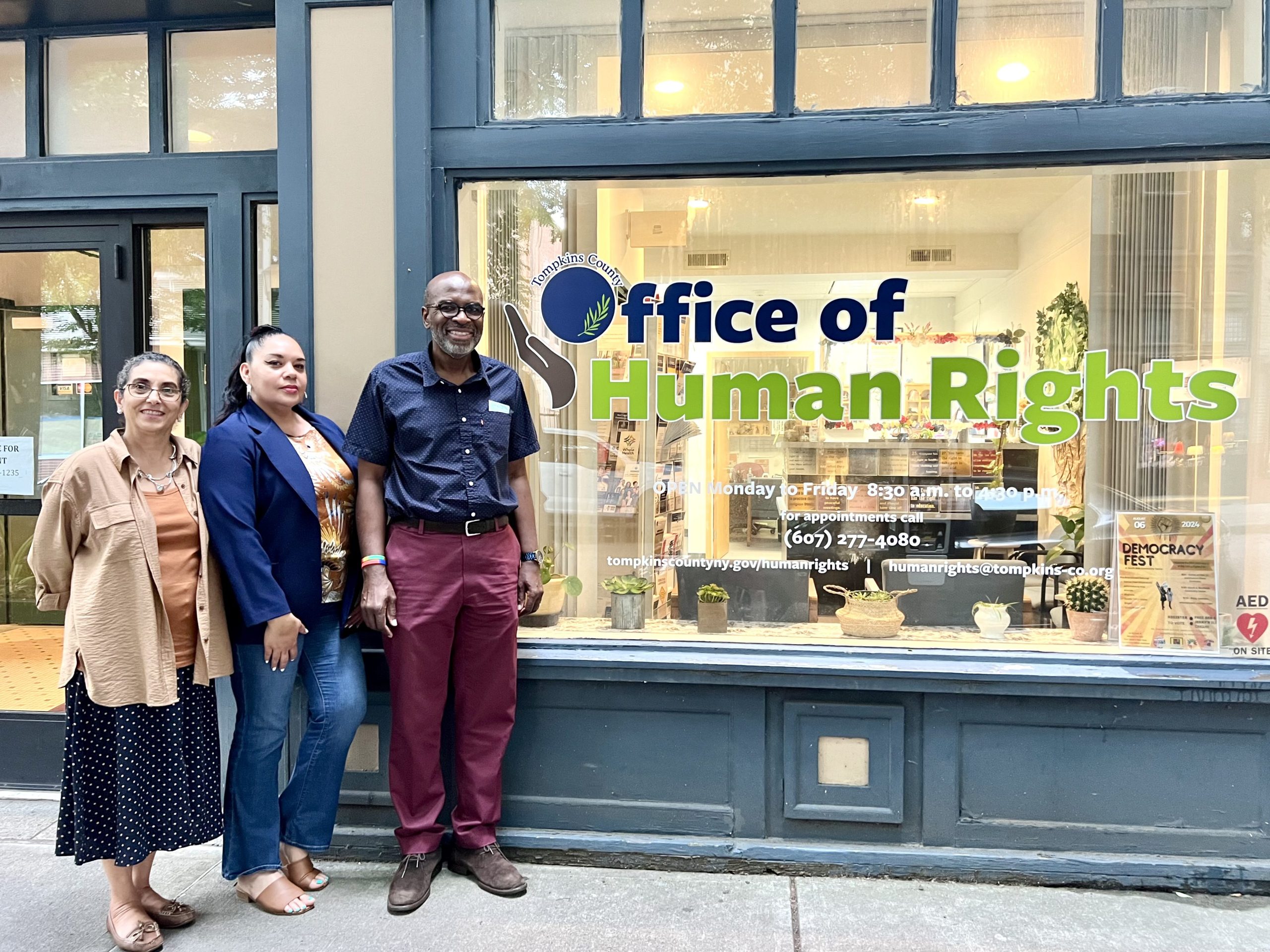
In 2023, county staff identified the need to revise the branding of the Tompkins County Office of Human Rights (TCOHR) and increase awareness of contemporary human rights issues. Community stakeholders informed the process through a survey and conversations with staff.
At the top of the list of important ideas to convey through the new logo was the fact that TCOHR is a welcoming space. The office’s employees frequently interact with people who are in the midst of a very challenging time in their lives, and TCOHR aims to provide a safe place where people who have experienced discrimination feel comfortable telling their stories.

Managing Editor
“Sometimes people need to get these stories out,” said TCOHR Director Dr. Kenneth Clarke, “and in a number of cases, people feel relieved to have gotten it out, so they’re not living in their head with these things. And the stories are important.”
Stakeholders also ranked “inclusivity,” “support” and “peace” among the top things a new logo and brand should portray.
Elements of the design include a circle, which mirrors the circle of the Tompkins County seal, and an olive branch, a symbol of peace held in the beak of an eagle in the county seal. The county’s name is prominently featured in the logo, as well.
“We serve the county, we serve the folks within this vicinity … and any citizen of this county who has a concern should feel free to bring it to this office, and [we aim] to help people, whatever concerns they may have,” Clarke said, adding that the office will point people toward experts who are in a position to help if there is another place better suited to address the person’s specific needs.
The recent survey also showed that community members valued the work of the office but wanted to learn more about the programming and services it offers.
TCOHR is a county department that facilitates the filing of human rights complaints with the New York State Division of Human Rights. Such complaints include allegations of discrimination in housing, employment, public accommodation, education or the many other areas covered by New York State Human Rights Law.
The office makes referrals regarding the interpretation of local and state human rights laws as well as federal laws, and office employees offer advice on human rights concerns.
TCOHR also organizes education and outreach initiatives addressing human rights and social justice issues and, in partnership with CNY Fair Housing in Syracuse, affirmatively furthers fair housing.
“We help people who are struggling right here, on the ground, with issues in the workplace, in educational institutions and other spaces,” Clarke said. “And we’re here to help.”
In the new logo, an outreached hand, extended palm up, is designed to reflect a helping hand, a welcoming atmosphere and a commitment to supporting, encouraging and educating about human rights, as well as standing on the side of justice.
“That should be our ‘handiwork,’ so to speak,” Clarke said.
The green of the logo symbolizes the verdant nature of the earth, and the blue symbolizes the water of the county’s lakes. “Those symbols really resonated with us,” Clarke said.
Clarke said that there comes a time when organizations must take stock of their brand and decide if it is worth giving up brand recognition in exchange for a fresh look. In the case of TCOHR, it was determined that the benefits of change outweigh any attachment to the old iconography, which is a drawing of seven stick figures, one of whom is in a wheelchair, holding hands.
“I think it reflects a new phase for the office,” Clarke said of the new design.
“Everyone in Tompkins County should know about the great resources offered by our Office of Human Rights,” Legislator Susan Currie, who serves as a liaison to the Tompkins County Human Rights Commission, stated in a recent Tompkins County press release. “I’m delighted that this new brand will help get the word out to the community about what human rights are, how to access resources, and how to get involved.”
TCOHR has a rich history. “We have a proud legacy of 61 years now that we stand on,” Clarke said. “We stand on the shoulders of others who have made that history possible.”
Another large component of TCOHR’s mission is to educate the public about human rights issues via local programming. Last January, the office did a program about Dr. Martin Luther King, Jr. and the case for reparations, as well as a program on the leadership role of Black women in the civil rights and Black power movements.
Coming up on Aug. 6, TCOHR will hold its second annual Democracy Festival for Civic Engagement. This event will include a processional march from the Dr. Martin Luther King, Jr., statue on the Ithaca Commons down MLK Street to Plain Street and Southside in Ithaca.
There will be performances by African drummer Dr. Aloja Airewele, singers from the Calvary Baptist Church, the Dorothy Cotton Singers and local singer SingTrece and her band. Interspersed between the music performances, short comments will be made about the importance of civic engagement and voting.
TCOHR has published 30 posters highlighting each article of the Universal Declaration of Human Rights. Community members are invited to visit the office to learn more about human rights and to take a free copy of the posters featuring rights that resonate most with them.
Author

Related Articles

Design details unveiled for new Center of Government
Design details for the Tompkins County government building in downtown Ithaca are now public, with a county survey open for feedback.
Holiday traditions bring community cheer
Tompkins County holiday traditions light up homes, farms, and schools with festive cheer and community spirit.
Cayuga Medical Center improves patient safety score
Cayuga Medical Center Leapfrog Grade rises to “B,” showing improved patient safety and nursing care quality.