
On the start of Cornell’s summer sessions
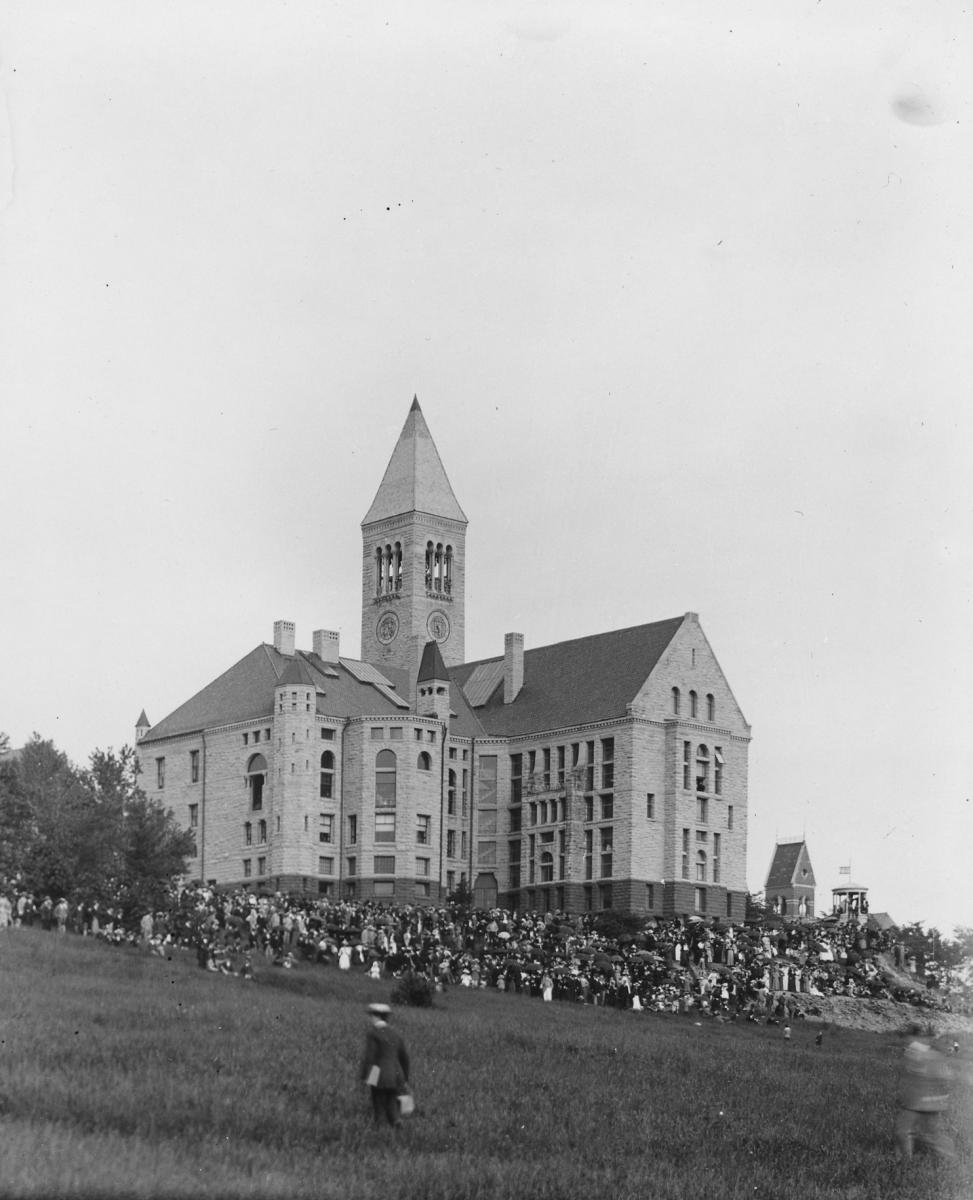
The first of a two-part East Hill Notes on Cornell and summertime academics:
Excerpted from School of Continuing Education (SCE)/Summer Session site:
The earliest references to summer study at Cornell University are found in The Cornell Era of 1876, less than a decade after CU’s founding. It notes that Cornell offers summer schools in botany, chemistry, drawing, entomology, geology, and zoology, to take advantage of the season’s natural outdoor classrooms and to serve elementary and secondary school teachers who wish to further their education while their schools are not in session. These summer schools are the first step toward establishing the Cornell University Summer Session.
The first of what will become Cornell University Summer Session’s off-campus programs is offered by Professor J. H. Comstock. The Aquatic Summer School takes students by steamer through the Great Lakes, studying the “Geology, Zoology, and Botany of the region,” attending lectures “illustrated by the stereopticon,” and collecting specimens. The Cornell Era notes that the purpose of the expedition is “to do some good work in the direction of scientific instruction and investigation.”
Having offered summer courses for the previous 16 years, in March 1892, Cornell’s Board of Trustees approved the formal establishment of Cornell University Summer Session. Described by Cornell President Jacob Gould Schurman in his 1892 report to trustees as an “integral part of the university,” Cornell’s Summer Session is one of the first such official summer programs in the United States.
In July 1892, the first formal Summer Session at Cornell began on July 7, 1892. Some 115 students attend courses in botany, chemistry, classical archeology, drawing and art, English, entomology, French, German, Greek, Latin, math, philosophy, physics, and physical training. The 1892 summer catalog states: “Without excluding others qualified to take up the work, these courses are offered for the special benefit of teachers with access to university instructors, libraries, museums, and laboratories.
“The courses are open to women as well as to men. The City of Ithaca is easy to access, is delightfully situated in the beautiful lake country of central New York, and with its lakes, hills, and glens is an attractive place of summer residence.”
In November 1898, Anna Botsford Comstock was named assistant professor of nature study in the Summer School making her the first woman to hold a professorial rank at Cornell. The following summer (1899), Comstock teaches insect life in the Summer Nature Study School created by her and Liberty Hyde Bailey. The program focuses on lectures, laboratory work, and field work in the areas of insect, plant, and farm life. “It is the purpose of the course to teach both the acts and the methods of serious Nature-study,” states the Summer Session course description of 1898-99, “with particular reference to fitting teachers to take up the work in their own schools. The vicinity of Ithaca is rich in animal and plant life and in entertaining scenery.”
The opposition of some trustees to Comstock’s appointment, however, is so great that at the end of the summer, she is demoted to the rank of lecturer. Comstock finally achieves full professorship in 1920 and continues to teach in the Summer Session until only nine days before her death in August 1930.
In 1906, George Prentice Bristol, a professor of Greek, was appointed director of Cornell University Summer Session, taking over from Dean Charles DeGarmo. Summer Session that year features 37 professors, courses in 20 departments, and tuition of $25. Bristol served as director until 1918.
East Hill Notes are published the first and third weeks of each month in Tompkins Weekly. Direct questions, comments and suggestions to gary.stewart@cornell.edu
Related Articles

Meinig Fieldhouse built to protect iconic red-tailed hawks
The Meinig Fieldhouse hawks project shows how Cornell protected Big Red and other red-tailed hawks during construction.

Town-Gown Awards honor housing, child care collaborations
Town-Gown Awards recognized Cornell and community partnerships supporting affordable housing and child care in Tompkins County.

Lorin Warnick to end term as Cornell Veterinary College dean
Warnick Cornell dean Lorin Warnick will step down in 2026 after leading the veterinary college through growth, innovation, and major public health milestones.