
Opinion: Cornell’s Proposed Fake Grass Could Cause Real Problems
Artificial turf conceals a host of potential environmental and health hazards from the toxins it releases. Yet the City and Town of Ithaca Planning Boards are considering allowing Cornell’s proposal for multiple new artificial turf fields at their proposed Meinig Field House and East Hill Plaza athletic facilities.
A lot is riding on the City Planning Board’s decision on Sept. 3. Right now, it rides on the thin ice of compromised “science.” Ironically, despite their role as a world-class institution focused on research for the public good, Cornell has taken a singularly unscientific approach to artificial turf.
In support of their plans, Cornell submitted a strikingly inept “research summary” on artificial turf to the Planning Boards. The summary is not authored by scientists, but by the pro-industry consulting firm Haley & Aldrich (H&A). Boasting awards from none other than BP, H&A says it strives to “[find] ways to reduce costs and lessen environmental liability…[to] contribute to positive cash flow” for polluting industries. “Research summary” co-author Jay Peters’ recent work includes minimizing the risks of coal ash, TCE toxins, and a coal industry’s superfund site for clients such as the American Coal Ash Association and Dominion Energy.
As critics at other universities have pointed out, universities do a profound disservice to the public good and their own mission by hiring industry consultants who have conflicts of interest.
The H&A consultants state in their summary, “We are not aware of any peer-reviewed scientific studies which draw an association between adverse health effects and use of crumb rubber.” In fact, many empirical studies highlight risks based on toxicity results, potential accidental ingestion, ecotoxicology, animal experiments, and limited human epidemiology. Assuming the consultants are aware of these studies, their statement can only be interpreted as setting the wrong standard for proof of risk. This replicates a Big Tobacco disinformation tactic: hold up a dangerously high standard for proof of harm and assume toxins are safe until then. As Cornell University and our Planning Boards should know, acting on partial evidence is often the only ethical course when making precautionary decisions in the public interest.
Equally disturbingly, the consultants’ research summary dismisses PFAS contamination from artificial turf by arguing that (some) PFAS concentrations in turf are lower than “background” soil contamination. In other words: because soil is already so contaminated, further contamination doesn’t matter. Note: True background levels of PFAS are zero. PFAS are not naturally occurring substances, but highly toxic “forever chemicals,” for at least two of which the EPA declared there is “no safe level of exposure” in 2024.
It is disturbing to see Cornell endorse such an unscientific view on pollution. High levels of contamination in soil and water provide evidence for the need to start regulating industry now – not evidence that we can tolerate further industry contamination.
The H&A research summary is problematic in other ways. It does not review a single study from the large literature pointing to harmful health and ecological impacts of artificial turf. It relies heavily on studies conducted by or for prospective clients of the synturf industry, contradicting the authors’ own assertion that “it is important to focus on scientific studies that are peer reviewed.”
Cornell Professor Frank Rossi, a leading expert in turfgrass science, stated in an email to us: “Upon review of the information provided by Haley and Aldrich I am concerned this is not a thorough review of the various aspects that should be considered when selecting synthetic turf.”
As if this flawed research were not problematic enough, Mr. Peters has contradicted his own research summary in testimony to the Planning Boards. He has issued significant false statements implying that artificial turf does not contain PFAS (or at least no “non-polymer PFAS”) and that it will not contribute to environmental PFAS contamination—contradicting the test results cited in his own research.
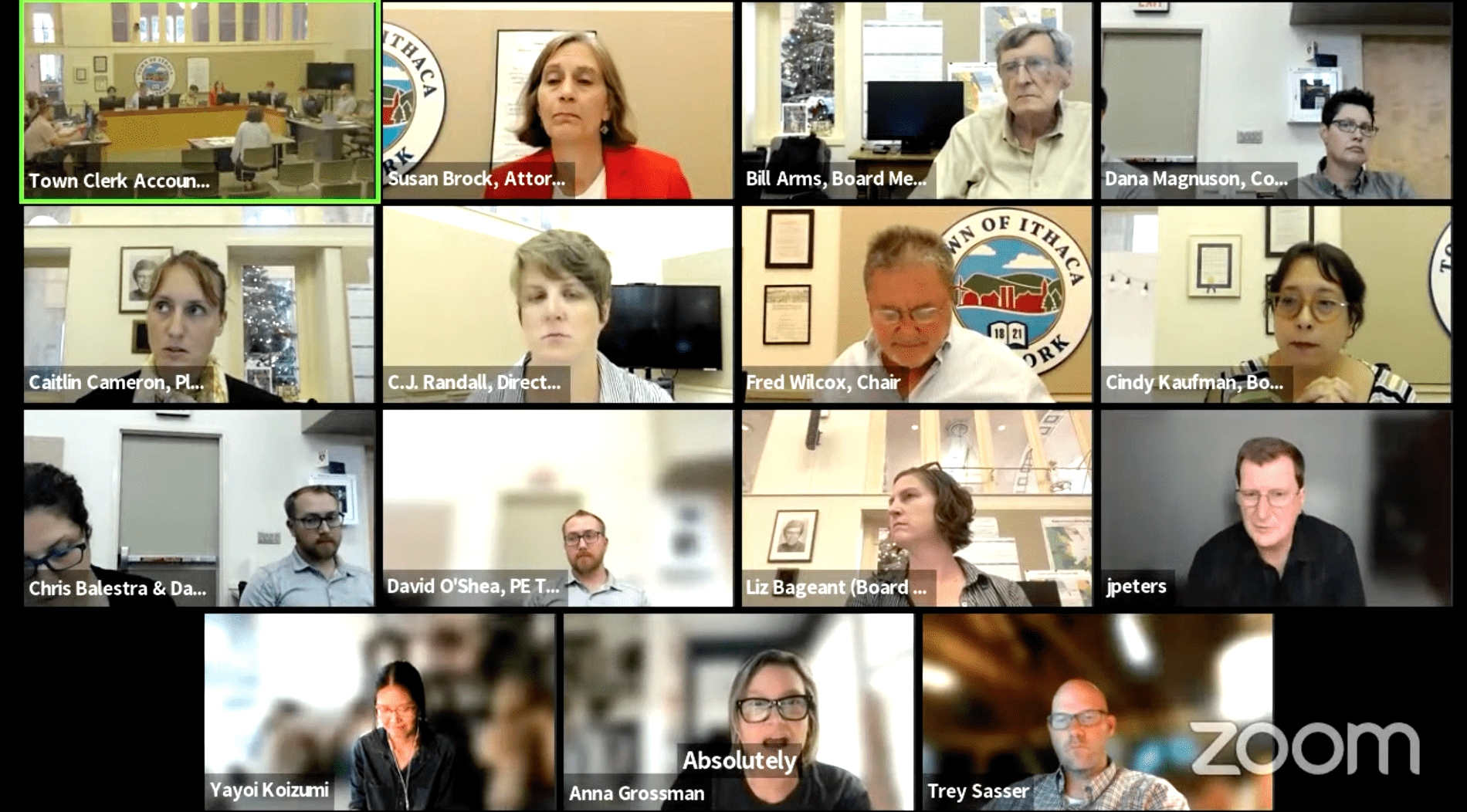
We are alarmed that Cornell’s hired “expertise” constitutes the only source cited in the City Planning Board’s draft environmental assessment form. We are not alone in our concern. At the July 16th Town Planning Board meeting, Board member Bill Arms, Cornell Professor Emeritus, implied that Cornell’s industry consultant “is clearly [a] lobbyist” and said that public commenters who criticize him “are absolutely right,” adding “I’ve not had much respect for the way Cornell’s presented this particular application.” Likewise, former Chair of the Tompkins County Environmental Management Council Brian Eden states, “The Haley & Aldrich information letter is wholly insufficient to serve as the sole basis” for decision-making in this important matter.
Over 80 local environmentalists, academics, and citizens are calling on Cornell to withdraw the H&A research from their application materials and initiate a credible scientific review of the health and environmental impacts of turf. When considering projects that will have irreversible impacts on humans and ecosystems, relying on pro-industry “research” puts the public at risk. Cornell should know this.
bethany ojalehto mays holds a PhD in the psychology of environmental decision-making and served as an Assistant Professor of Human Development at Cornell before leaving to engage in climate action. Peter McDonald is Dean and faculty emeritus of California State University, Fresno, and current Chair of the Sustainable Finger Lakes.
The Signs of Sustainability column is organized by Sustainable Finger Lakes.
Related Articles

Why accessibility is not an option, but a responsibility
TCAT accessibility in Ithaca leaves disabled residents struggling. Community advocacy is essential to improve public transit for all.
World peace – one person at a time
Ithaca peace activism supports nonviolent solutions, nuclear disarmament, and global awareness through weekly corner gatherings.

Signs of Sustainability: Growing trust and resilience in Danby
Danby community resilience grows as neighbors build relationships, share resources, and create supportive local networks.