
Parking perceptions and realities: Experts discuss downtown Ithaca’s parking challenges
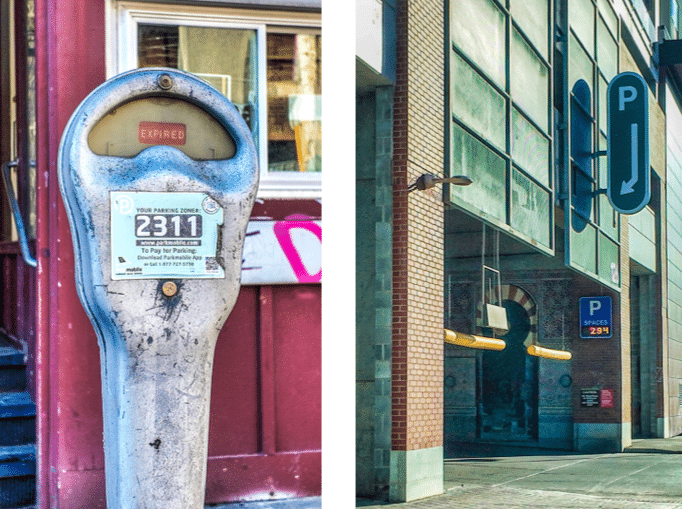
A downtown Ithaca parking meter and the Green Street garage in Ithaca.
Three local experts gave their take on the parking situation in downtown Ithaca at the 2025 Economic Summit at Cinemapolis As one speaker, Nicholas J. Klein, put it, the subject of parking can be “both incredibly mundane and incredibly emotional and fascinating,” and the presentation tapped into how the quirks and emotional proclivities of Ithaca’s residents and visitors are at play every day in the ecosystem of the city’s downtown.

Managing Editor
Klein received his Ph.D. from the Edward J. Bloustein School of Planning and Public Policy at Rutgers University, a master’s degree in urban spatial analytics from the University of Pennsylvania, and a bachelor’s degree in operations research and industrial engineering from Cornell University. His research focuses on understanding the factors that influence how people travel on a daily basis and how these changes play out over the course of their lives.
Tom Knipe, deputy director of economic development for the city of Ithaca, and Yamila Fournier, senior planner with the City of Ithaca Department of Planning and Development, also presented insights from each of their perspectives.
“I’ve been in this role of the city for about seven years and doing economic development,” Knipe said. “And I was surprised, I’ll admit. It’s amazing to me still how many conversations about development, about business retention, attraction, about our perception of the Commons in downtown and Collegetown relate to parking and come back to parking. And so rather than deny that this relationship exists, we’re here today to acknowledge it and hopefully pose some interesting questions, perhaps bust some myths and pose some ideas for where we could go from here and continue this exploration of how we can optimize our parking system for a bunch of community goals, including economic development.”
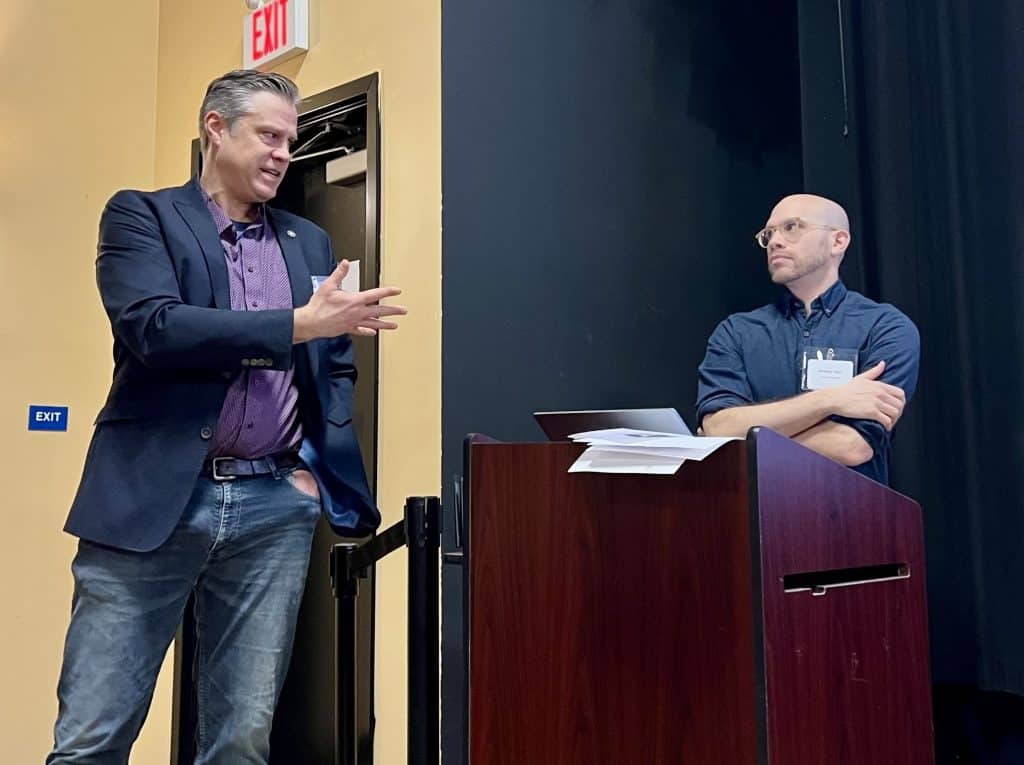
Tom Knipe (left), deputy director of economic development for the city of Ithaca, gives a presentation with Nicholas J. Klein at the 2025 Economic Summit on March 6, hosted at Cinemapolis by Ithaca Area Economic Development and the Tompkins Chamber.
The discussion, held on March 6, focused on parking in downtown Ithaca, and much of it relied on a study that was done in 2019, which was the last thorough parking study that took an inventory of how parking is being utilized. Its pre-COVID-19 pandemic numbers reflect a higher number of people parking downtown than what is thought to be the case today.
In downtown in 2019, there were 4,387 spaces, 55% of them open to the general public. About 25% were on-street and 75% were off-street, in a lot or garage.
Within the on-street spaces, 28% were metered with a two-hour parking limit, and 23% were unrestricted. A little less than half of the off-street space was in the garage.
“While the general perception is that most on-street parking in downtown is two-hour metered parking or unmetered parking, there are actually 13 kinds of on-street regulations in downtown Ithaca,” Knipe said.
The time limitations on parking on the street are there to help ensure that the spaces turn over frequently for the use by customers of downtown restaurants and retail, he explained. Most of these spaces are on the edge of the Commons and a few adjacent blocks.
Twenty-four-hour spaces are mostly located further from the Commons in the proximity of the residential buildings. Within the 1,436 off-street spaces, 43% of the total off-street spaces were open to the public, including some spaces that were shared with hotel guests. Most of the remaining off-street spaces are either private or restricted to employees, business owners, and residents.
There are about 17 types of off-street parking regulations available. There are some private parking spaces that require permits to park, but these are not administered by the city. Most of them are controlled by local hotels.
Permit parking is also available when permits are issued by the city in the Seneca Street garage and Green Street garage.
“Let’s look at utilization or occupancy. This is where I think it gets a little interesting,” Knipe said. “Overall, in all those 4,000-plus spaces, there was a 64% weekday peak utilization rate, and that occurred at noon.” This rate dropped significantly during the evening hours to around 33% around 7 p.m.
“I consider 2019 peak parking, if you will, because we were bustling at that time, and it was pre-pandemic, and all the employees were still in their office,” Knipe said.
The peak utilization rate for the weekends was 40%. “Whereas on-street unmetered parking spaces have higher occupancy during the morning, early afternoon hours when one has to pay for meter parking,” Knipe said. “So people are responding to pricing by trying to park for free.”
Within the parking world, 85% is considered an optimal occupancy rate. “Why is it optimal?” Knipe asked the audience. “Because at 85%, someone looking for parking can find it.”
“At 85%, we’re also seeing high utilization, meaning the owner of the parking is monetizing or using that asset for his whole thing,” he added.
On the weekends, there’s about 514 meter on-street parking spaces within downtown, and peak utilization of on-street meter parking occurs at around 7 p.m., which is 66%.
“Otherwise, it’s about 45% to 50% throughout the day,” Knipe said.
Upon reviewing the data and thinking about the relationship between parking and economic development, Knipe said that the first big conclusion that jumped out at him was that there is a substantial amount of parking downtown, and it is generally not at capacity.
“Second, I’m reminded that the city’s investment in garages is a choice that we’ve made to ensure that we can attract and retain employers and promote dense, walkable development downtown,” Knipe said. “This has important dividends in terms of increasing the tax base, housing, and commercial space downtown.”
Third, he added, is that data from the 2019 study appear to show that people generally prefer on-street parking, even though it’s more expensive.
“That’s interesting,” he said, “And what it leads me to ask is, are there things we can do to promote garage parking to better balance supply and demand amongst the parking type?”
The 2019 parking study did not address user experience, he pointed out. “Moving forward, what can we learn from smart parking technologies or best management practices for improving the user experience?”“Decisions about investing in garages are lumpy,” Knipe said. “We do them once in every 30 to 50 years, unless we’re trying to limp along the Seneca Garage and decide what to do to keep that going, which we’re doing now … These decisions should be informed by the best possible data and analysis. We have a good baseline here from the 2019 study that can be updated to inform future decisions, such as about the future of the Seneca Garage.”
Yamila Fournier, the city of Ithaca senior planner, said that her job entails looking at the city’s long-term planning process, which includes communication with the public, surveys and working with an advisory committee to bring information together that can inform what Ithaca as a community “would really like to see in the future.”
Plan Ithaca, which was developed in 2015, states that the city manage its parking supply to enhance vitality, she said. It also prioritizes alternative transportation such as biking and walking, which mitigate the need for parking.
Part of figuring out the parking puzzle is determining how it can be cost-neutral to the city.
“We know building a garage is incredibly expensive,” Fournier said. “If you want to go on a per-spot basis, there’s no way it’s cost-neutral … That one spot might cost us $80,000 per spot to build, but over the course of 30 years, what does it mean to our tax base and stuff? So that’s a hard number to reach. But I will guarantee you, building it is not cost-neutral.”
Innovative technology can be used to the city’s advantage, she said, adding that data is very important.
“The better data that we have and the more responsive we can be to how people want to park, the better our parking will be managed,” said Fournier. “And we’ve done some of that with the advent of ParkMobile, we’re able to set times and set prices in a different way. We haven’t done a lot with changing times or changing the cost of parking on the street, but we certainly are at a point where we could begin to use that data to adjust what we need to do.”
ParkMobile is a free app that drivers can use to find parking, pay to park and extend a parking session, all from their smartphone, eliminating the need to stand at a street meter or parking kiosk. Some meters are marked with a green ParkMobile sticker.
In the city’s 2024 downtown plan, the city tripled the number of recommendations about parking.
“They all speak to the idea that we really need to take the pressure off parking by making it easier to be a pedestrian,” Fournier said. “Easier for you to take a bus, easier to take your bike downtown, or use any of our multimodal ways to get around … how do we increase that safety for folks so that we do get more people walking around?”
Through the city’s studies, Fournier said, it was found that it is most important for residents that downtown feel “vibrant.”
“They’re all about having a bustling, busy downtown with lots of supportive retail,” she said.
Secondly, they would like to see more pedestrian and bicycling amenities, which might mean transforming some of the parking areas.
“We could have a very wide sidewalk with a gorgeous cafe if we just had a little less space for parking,” she said as an example.
But, she said, there is the push and pull between business owners, who believe accessible parking is key, and the initiatives that might transform some of that parking for other uses. “There’s a little bit of a fear that, well, if we don’t have good parking, how do people get to us?” Fournier said.
Klein, who is a professor of research consultation at Cornell University, said that in his 15 years of studying parking he has found that it becomes more and more complex. “It ties into so much of what we do in our lives and how we build cities,” he said. “And yet we often just ignore it.”
In most cases, we do not need as much parking as we have available to us, Klein said. In Des Moines, for example, there are about 20 parking spaces for every household.
“I don’t think every household has 20 cars, but that’s a lot,” he said, adding that a surplus of parking can be found in many American cities and towns across the United States. In Kansas City, for example, 29% of the central area is covered by parking.
One myth about parking: there is not actually a scientific method for determining how many parking spots should be allotted for any specific type of business.
Many municipalities rely on the Institute of Transportation Engineers Parking Generation Manual. It lists different rates of parking you should provide based on business type and is very specific, with the most recent edition providing a recommendation rate for marijuana dispensaries.
The studies done by the institute are often “terrible,” Klein said. “They’re done on a handful of observations,” and they’re all done in suburban environments where no one could really get around without driving.
“They’re often absolute garbage, and they don’t apply to places like downtown Ithaca, and yet we are often applying them,” Klein said. “And planners often set their standards higher than these because they think, ‘we don’t want to piss people off. We want to make sure there’s enough parking.’”
But in places where there are no minimum parking standards for businesses, it all seems to work itself out, Klein said.
In the case of Collegetown, where parking minimums have been eliminated (they were removed in the downtown Ithaca overlay zone as well), “the sky has not fallen,” Klein said. In fact, he said, one of his students looked into how much parking would have been provided for all the new development between 2014 and 2020 versus how much was actually created.
Under the previous regulations, Klein said, Collegetown’s developers would have had to create 412 new parking spaces to accommodate new residential development. In actuality, with no regulations, only 25 spaces were created.
“What happens,” said Klein, “is that people decide not to bring their cars, or they go and use garages that are already there that are under capacity.”
One of the major takeaways from the presentation was that parking is emotional, and that the perception that there is a lack of parking available downtown does not match the actual data.
“I think people overestimate how much time they search,” Klein said. “People think that it took them a really long time … five or 10 minutes looking for parking, but in actuality, it’s like three minutes, and they didn’t go that far. But again, at the time when we’re already at our destination, it feels much longer than it is. Which is understandable.”
Author

Related Articles
Cayuga Medical Center nurses’ vote for unionization approaches
The Cayuga Medical Center nurses union vote approaches as nurses cite workplace concerns, leadership changes, and national labor issues.

Holiday traditions bring community cheer
Tompkins County holiday traditions light up homes, farms, and schools with festive cheer and community spirit.