
Pilot led by New Roots supports green work
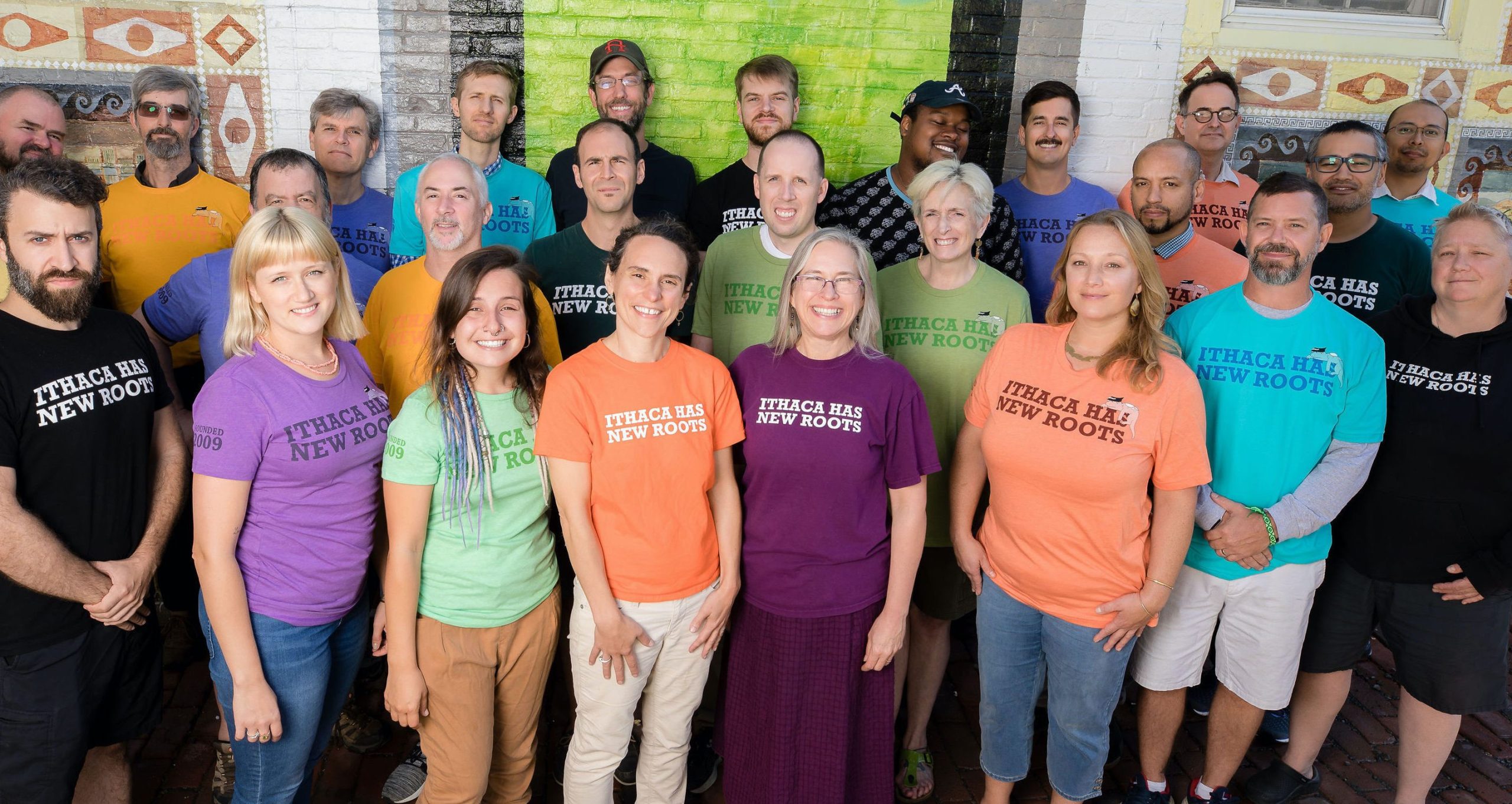
Juniors and seniors at New Roots Charter School in Ithaca are piloting Roots of Success, the city’s green workforce development program, this spring, according to a recent press release. Participating students will receive Environmental Literacy certification from the U.S. Department of Labor, which the release said “will be recognized by local employers benefitting from the city of Ithaca’s electrification initiative.”
New Roots founder and Superintendent Tina Nilsen-Hodges said that despite the similarity in name, Roots of Success wasn’t founded by New Roots. Instead, Roots of Success (rootsofsuccess.org/about-us/) was created by Dr. Raquel Pinderhughes, professor of urban studies and planning at San Francisco State University and “an internationally recognized expert on the green economy and green workforce training,” she said.
“The curriculum is informed by Raquel’s decades of experience working with and teaching underserved populations and in-depth research with employers in 21 sectors of the green economy,” Nilsen-Hodges said in an email. “What the two organizations do have in common is that they were both founded in 2009, and both founders were finalists for a Best of Green Schools Award in 2021 for their organization’s contributions to the Green Schools movement!”
Michael Mazza, director of community engagement at New Roots, added that the City of Ithaca has brought on Pinderhughes as a paid consultant for a year to “support a successful launch of the program citywide.”
“Lisa Marshall, program director of HeatSmart Tompkins, has also been trained to teach New Roots students the Roots of Success curriculum,” he said in an email. “All is made possible through the generous funding support from the Park Foundation.”
As Nilsen-Hodges explained, Roots of Success is a response to the need for living-wage jobs and career pathways in poverty-stricken areas and meant as a way to promote sustainable development.
“They do this by strengthening core academic skills, increasing people’s understanding of environmental problems and solutions, preparing them for jobs and career pathways in multiple sectors of the economy and to improve conditions in their communities,” she said. “Their focus is on student success, making learning relevant, building on prior experiences and connecting education to employment.”
The green economy is one of the fastest growing economic sectors, Nilsen-Hodges said, providing workers, even in entry-level jobs, with “higher wages, better benefits and greater occupational mobility than entry-level jobs in other sectors.” The Roots of Success model is used by high schools, youth programs, colleges and job training programs throughout the country.
As far as how New Roots got involved, Nilsen-Hodges explained that the charter school is a member of a “new regional green workforce development ecosystem that the city of Ithaca is leading in our region.”
“Along with partners such as Tompkins Cortland Community College, New Roots will open up pathways for young people to bring their unique gifts and passions to the growing green economy in our region,” she said. “Integrating sustainability knowledge and skills throughout all four years of curriculum since 2009, the city of Ithaca recognized New Roots Charter School as uniquely positioned to provide the extensive soft skill development needed for the transition to a more sustainable infrastructure and community practices in our region.”
Luis Aguirres-Torres, director of sustainability for the city of Ithaca, shared his support for the program and New Roots’ efforts.
“Our partnership with New Roots Charter School is of great importance for the city of Ithaca if we are to achieve our goals,” he said in a letter. “Its current emphasis on sustainability and environmental literacy, as well as on career and technical education, training through coursework, internships and apprenticeship programs create the necessary career pathway for high school students wanting to pursue a college degree or wanting to join the workforce and obtain meaningful and fairly compensated employment.”
New Roots is piloting Roots of Success as part of its Career and College Success curriculum, Nilsen-Hodges said, which is a four-year required course sequence at the school that “supports students in exploring how their talents and passions align with employment opportunities and college programs, supporting them in creating a path towards making their goals a reality.”
The Department of Labor’s Environmental Literacy certification will be awarded upon completion of the 60-hour Roots of Success course, Nilsen-Hodges said.
“Students need to demonstrate proficiency of the skills and concepts they learned in each module to receive the endorsement for that topic,” she said. “The curriculum supports development of comprehensive understanding of how more sustainable systems for providing essential human services work, giving certificate holders the knowledge and skills necessary to contribute to employer’s sustainability initiatives. This certification will provide local employers with the assurance that New Roots students can add value to their organization in this area.”
As Nilsen-Hodges and Mazza both attested, Roots of Success is very much in line with New Roots’ usual commitment to supporting green energy education and related efforts.
“As part of Tompkins Cortland Community College’s [TC3] CollegeNow Program, New Roots offers core and elective courses for college credit that can be applied to undergraduate degrees as well as high school requirements,” Nilsen-Hodges said. “We are expanding our offerings in the popular areas of Sustainable Food Systems and Entrepreneurship in 2022-23, in addition to aligning high school courses with TC3’s new applied science and technology degrees, developed in response to the anticipated needs of regional employers.”
Also on the horizon for New Roots is the Cayuga Wetlands Restoration project, with its fourth summer coming up this year. The project was born in 2016 from a collaboration with Sachem (Chief) Samuel George of the Gayogo̱hó꞉nǫʼ and supported by the New York State Department of Environmental Conservation (DEC).
“In response to water quality testing and research about indigenous land and water management practices, students petitioned the City of Ithaca for permission to establish a pilot wetlands site by planting cattail, calamus and arrowhead,” Nilsen-Hodges said. “Subsequent water testing by several science classes at the test site has demonstrated improved water quality due to biofiltering of harmful pollutants, including phosphorus that may lead to harmful algal blooms.”
New Roots is in its 13th year of operation and recently received its fourth charter renewal from the State University of New York, Nilsen-Hodges said. The charter school is also celebrating its recent designation as a Green Ribbon School by the United States Department of Education, as well as a fully in-person school year.
As Mazza explained, there’s a lot to look forward to with what’s left of this academic year.
“The Class of 2022 will be fine-tuning their sustainability capstone projects to present their findings to their peers in June,” he said. “Senior capstone projects at New Roots are an opportunity for students to research, reflect and address a sustainability issue of importance to them in the community, as a culmination of all of their hard work and learning during high school at New Roots. In addition to the capstone projects, we’re looking forward to another outdoor graduation at the Ithaca Children’s Garden from 4:30 [to] 6 p.m. on June 23rd.”
To learn more about New Roots, visit its website at newrootsschool.org.
Jessica Wickham is the managing editor of Tompkins Weekly. Send story ideas to editorial@VizellaMedia.com.
Related Articles

Design details unveiled for new Center of Government
Design details for the Tompkins County government building in downtown Ithaca are now public, with a county survey open for feedback.

Holiday traditions bring community cheer
Tompkins County holiday traditions light up homes, farms, and schools with festive cheer and community spirit.
Cayuga Medical Center improves patient safety score
Cayuga Medical Center Leapfrog Grade rises to “B,” showing improved patient safety and nursing care quality.