
Planned Dollar Generals spark debate over stores’ impact
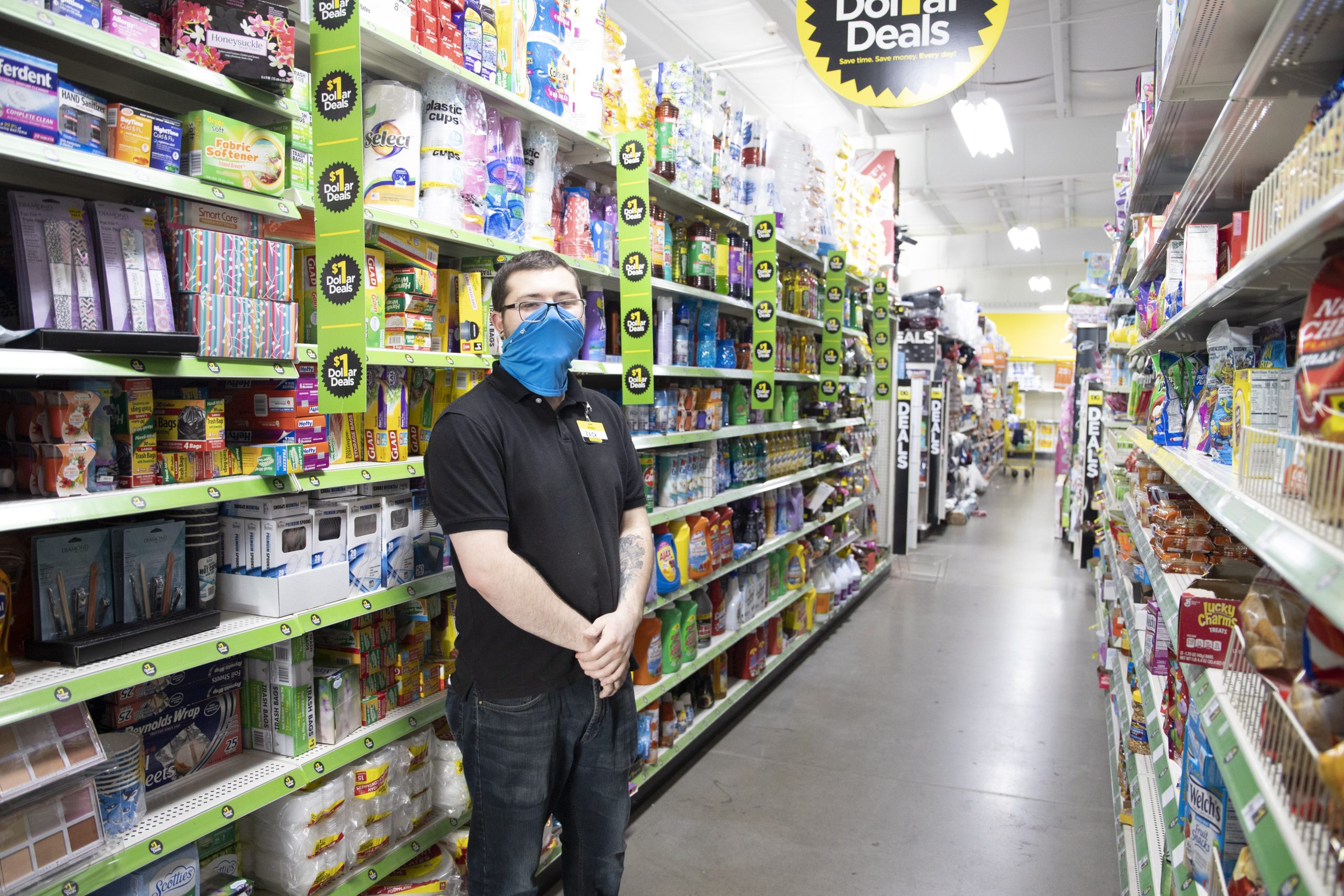
For over a decade, Dollar Generals have been part of several local communities, and additional planned stores have sparked debates over the efficacy of increasing the discount store’s presence in Tompkins County.
While new stores are facing some opposition from residents and leaders, others argue Dollar Generals are an important resource, particularly for underserved communities. With such a wide disparity on the subject, we’re diving into the effects of Dollar Generals past, present and future on the county and how the culture of a community plays into the conversation.
The first local Dollar General arrived in 2004, just over the county line in Covert with a Trumansburg street address, according to Crystal Ghassemi, spokesperson for Dollar General Corporation. Nine years later, another opened in Dryden, and locations opened in Lansing and Enfield just a couple years after. This increase is in line with statewide trends, with the first Dollar General arriving in the state in 2001 and overall numbers currently at 500 throughout New York.
Ghassemi explained the mentality behind the company’s decision to come to the county over 15 years ago.
“When we look at where we put stores, and there’s a lot of different factors that we take into consideration, I think the first foundational one is around being able to serve our customers,” she said. “And for us, that’s giving them the price and value and convenience offerings that our stores provide to residents. And so, when we identify a community that can benefit from the offerings that we have, certainly that’s going to be our core focus.”
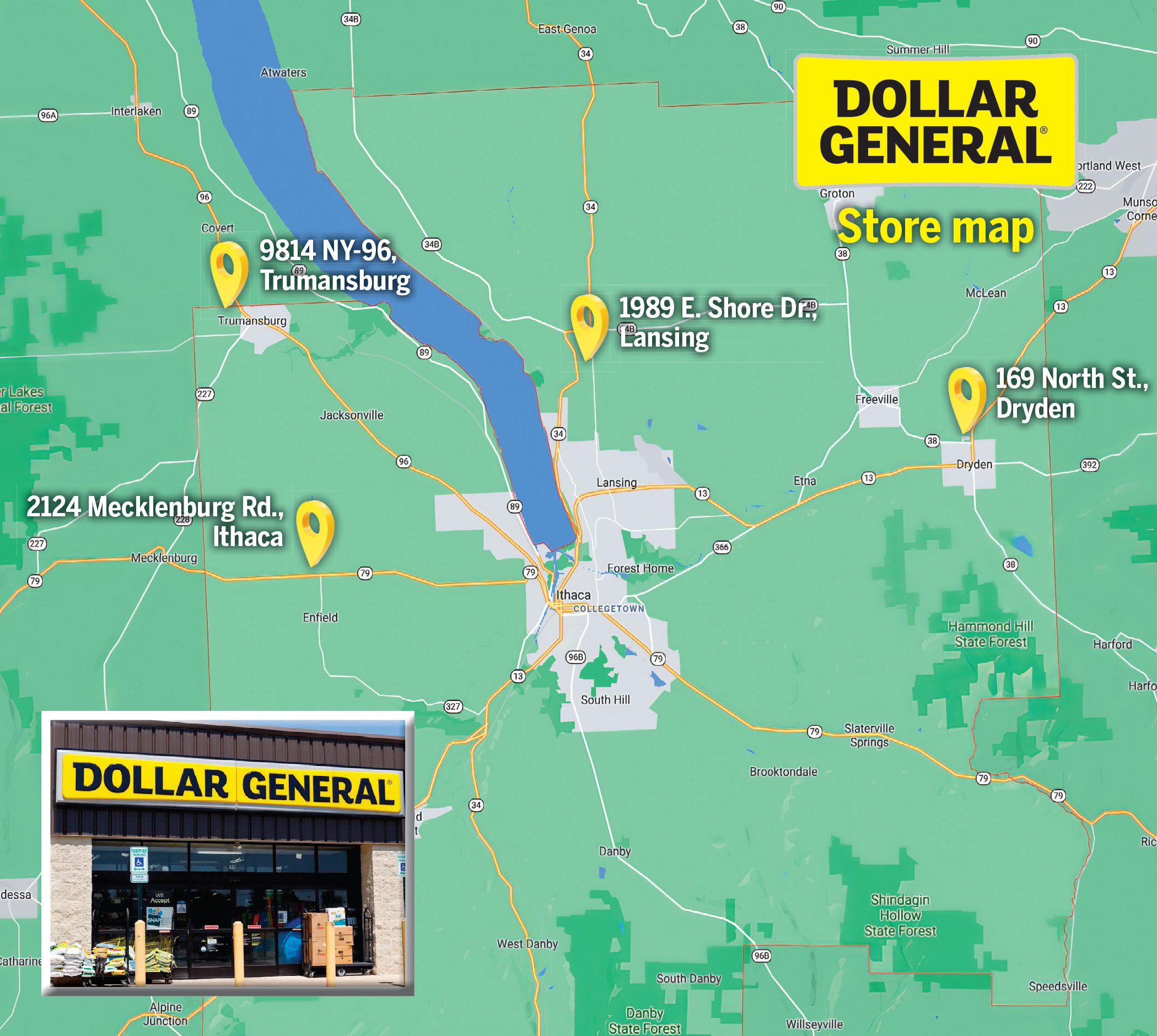
For communities that have had a Dollar General for at least a few years, local leaders largely view them as either a neutral or beneficial resource for the community. In Trumansburg, for example, Mayor Rordan Hart said that he hasn’t heard much local feedback — negative or positive — about the Covert store, but in general, residents seem to appreciate having it as a resource.
“If there was only one store between here and Ithaca, we would have one finite amount of supply,” Hart said. “Having more than one place for that kind of thing is helpful, particularly as you head to the north and towards Interlaken. There’s no retail of that type between here and there. So, it’s … certainly serving the community in providing convenience retail that people need.”
It’s a similar story for the current store in Dryden, as Town Supervisor Jason Leifer explained.
“The people against them say that they prey on poor communities or neighborhoods,” Leifer said. “Then, there are people who talk about, well, we need them because they sell things other places don’t. I haven’t seen any negative [in Dryden].”
In Enfield, Town Supervisor Beth McGee shared Hart’s sentiment that the Dollar General in her area serves residents who wouldn’t have as easy of access to food and other supplies if the store weren’t there.
“Enfield has not been served by a store except for a gas station or convenience store in the past,” McGee said. “I think that it serves Enfield well and makes [residents] feel less isolated, especially families that … either use public transportation or don’t have a vehicle to access these things.”
McGee expanded, adding that Dollar Generals in several communities are built in low-income areas where discount options are favorable.
“[In Dryden,] that’s just a nice little safe drive for people who live in the senior housing just across from the school,” she said. “The one in Trumansburg, there’s a mobile home park just around the corner and affordable housing just around the corner from their Dollar General. So, I do think that they choose areas that are going to serve underserved or unserved communities.”
Local leaders also said that during COVID-19, Dollar Generals have been a good source for essentials like toilet paper. Ghassemi echoed that sentiment.
“The critical role that our stores have, specifically around COVID, has really been highlighted, to be able to provide not only an open store for folks to be able to get the essential items that they need, but then certainly, an easier kind of in-and-out shopping experience,” she said. “We’ve certainly seen where customers are looking to us to not only help stretch their budgets, but also, from the dependability standpoint, of having the products that they need when they need it.”
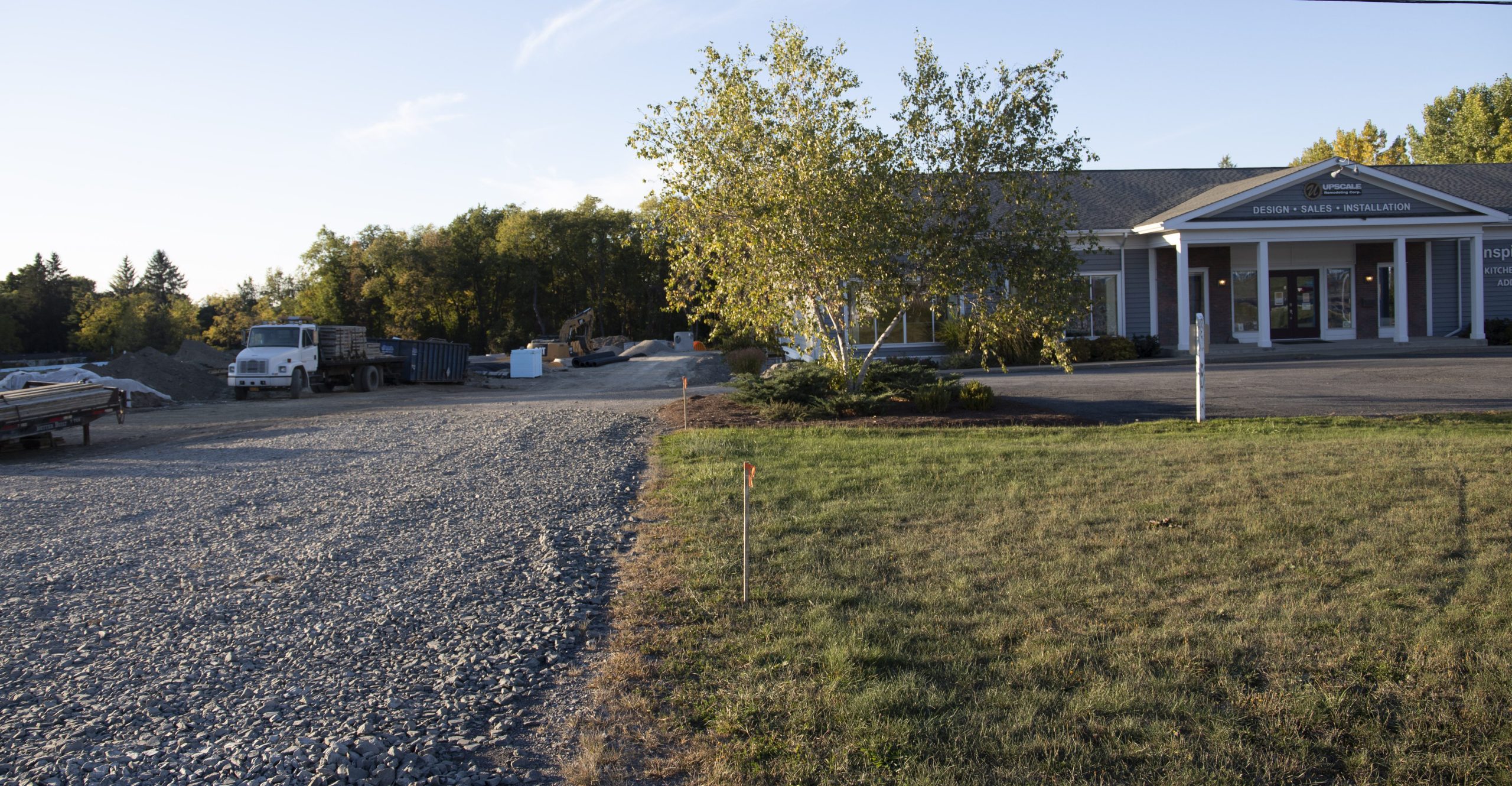
The trend of increasing Dollar Generals in the area is set to continue over the coming years. Another location is under construction in Dryden (Freeville address) and is set to be completed by the end of the year.
Another store is in the “due diligence” phase in Groton, meaning Dollar General is interested in adding a store there but hasn’t completely committed to the project, Ghassemi said. Another store is being considered for either Lansing or Ithaca, and another is planned for Caroline.
These new stores are where a lot of the opposition comes in, the loudest arguably from Caroline. The town passed a moratorium June 10 on land use development for 180 days, effectively pausing the development and construction of a new Dollar General in the area.
While the moratorium isn’t specifically against Dollar General, Town Supervisor Mark Witmer explained that the proposal brought the need for a moratorium on land use developments to local leaders’ attention.
“The moratorium was not a moratorium imposed on a particular project,” Witmer said. “It was a moratorium imposed because a comprehensive plan that the town was updating for the last six years was near completion, and so, we did our due diligence, we felt, to impose a moratorium so that any developments going forward would be consistent with that.”
A similar sentiment was expressed for the one coming to Dryden at 1410 Dryden Rd. toward Freeville. Leifer said that while the store doesn’t directly clash with Dryden’s overall culture, the new location does appear to be significantly out of the way for many residents.
“I really don’t even know if it’ll succeed because there’s nothing else over there,” he said. “Where they’re talking about putting it, there’s no other real retail. They are literally just hoping people pull in there.”
The idea of a Dollar General being inconsistent with the overall culture and character of a community isn’t unique to Caroline. As town of Lansing Conservation Advisory Council member Karen Edelstein explained, the Dollar General in Lansing faced considerable opposition when first planned, and that has stayed consistent over the past few years. Edelstein described some of the local feedback she’s heard.
“‘This is a scenic byway’ and ‘what an inappropriate business to put on the scenic byway because it reflects nothing about the rural and scenic character of Lansing,’” she said. “I’ve heard that, and I agree with that.”
And for the one possibly coming to Lansing, several local families voiced their opposition to the project in a recent letter to the Lansing Town Board.
“The proposed location is not within a business district; it is an area intended for agricultural use,” the letter said. “Although general retail is a permitted use, it is not in the best interest of the community to perpetuate sprawl of such formula driven retailers beyond distinctly defined business areas.”
Witmer expressed a similar mentality for Caroline.
“I’m concerned about sprawl along our arterial corridors,” Witmer said. “It is proposed in a piece of land that presently is just an open field. There is no other commercial development right there. Both our 2006 and this comprehensive plan explicitly mentioned the desire to focus development within the hamlet of the town to preserve open space, so that’s my real concern.”
Dan Hooker, senior lecturer at Cornell University’s SC Johnson College of Business, has considerable experience in retail and Dollar Generals in particular. Hooker added that, despite the discount store’s intentions, Dollar Generals are lacking in many fresh foods, which can have a detrimental effect when it’s a resident’s only source of groceries.
“Consumers, in general, if you don’t have the accessibility to fresh fruits and vegetables, and ‘healthier foods,’ … because that’s your only alternative, you have less income to spend on it, you tend to buy the lower-quality foods,” he said. “So, I think that overall, [it] probably does have some implications for the overall health of the people in the community.”
Edelstein shared that sentiment, adding that the store also disadvantages local food sources that provide healthy foods for customers.
“That’s their business model, to get people to come to their cheap convenience store rather than going to the local, more nutritionally balanced, food suppliers like the Lansing Market, which is a locally owned business that is much more oriented towards providing well-rounded food offerings than the fast food,” she said.
That concern is echoed by the Institute for Local Self-Reliance (ILSR), a national nonprofit, as well as county officials. City of Ithaca Deputy Director for Economic Development Thomas Knipe explained.
“Generally speaking, national chain stores like Dollar General source less locally, so there is less circulation of money in the local economy than with an independent, locally owned business,” Knipe said. “That’s part of the reason why ‘buy local’ matters from an economic development standpoint.”
Opposition to Dollar Generals follows three main mentalities: They don’t fit in with the culture of the town, they are a threat to local food sources and they don’t provide essential, healthy food for the communities they serve.
To these arguments, Ghassemi said that there is little evidence to suggest that Dollar Generals disadvantage local food sources, and the company works with nutritionists to provide healthy options at each store.
“Recent industry data indicates that the actual grocery industry is not growing in any type of meaningful way. And that’s certainly irrespective of dollar stores,” she said. “The ‘unhealthy’ items that ISLR criticizes us for carrying are widely available at grocery stores, drugstores, convenience stores, fast food restaurants across the country. It indicates consumer choice.”
For those concerned about Dollar Generals, most said that, because there is little local governments can do to block a Dollar General from coming to the area, emphasizing and increasing local and/or healthier food sources can help mitigate the negative effects previously discussed.
“It’d be interesting to see some type of … public-private partnership that would provide incentive for both the employees of a Dollar General and the consumers who shopped there that would give some incentive for consumers and employees to buy healthier foods and then add things like fresh fruits and fresh vegetables and other products that would be healthier,” Hooker said. “That would be nice to see.”
Overall, the effects of current and future Dollar Generals vary depending on the location, culture and population of the area where it is or is being built. Leifer said that the effects of future developments, particularly in Dryden, are difficult to predict.
“These companies that come in, they are only going to build where they think they have a market, and whether they’re right or wrong, you don’t know until it’s built, really,” he said. “It’s hard to even quantify how it would actually affect the town.”
Hart summed it up best.
“If there’s enough population that would be served by each new store, then I think it’s good because we’re serving that population with goods and materials that they want and need,” Hart said. “On the other hand, if it turns out that we don’t have the demand to satisfy this new supply, then I think that could potentially be problematic if we end up with, five years from now, empty storefronts.”
Related Articles
Street Beat: What are you looking forward to in the new year?
We asked five random people. Here’s what they had to say.

5 things to do in Tompkins County this weekend
Plan your visit and discover what’s happening this weekend.