
Plans for Rhize Up Community Farm progressing in Danby
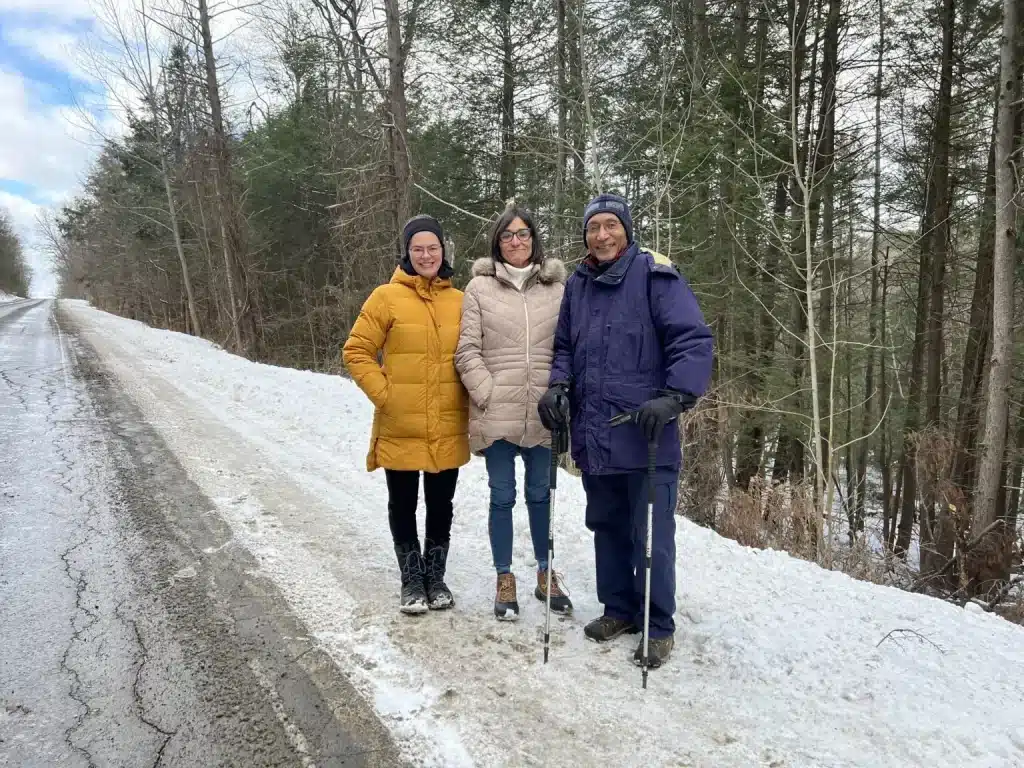
Driving by the unassuming 14-acre plot of land on Hornbrook Road where Khuba International plans to build Rhize Up Community Farm, one would probably not envision it the ideal location for four homes and a community building. There are wetlands and a stream. The terrain is forested and uneven, dropping down from the side of the road, then rising up from the streambank on the other side. But Black-led non-profit organization Khuba International saw potential.

The plan, a vision of Khuba International Founder Christa Núñez, is to develop four homes and a communal gathering, kitchen and meal place.
Each of the four dwellings will be 1,200 square feet and modeled after West African building and design concepts.
With this project, Khuba International is committed to creating a sustainable community of the future for people of color, said Asya Ollis, Khuba International program manager.
“In attending to the work of refining our inner selves, we can create peaceful, loving environments where we all can thrive together,” Ollis said. “We commit to this and welcome healthy, positive collaboration in the achievement of our collective goals.”
The land was purchased by Khuba International for $30,000, which was donated to the nonprofit by Jerry Greenfield of Ben & Jerry’s ice cream.
“The concept definitely came first,” Núñez said. “[The idea] of people being able to come out of cities and come back to the land we had for a long time, but the idea of purchasing a piece of land and developing a cooperative, and all the specifics of it, came to me more right around COVID. I was reading articles about people living in cities and seeing that they were perishing at faster rates because they were forced back to work or couldn’t socially distance. There was a high death toll in cities around COVID, and it became urgent for me that we provide new ways for people to live.”
Eventually there will be a formal application and vetting process for the selection of the four families who will live in the houses. In recent months, Khuba International’s focus has been on securing the necessary town approvals to build the five structures, an ongoing process with the Town of Danby Planning Board.
The original plan was to construct a bridge over the wetland, but a study of the land revealed that there was additional wetland on the property in addition to the previously designated wetland area.
“It uncovered the fact that there was wetland up front, so we discovered we have to navigate past that area,” Núñez said, adding that the group will be creating a narrow passageway without any buildings and then crossing the property’s creek in a noninvasive way, all while following recommendations about how to do that without disturbing any plant or animal species.
An LED certified architect and environmental conservation volunteers will help Rhize Up take an ecological approach to accessing the back portion of the land, which includes the installation of a culvert, Núñez said.
“That front section is unbuildable,” she explained. She said that as long as the group’s only disturbance to the area is to develop a driveway and a culvert, the project will not require a special permit because it will create less than a tenth of an acre of disturbance.
“That would navigate us past the wetland area into the buildable part of the land,” Núñez said.
“It’s a really beautiful, heavily wooded site that we want to preserve,” Núñez added. “We are a group intent on the preservation of woodland and forests, and we are comprised of members of the Gayogo̱hó꞉nǫɁ tribe, who are indigenous to Ithaca, and they really love this site.
Michelle Seneca, outreach and engagement lead for the Gayogo̱hó꞉nǫɁ Learning Project, said she became involved through her husband, Stephen Henhawk, who is language and culture lead for the Gayogo̱hó꞉nǫɁ Learning Project and a research associate at Cornell University. . “She brought us on board with the Rhize Up Project, and we have been involved with this since,” said Seneca, who grew up on the Seneca Cattaraugus reservation in Western New York and lived for a number of years in the Gayogo̱hó:nǫˀ community at the north end of Cayuga Lake. Since moving off the reservation in recent years, she had to rebuild her sense of community.
“There was no diversity on the reservation,” Seneca said. “I want to go back and show my family, my children … What I’m learning from being in this organization is that it’s not just us [Native Americans]. It’s different people who experience the same barriers, just in a different lens, and now I’m overcoming these barriers, meeting challenges and being resilient and having fun.”
Jay Smith met Núñez when they worked together on a farm training program for people of color.
“She’s a visionary,” Smith said. “I kind of aligned with her, and she invited me to become part of the project.”
“Part of this project is to create intentional communities that people of color are interested in building,” Smith said. “Climate change gets a lot of the headlines today, but there are an array of ecological challenges—loss of diversity, loss of land, loss of water—when you think those things through, the only way we’re ever going to solve them is for people to collaborate across ethnic and all kinds of divisions, so it’s exciting to me that at least we are trying to bring that message forward in the implementation of this project.”
As the site changed hands through multiple owners throughout the years, it remained undeveloped. Now, Núñez said, Khuba International would like to ensure that is preserved for people to live with harmony in nature, “that people can actually live in nature and children be able to play in nature,” she said, adding that the land is now mainly used by neighbors for hunting.
“We want to provide access to people who want to do other nature-oriented activities,” Núñez said. “We are not clear cutting; we’re just planning for activities amongst the trees—just a mindful, small scale housing development in the landscape.”
Núñez said that part of the reason she wanted to locate the project in Ithaca was the area’s strong public school system.
She envisions the residents of Rhize Up supporting the community through environmentally friendly endeavors such as high-end mushroom growing, small-scale fiber operations with a small flock of sheep, and agritourism programs.
After all of the planning and approval processes, Núñez said she is excited that the project is finally gaining traction.
“We’re finally getting somewhere,” she said.
Author
Related Articles
AmeriCU proudly connects students with annual scholarship opportunity
AmeriCU scholarship program awards $1,000 to students pursuing college or vocational education. Applications are open through March 15.
Street Beat: What’s one of the best holiday gifts you ever received?
We asked five random people. Here’s what they had to say.
5 things to do in Tompkins County this weekend
Plan your visit and discover what’s happening this weekend.