
Police and local agencies aim to curb crime at Asteri apartments
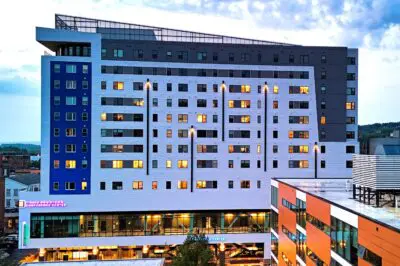
Asteri Ithaca, a new downtown apartment building with supportive housing units that residents moved into this past summer, has been seeing a high volume of crime. Since the residents were first moved in last June, there have been 492 police calls to the building.

For comparison, the properties highest on the Ithaca Police Department’s list of response locations are the police department itself, with 962 calls so far in 2024, West Village Apartments, with 612 calls, and Ithaca Arthaus, with 317, according to the police department’s Community Dashboard website.
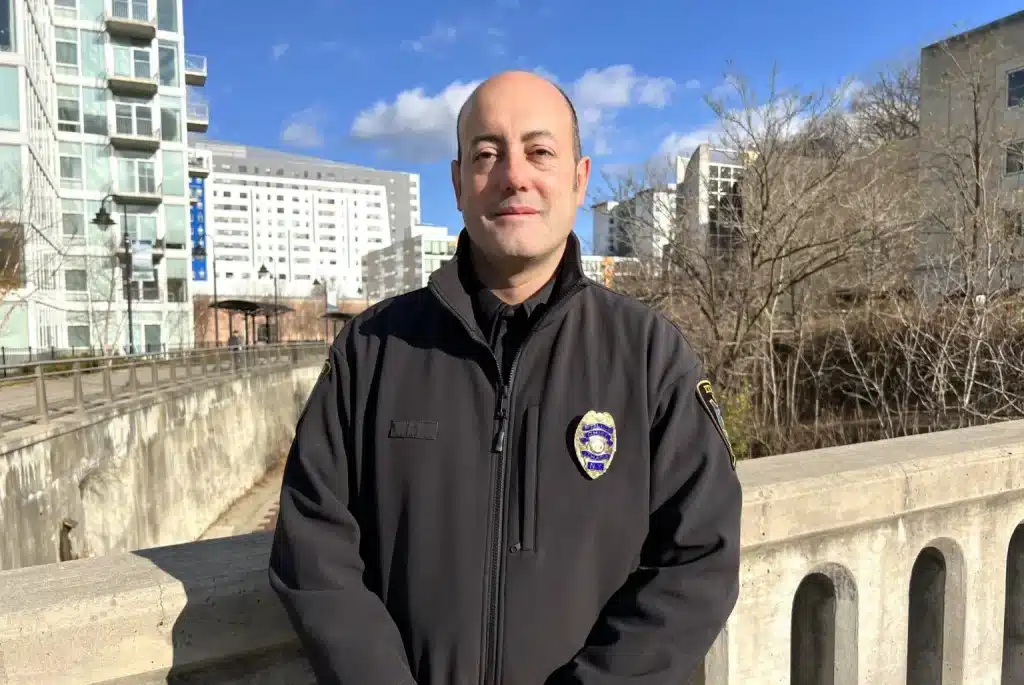
An increase in security and police surveillance, as well as continued communication among local support agencies, appears to be improving the situation, but police and others involved in the efforts to keep residents safe are still wondering if the progress will continue.
“We do respond there quite a bit, for a number of issues related to everything from basic housing needs to crime to domestic altercations and trespass,” said Ithaca Police Chief Thomas J. Kelly. “We respond to [Asteri] sometimes three, four, five times a day.”
Asteri is located at 118 E. Green St. The apartments are on the fourth to 12th floor, above the newly opened Ithaca Downtown Conference Center. In total, 181 of the building’s apartments are classified as “affordable housing units.”
Forty apartments are supportive housing for people who have had difficulties maintaining housing, most of whom were recently living unhoused.
“It really is an abuse of the city resources,” the chief said. “In building that project, and the types of housing that are provided, we know from experience that there’s going to be an increased need of support for a vulnerable population that needs assistance. A number of them are moved in there from the street, and they have to build resources in there to support them.”
The occupants of Asteri moved in as part of an effort termed the Ithaca “housing surge,” which took place this past summer. Many of them came from the homeless encampments near Walmart, often referred to as The Jungle.
“I could see a lot of the issues in that process and how those people who were part of that surge could have been supported better,” said Deb Wilke, Homeless Crisis Alleviation Coordinator with Second Wind Cottages, a cluster of homes in Newfield that provides housing for homeless people.
Wilke assisted in the efforts to help unhoused individuals transition to life at Asteri, in their new apartments. Outside of her work at Second Wind, Wilke works collaboratively with local organizations, community members and social service agencies to assist in coordinating services and building a bridge to safe, permanent housing.
Wilke said she identified several serious issues. Broken locks on Asteri’s main doors have gone unfixed for long periods of time, allowing people to walk in off the street, she said. “When [the building] opened there were no security cameras,” she said. “People knew that was the case, and that breeds problems.”
New magnetic locks were recently installed on the front doors, according to Heather Bradley-Geary, director of supportive housing for Vecino Group, the for-profit development company that owns and manages Asteri. “Those seem to be working really well,” she said.
In addition to the broken locks, Wilke said agencies that aim to serve the residents of Asteri are not set up for success.
“They intend to help,” she said. “They want to help. But there is no consequence if someone chooses not to engage with the supports available.” Therefore, once a tenant moves into one of the supportive housing units, they are not obligated to interact with the support system offered to them.
This is in contrast to Second Wind, where residents must uphold their end of a specially designed program to remain living there, Wilke added.
Kelly said people often have difficulty transitioning to housing after spending time unhoused due to mental health and substance abuse issues, “and we need to provide enough services to help people work through those. Police have a role in providing assistance to a certain level, but a lot of the things we’re talking about are beyond the scope of law enforcement. There are better ways to assist people.”
Vecino Group also owns the Ithaca apartment building Ithaca Arthaus, which has supportive housing units as well.
Vecino currently has supportive housing to end homelessness in 28 locations in 10 states throughout the country. Vecino’s housing is “dedicated to the folks that are identified as maybe the hardest to house, and folks that other property management companies choose not to house,” Bradley-Geary said, “so we make a conscious decision to house people because we believe housing is a human right.”
Bradley-Geary said Vecino is learning from every property they open but that a spike in crime in the initial days and months when residents are getting settled is normal at Vecino’s properties.
When a building first opens to serve individuals with “severe, persistent mental illness or an active addiction,” Bradley-Geary said that “some of the police calls are a little higher as they are getting used to permanent housing.”
“Of course we never want it to be super high for our police force, so we’re working with them to reduce those calls … But for the type of housing that we’re doing, especially during that first year, [police response] does tend to be a little bit higher,” she added.
As police chief, Kelly said he has witnessed a learning curve among the Ithaca community. “From Arthaus and a number of housing initiatives, Ithaca has learned from this process that support is essential for this to succeed,” Kelly said. “There is a population that is also being victimized from outsiders — people who don’t live in the building — because of the lack of resources available in Asteri.”
There have been “a number of staffing struggles” at Asteri, Kelly said, and police are working with different outreach groups to support the building’s residents and to “try to take a little bit more preventative approach.”
The security has improved recently, said the police chief. There is staff managing the traffic in and out of the building, and an employee providing guardianship, not just during the day but throughout the night, as well.
There is currently security at night from 5 p.m. to 5 a.m., according to Bradley-Geary.
“But,” Kelly said, “ultimately, the building needs more security overall.”
The chief said that the police department has proactive patrols to try to mitigate the situation.
“We stop there on a regular basis,” he said. “We walk the stairwells and the halls. It’s something we do because of the call volume and the types of calls that we’re getting. It’s a deterrence for some of the criminal activity that has been taking place.”
Several of the calls responded to by police have involved property damage, such as holes in the walls or damage to the doors.
“We think that it’s not the residents,” Kelly said. “I’m sure there’s some overlap, but a lot of the issues have not been residents.”
Many of the problems stem from visitors, and having a large group of unhoused people move into one location all at once creates a unique situation wherein residents, in an effort to help, frequently allow their friends to stay at their apartment. According to Wilke, this can create an awkward dynamic that can be tough to remedy, as guests cannot be asked to leave unless the tenant requests that the unwanted person be escorted out.
“It puts that burden on that vulnerable person and puts them in harm’s way, if you’re asking someone to leave,” Wilke said. “Folks who have lived outside for a long time have a really difficult time telling friends they have to leave because you want to help them out because you know what it’s like to not have a place to sleep that’s warm … and then when they let them stay, it’s hard to get them to leave.”
There have been issues with dogs in the building. Pets are prohibited, said Bradley-Geary, with the exception of support animals. Many of the building’s residents have emotional support dogs, according to Kelly, and many of them were not registered and licensed when residents moved in.
“Everybody had a dog,” Kelly said, “and all the people visiting had a dog. It got a little out of control. There was an outbreak of the canine disease parvo in that building … and typically [the dogs] don’t have their shots, so they can get sick.”
That was a couple months ago, Kelly said, and when the problem was reported, one of the outreach groups came into the building and vaccinated the animals.
Overall, there was a lack of assistance to the residents in multiple areas when the building first opened, Kelly said.
“In the last month, we’re getting to the point where there are more resources provided by Asteri,” Kelly said.
Kelly said that the police department has a working group that includes Asteri staff and members of the outreach groups. They meet biweekly to discuss potential solutions, with a number of ongoing projects within the building and the goal “to make modifications and provide additional security.”
Local fire departments and Bangs Ambulance are also regularly called in for assistance. “I think now we’re starting to see the benefits of working together as a team to address issues proactively,” Kelly said.
At Ithaca Arthaus, which opened in 2021, it seems that the residents, staff and security may have found their footing. The number of police calls to Arthaus “has come down a lot,” Kelly said. “Some of that is that it is properly staffed, with guardians to staff the property and assist the residents.”
“I think we have the services,” Kelly said. “It’s the coordination that we’re continuing to develop and continuing to work on. There’s always been this distrust among different groups, but we’ve made a lot of progress here.”
“In the past,” he said, “whenever there was a new issue or a new problem was identified, it was put on the police to fix, and now people realize you can’t arrest your way out of a problem.
The chief said that, ideally, police will be able to mitigate any danger, then hand a person off to the correct professional who has the right experience to help that person.
“I think we recognize the role — the essential role — that law enforcement plays in enhancing community safety,” Kelly said. “That we need to work together. Sometimes there is a crisis that requires a law enforcement officer to help de-escalate and keep people safe.”
Two new communities opening soon
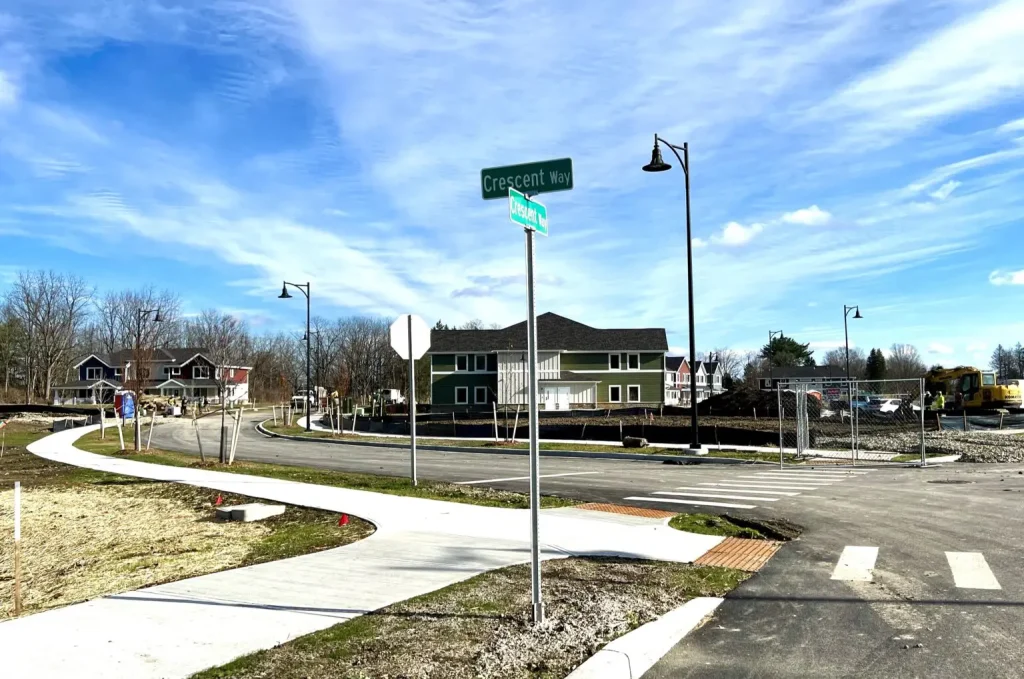
Trumansburg Police Chief Joe Nelson said that he is not planning to increase his staff size or the number of hours officers work each week, in anticipation of residents moving into Village Grove, a new development on a 19-acre parcel of land located in the village at 46 South St.
“You have to approach it by itself to see what comes,” Nelson said of the residential mixed-use, mixed income project, owned by Ithaca Neighborhood Housing Services (INHS). It is a subdivision of the larger new neighborhood of Crescent Way.
Seven of the 46 units at Village Grove are set aside for disabled veterans, and three are dedicated for survivors of domestic violence. The housing for veterans is part of the Empire State Supportive Housing Initiative (ESSHI), which is the same program that allows for supportive housing at Asteri.
“[ESSHI] is a model that New York State has embraced. … It’s something that allows us both a mixed-income community and the ability to create impact and positive outcomes for all, which is something that is super important for all of us,” said Kate de la Garza, INHS executive director.
While the housing for veterans is part of ESSHI, it is a different demographic than the people who live at Asteri as part of the same initiative, as a number of the residents of Asteri fall under the ESSHI-eligible categories of people with serious mental illness or substance use disorder.
Services for the veterans and domestic violence victims will be provided by the Salvation Army Ithaca Corps, the Department of Veterans Affairs and the Advocacy Center “to make sure they thrive,” de la Garza said. “We partner with our service providers, including the county, and an in-house services person that coordinates everything for the best outcomes and maximum stability for our residents.”
For the time being, Nelson said he will run on the assumption that his staff of two full-time and eight part-time officers will be adequate to cover the new housing development, which de la Garza said INHS is hoping to start moving people into later this month.
In Dryden, Second Wind Cottages is looking to open its second location. The organization is expanding from its first grouping of cottages in Newfield, opening its first women-only housing on Dryden’s Main Street.
With the new second location, the Newfield housing will now be referred to as Newfield Cottages, and the Dryden housing has been named Dryden House. Wilke said it just recently received its certificate of occupancy, and the hope is to move residents in by Christmas. She said that the newly constructed house, which will accommodate four women and their children, is the only housing of its kind for women that she is aware of in the area. It differs from Asteri in multiple ways.
“I would say our model of support is much more intensive,” Wilke said. “We try to make it clear in our interview process that you have to want what we are offering. It’s a lease, not just housing.” A resident who refuses to comply with the plan set for them before they move in would ultimately be asked to leave, Wilke said.
While she is looking forward to providing safe housing in Dryden, Wilke continues to hope that conditions at Asteri improve.
“I’m hopeful that collaboratively we can come up with solutions,” she said, “because we need to do better.”
Author
Related Articles

Holiday traditions bring community cheer
Tompkins County holiday traditions light up homes, farms, and schools with festive cheer and community spirit.
The gift of an experience: Local businesses offer hands-on holiday fun
Holiday experience gifts in Tompkins County include candle making, gourd crafts, and pottery workshops for creative seasonal fun.
Code Blue shelter opens amid praise, concerns and ongoing debate
Ithaca’s Code Blue shelter opens with larger space, showers, and case management to help residents during cold weather.