
Property assessments increase an average of 20 percent across the county
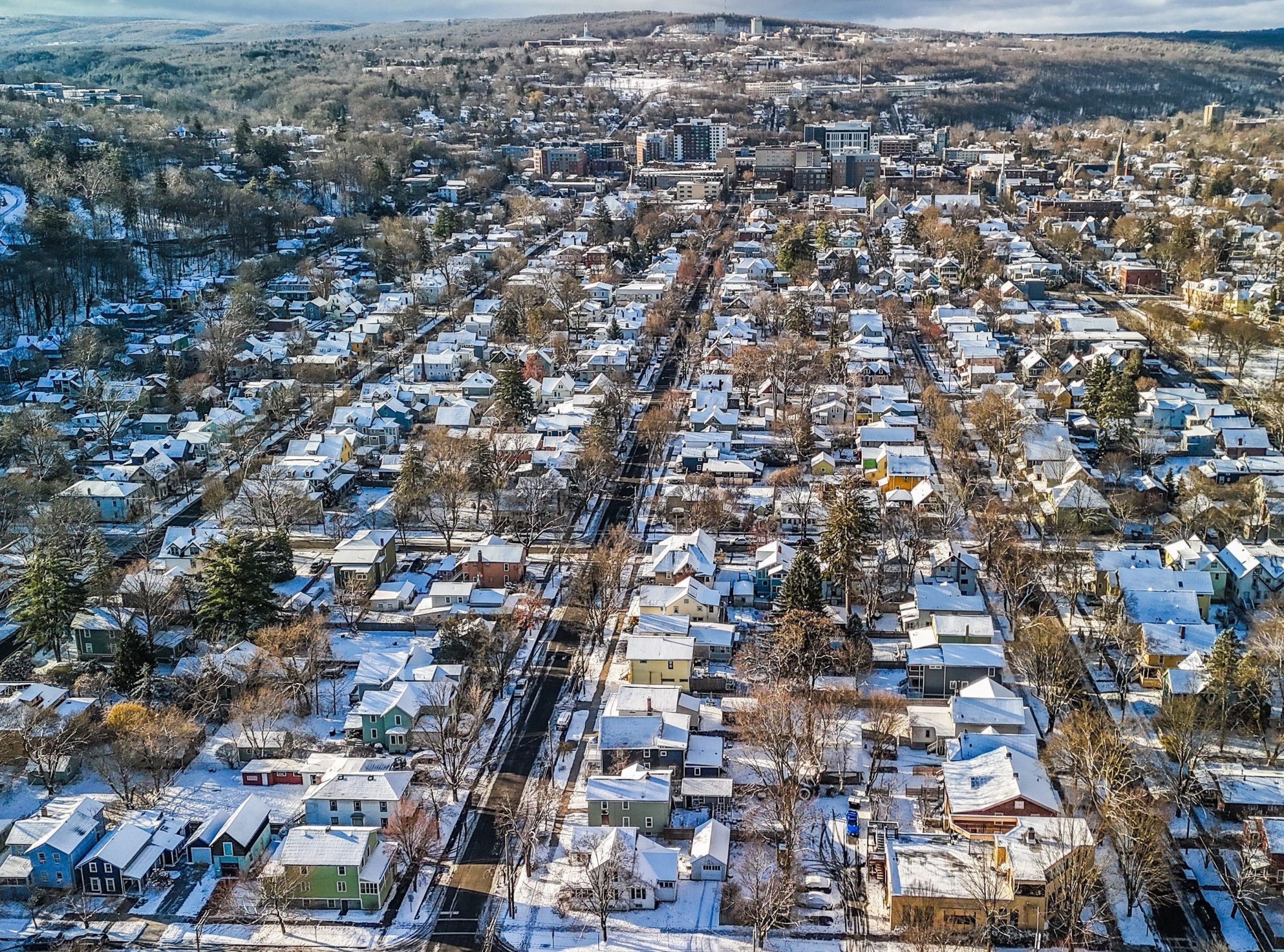
Jay Franklin, director of Tompkins County’s office of assessment, is keenly aware of how unusually high his office’s property value assessments were this year.
“Every real estate professional I talk to that has been in the business longer than me has never seen a real estate market like the one we’re in now,” Franklin said.

The value of Tompkins County property has experienced an overall average increase of about 20% in the last year, according to the Tompkins County Office of Assessment, and with the attention that has been getting comes a discussion among the public that highlights several common misconceptions, according to Franklin.
“The main difference between tax assessor and property assessor is there is no such thing as a tax assessor in New York state,” Franklin said.
The assessor is not involved in setting the actual tax levy. “But most people associate us with that because we’re the face of it,” Franklin said. “Our goal is to simply value property at its market value.”
In order for his office to do its job effectively, Franklin said he and his staff stay out of school board budgets and municipal discussions.
“I keep hearing we’re in cahoots with the school districts to raise taxes,” Franklin said. “I’m too busy to be in cahoots with anybody.”
In certain situations, property values can go up overall within a town, and the town board can then lower the property tax rate, but not enough to give an actual tax break for those whose assessments went up. The municipality is still requiring taxpayers to pay more for their property tax bill. In these cases, the mismatch in assessments versus tax rate is ultimately caused by the town board’s budgeting decisions, not the fact the assessments went up, Franklin said.
“We are not going to be 100% right,” Franklin said of his office’s assessments. Sometimes property owners do not let assessors inside to check on the condition of the home.
“We’re saying, ‘According to the best information we have available, this is what we think the property is worth,’” Franklin said. This includes keeping an inventory of property transactions and taking into account how much homes in the neighborhood have recently sold for, he said.
“The first step for us knowing where the market is currently is knowing the sales,” Franklin said, adding that his office has one employee who is dedicated to the task of keeping track of real estate transactions.
“I think there are a lot of factors that are going into it,” Franklin said of the climbing property values. “Even with interest rates high, there are still a lot of people with a lot of cash. I hear reports of all-cash buyers, and that’s happening here.”
At the same time, many homeowners seem reluctant to sell. In a normal market, there is a predictable life cycle driving the sales of homes. Couples have a child and buy a larger home, then they have more children, and that motivates them to consider upgrading to more square footage, and then when the children leave home the couple will often downsize to something smaller.
“But with interest rates at 6%, 7%, and them already having a 3% mortgage, why exchange that for a much higher monthly payment?” Franklin said. “So, I think lots of people haven’t put their house on the market, and that has further reduced supply. But there is still the demand of people moving into our county.”
The result is a very competitive market with many potential buyers bidding on desirable properties when they do happen to go on the market.
“The big one I heard recently was that there were 22 people bidding on one property,” Franklin said. “That kind of competitiveness is going to drive up prices.”
Another piece of the puzzle: Tompkins County has been slow to build new homes and is not keeping pace with demand. A 2023 Tompkins County housing study found that the county’s number of new builds is mirroring what it was in the 1940s. “We were in the middle of a world war,” Franklin said. “We weren’t building housing.”
For an area that is so in-demand, currently there are not a lot of opportunities to build new homes, Franklin said.
“There’s not a lot of shovel-ready sites,” he explained. “You need roads, electric, water, sewer, to be able to develop.”
Even if there were construction-ready sites available, the cost of building is significantly higher than it was in the past, and Tompkins County has a lack of local construction companies compared to other areas.
“We don’t have a pool of builders that can go in and build a subdivision,” Franklin said, adding that this probably goes back to the lack of buildable lots. “It’s supply and demand, and I think we’re just not building the supply to build that demand.”
In some ways, the high demand for housing in Ithaca contradicts the current popular narrative of people, in general, leaving the state of New York.
“But people are still coming here [to Tompkins County],” Franklin said. “We see the population increasing. It seems counterintuitive.”
But it should perhaps not be all that surprising that Ithaca and the surrounding area remains in high demand when one considers all the contributing factors: the multiple institutions of higher learning, the unique natural areas and the cultural offerings that are available to those who reside in this area.
“We’re kind of secluded,” Franklin added. “We don’t have four-lane highways. It’s not like a big city in terms of commercial development and chain restaurants.”
Franklin said that the popularity of Tompkins County’s neighborhoods is constantly changing and sometimes cyclical. Cayuga Heights, for instance, has been gaining in popularity in recent years. Fall Creek is unique in that it is one neighborhood that has remained desirable for several decades.
The Ithaca area tends to attract professionals working in one of two specific fields. “You hear people talk about ‘eds and meds,’” Franklin said. “Whenever you talk to somebody, they’re probably affiliated with one of the [educational institutions], or they’re medical.”
With notices of property assessment changes going out Feb. 23 for the first municipalities on the list to receive them, and with so many assessments going up this year, Franklin’s office is currently in the midst of fielding calls from homeowners who take issue with their house’s assessed value.
Franklin said that what he currently needs from the public is any information from property owners that could help the assessor’s office place an accurate value on each property.
This includes information about the condition of the home. The assessors might decide to conduct a closer inspection of the home in person.
“There’s no substitute for us looking at it,” Franklin said. “We wish we could do that for every home, but it would coast us between $15 and $18 million in staff time and staff salary,” he said, “and that’s not going to happen. Even if we could, not everybody is going to let us go in their house, so it would be a waste of money, and in the end values are maybe marginally better.”
Last year, 5.8% percent of property owners with increases in assessment filed for review, Franklin said, adding that his office does not keep track of the percentage of assessments that are actually changed as a result.
When new assessments are made, the assessor’s office expects that about 15% of the new values will be challenged. “We plan for 20%, hope for 10, but more expect 15%,” Franklin said. “Our average is under industry standards. It has actually made me a little concerned that only about 6% wanted to talk to us.”
So far in 2024, that percentage has picked up to about 10.6%. “That’s making me feel a little bit better that it’s picking up a bit this year,” Franklin said. “We need that public participation.”
“We’re trying to do the impossible,” he said. “But when you look at us versus industry standards, we’re doing a great job.”
Author

Related Articles
Holiday traditions bring community cheer
Tompkins County holiday traditions light up homes, farms, and schools with festive cheer and community spirit.
The gift of an experience: Local businesses offer hands-on holiday fun
Holiday experience gifts in Tompkins County include candle making, gourd crafts, and pottery workshops for creative seasonal fun.
Code Blue shelter opens amid praise, concerns and ongoing debate
Ithaca’s Code Blue shelter opens with larger space, showers, and case management to help residents during cold weather.