
Purchase of Cherry Street site for new homeless shelter approved by legislators
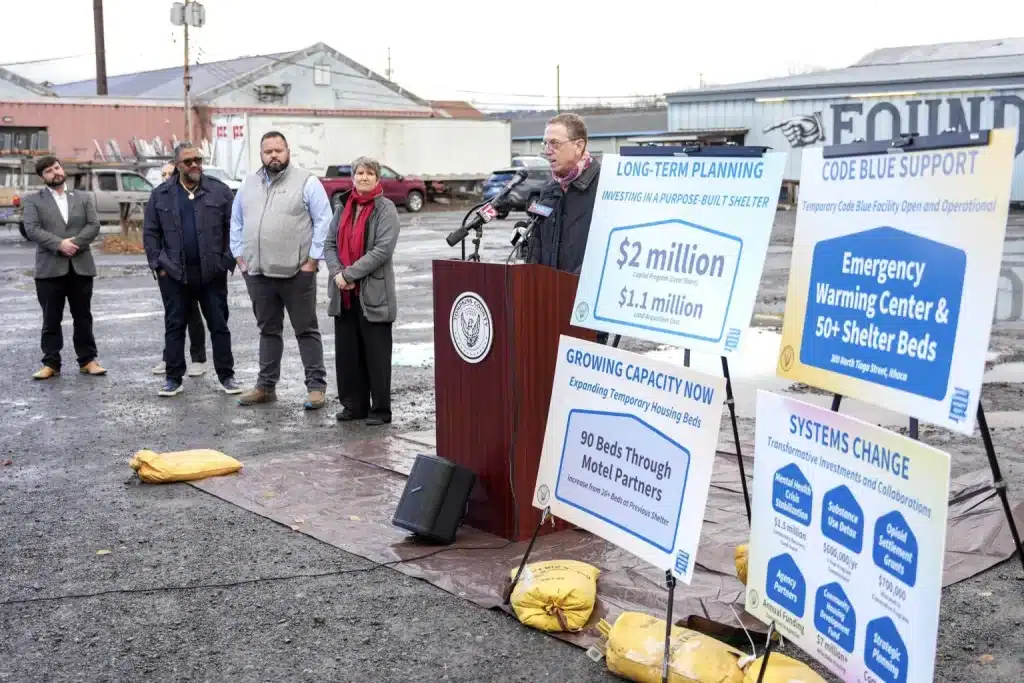
Tompkins County legislators voted at a recent meeting to move forward with the construction of a 100-bed permanent homeless shelter amid concerns from the public that its city of Ithaca location may prove problematic.
The Tompkins County Legislature unanimously approved on Dec. 3 the purchase of a plot of land in the city’s West End, a one-acre parcel located at 227 Cherry St., where antique mall FOUND in Ithaca is currently located.

Managing editor
MM Development Advisors, an affordable housing development partner with experience developing shelter facilities, will be contracted by Tompkins County for the project, county officials announced at a press conference Nov. 26.
Prior to the vote that would approve the purchase, Legislator Rich John (D-Ithaca) asked at the December meeting if there was consideration for allowing the current business to operate while the county continued the planning stages of its project in order to give the business time to relocate.
“Absolutely,” Tompkins County Administrator Lisa Holmes replied.
John asked when construction would take place.
“I think that the most accelerated timeline, if we assumed that, would be probably 2027,” Holmes said.
This time frame includes demolition of the current building, followed by construction in 2026, Holmes added.
Tompkins County resident Zachary Winn spoke during the public comment portion of the meeting, stating that he believes the Cherry Street location is a poor choice for a permanent homeless shelter. “It is easy to imagine people continuing to live in the woods by the train tracks while utilizing the services of the shelter,” Winn said. “The shelter should be located outside of the city and away from the drug and street culture that makes the state of homelessness an often permanent and fatal condition. The $1.1 million purchase price would be better spent on a larger plot further away from downtown.”
“If you are truly wedded to locating the shelter in this part of town, it is my understanding that the city of Ithaca owns the wooded area at the end of Cherry Street, where existing encampments are located,” Winn added. “As a junior partner in this project, the city could sell this land to the county for $1 and use the $1.1 million intended for this property acquisition towards clearing the trees and preparing the site without removing another property from the tax rolls.”
Patrick Kuehl, 4th Ward Alderperson for the City of Ithaca Common Council, echoed some of Winn’s concerns.
“The literature suggests that transitional housing is really what we should be moving into as communities across this country. … Collocating 100 beds of emergency shelter in one place in the city is not, maybe, the most effective way that we could be moving forward,” Kuehl said.
In response to some of the public comments, Legislator Gregory Mezey (D-Dryden), chair of the legislature’s housing and economic development committee, said he would like to remind people that the shelter is the first step in a continuum of needs that the county is going to have to continue to address.
“We cannot address the entire system in one swoop,” Mezey said. “We don’t have the tax base … We don’t have the state, federal and other municipal support to do that. … We desperately need to improve our current condition, and this is just the beginning of a solution to address that issue.”
In regard to the wooded area on Cherry Street where homeless encampments have long been an issue, Mezey said it would be up to the city to take the first step.
“That’s something that would need to go through a process, which you could all expedite,”
he said to the city officials present. “The sale of that is something you all could do.”
Keeping people close to services in the city of Ithaca will create the best possible outcome, Mezey argued.
“What we need to do more, rather than pull people away from the city, is put more services closer to where people are,” Mezey said. “A purpose-built shelter will allow us to do that, creating a space where we can have service providers, partners, advocates.”
“I think a lot of people think of this is as an end and not a beginning, and I’d like them to think of it the other way around,” Legislator Mike Sigler (R-Lansing) said, adding that, based on comments he has read online, he has concerns that the public does not fully understand the gravity of the county’s homelessness situation.

“I don’t think they really understood the immediacy of the problem or that the situation on the ground has changed for Tompkins County,” Sigler said. “Just in the availability of rooms, I don’t think that they adequately have that information — that we’re not dealing with two years ago or four years ago. We’re dealing with a different situation now.”
In early November, the county’s permanent homeless shelter on West State Street/West Martin Luther King Jr. Street, operated by St. John’s Community Services (SJCS), closed. County officials recently announced that an increased number of beds will soon be available through contracted motel partners for the Temporary Housing Assistance (THA) program. Capacity to serve up to 90 people will be available for THA clients, an increase from the 26 beds at the former THA shelter operated by SJCS.
In addition, in recent months the county has renovated the former Key Bank building in downtown Ithaca to serve as an emergency Code Blue shelter. Upwards of 50 individuals can now utilize the facility.
John said he would support the resolution but had real concerns about how the project would be executed.
“There’s a tremendous amount of planning that has to go into this, and some hard choices. I don’t think the current approach is working very well. … The evidence is that unrestricted drug use is really bad and dangerous and it’s killing people. I think we do need a new approach in this specific site, which is part of a much larger approach.”
John added that he worries about the property’s neighbors, as well.
“I have real concerns for the residents of Nate’s Floral Estates and for the businesses on Cherry Street in the city’s industrial park,” John said. “We need to be very cognizant of those neighbors, both commercial and residential, and as we go forward, protect their interests to the maximum extent we can.”
“But,” John said, “I will support the resolution.”
The resolution to make a negative determination of environmental significance regarding the project passed unanimously prior to the vote to acquire the property.
Sigler raised questions about the environmental impact that taking down an old building and constructing a new one would have on the area.
“The negative declaration doesn’t mean ‘no impact,’” Tompkins County Attorney Maury Josephson responded, adding that the impact “doesn’t have to be zero, but it has to be slight enough that it’s not going to be damaging to the environment or require a further environmental impact statement under the parameters of the SEQR Act.”
Legislator Veronica Pillar (D-City of Ithaca) commented on part of the SEQR documentation regarding input from the Tompkins County Environmental Management Council around indoor and outdoor lighting standards.
Health hazards from lighting “can be surprisingly significant,” Pillar said, pointing out that the Environmental Management Council recommends incorporating dark sky outdoor lighting standards, “which I think is a great idea,” they said.
“I guess this is on my mind because over Thanksgiving I went to the Natural History Museum, and they had an exhibit about the night sky, and it had a bunch of interesting examples of how man-made light affects lots of things that we do and how, often, a lot of lighting is there for public safety but that often more light leads to less safety, and instead you want to have the right kind of light in the right place at the right time,” Pillar added.
Legislator Travis Brooks (D-City of Ithaca) said that now it is the responsibility of the legislature to oversee the project in such a way that it will have a positive outcome, not only for the people who need shelter, but for the business community and the residential neighbors, as well.
“Over the next few years, I think we really owe the folks that find themselves in these situations — the communities, both business and the residents around that area — we really owe it to all three of those groups to put the best plan forward and really incorporate the community … so that everybody’s interests are met,” Brooks said, “especially the vulnerable.”
Author
Related Articles

Holiday traditions bring community cheer
Tompkins County holiday traditions light up homes, farms, and schools with festive cheer and community spirit.

The gift of an experience: Local businesses offer hands-on holiday fun
Holiday experience gifts in Tompkins County include candle making, gourd crafts, and pottery workshops for creative seasonal fun.
Code Blue shelter opens amid praise, concerns and ongoing debate
Ithaca’s Code Blue shelter opens with larger space, showers, and case management to help residents during cold weather.