
Ithaca startup REEgen pushes toward cleaner future for rare earth mining
REEgen in Ithaca uses bacteria to recover rare earth elements, offering a safer, sustainable alternative to traditional mining methods.
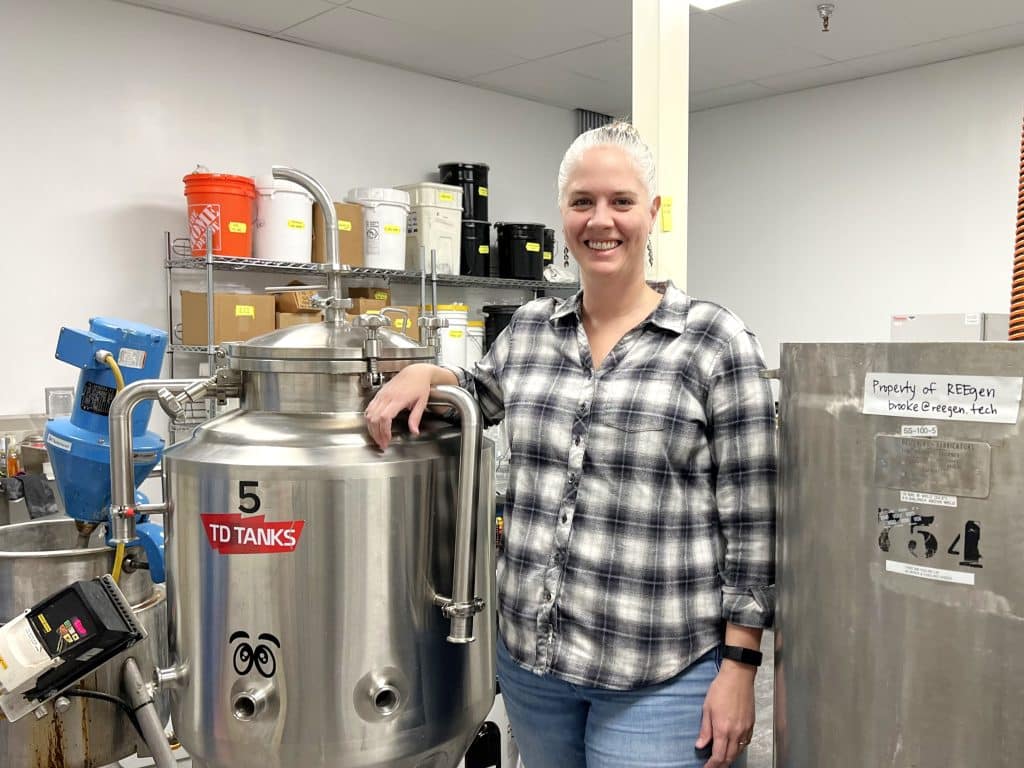
Alexa Schmitz, co-founder and CEO of local biomining startup REEgen, at her headquarters in Langmuir Labs in Ithaca.
At Langmuir Labs in Ithaca on a recent weekday morning, Alexa Schmitz, co-founder and CEO of REEgen, was hard at work in her laboratory. She and her team had just added a shiny new fermenter to the collection of equipment that fills every corner of the lab. They’d purchased it secondhand from a brewery in Brooklyn, cartoon eyes sticker placed above the spout and all.
The whimsical piece of machinery is now commissioned for a serious job: playing a role in REEgen’s mission to change the mining landscape using biotechnology.
“It’s a fermenter that we use to make the leaching solution that gets the rare earths out of the minerals,” Schmitz explained.
Biomining startup REEgen recently won the $150,000 grand prize at the 2025 FuzeHub Commercialization Competition, positioning the Ithaca-based company to have a profound impact on the national economy and global clean energy efforts.
REEgen’s BioREEcover technology addresses a critical national vulnerability: the United States currently recovers less than 1% of rare earth elements domestically and depends heavily on imports for materials essential to defense, clean energy and advanced manufacturing.
The new, larger fermenter will allow the startup to run its unique process much more efficiently from start to finish, so that the company can get a sense of the size of the equipment that it will need on a commercial scale.
The startup uses genetically engineered bacteria to recover rare earth elements and other critical minerals from industrial waste, offering a sustainable alternative to conventional mining.
REEgen’s approach replaces the harsh chemicals traditionally used in metal extraction, such as sulfuric and hydrofluoric acids. “We’re trying to eliminate that from the mining industry,” Schmitz explained, “reducing the usage of those high-impact, high-energy and hazardous waste-producing processes and replacing them with engineered bacterial solutions.”
“We can actually work with these unconventional feedstocks on site. And the partners are really excited to have us there, because we don’t use a lot of electricity and we don’t produce hazardous waste, so it’s a perfect match,” she added.
Schmitz explained that the Idaho National Lab discovered the bioleaching microbe, and further work was done at Cornell University to develop and engineer the discovery into a scalable technology, which focuses on replacing hazardous steps in critical mineral recovery using unconventional materials such as slags, electronics and coal ash to avoid hazardous waste production.
Schmitz received funding from Activate, a national fellowship program that paid for her salary and travel for two years, in addition to providing professional development and a $100,000 research grant. The funding allowed the company to enter Cornell’s Venture program.
During the New York State Innovation Summit, which celebrates New York state leadership in technology-led economic growth, FuzeHub hosts the annual Commercialization Competition. REEgen competed against 12 entrepreneurs from across New York state and won FuzeHub’s top prize by demonstrating the commercial viability and national security importance of its BioREEcover technology before a panel of expert judges.
Award funds must be used to improve existing prototypes, enabling companies to pursue additional investments and customers and leading to successful commercialization.
“We are so excited to be working with Alexa and the REEgen team again, after having previously supported them when they received an award with Cornell University through our manufacturing grants in 2024,” said Patty Rechberger, Innovation Fund Manager at FuzeHub. “They have the vision, expertise and drive necessary to take their timely and crucial biorecovery technology to market.”
The funding will accelerate REEgen’s path to commercialization. The company’s aim is to produce rare earth products for the United States supply chain by the end of 2026.
The company uses bacterial mechanisms to engineer processes that are efficient and scalable. REEgen has developed two technologies: The first technology aims to replace acid leaching, using bacteria to convert agricultural waste into an efficient leaching solution, and the second involves using bacteria to bind metals, replacing harmful organic solvent chemicals in solvent extraction.
These new methods are cost-effective due to reduction of hazardous waste and the reusability of the processes’ leaching solution.
REEgen’s on-site biorecovery process involves three main steps:
- Fermentation: Bacteria are fed low-grade glucose from agricultural waste. These bacteria convert it into an organic acid leaching solution (mainly gluconic acid and similar acids).
- Leaching: The bacterial broth is combined with solid waste materials. This mixture leaches rare earth elements and other critical metals out of the solids and into the solution.
- Purification: The solution, now containing dissolved metals, undergoes further processing to extract and purify the target rare earth elements and other valuable metals. Currently, some conventional chemistry is used, but REEgen is also developing proprietary methods for this step.
Schmitz has lived in Ithaca since 2009, having received her PhD in plant pathology and plant microbiology and post-doctoral training in biological and environmental engineering from Cornell University.
“New York state is still super supportive,” she said, “and I am hoping that we can really build REEgen out here in that environment, in that sort of ecosystem of like-minded, sustainability- forward people.”
Author

Related Articles

Cayuga Medical Center nurses to rally, alleging anti-union tactics by hospital management
CMC nurses plan a rally, alleging unsafe staffing and illegal anti-union tactics as the hospital highlights recent patient-safety gains.
Holiday traditions bring community cheer
Tompkins County holiday traditions light up homes, farms, and schools with festive cheer and community spirit.