
From bulls to batteries: Renovus Solar transforming former livestock facility
Renovus Solar Expansion redefines old GENEX site with batteries. Explore the green campus vision in Ithaca!
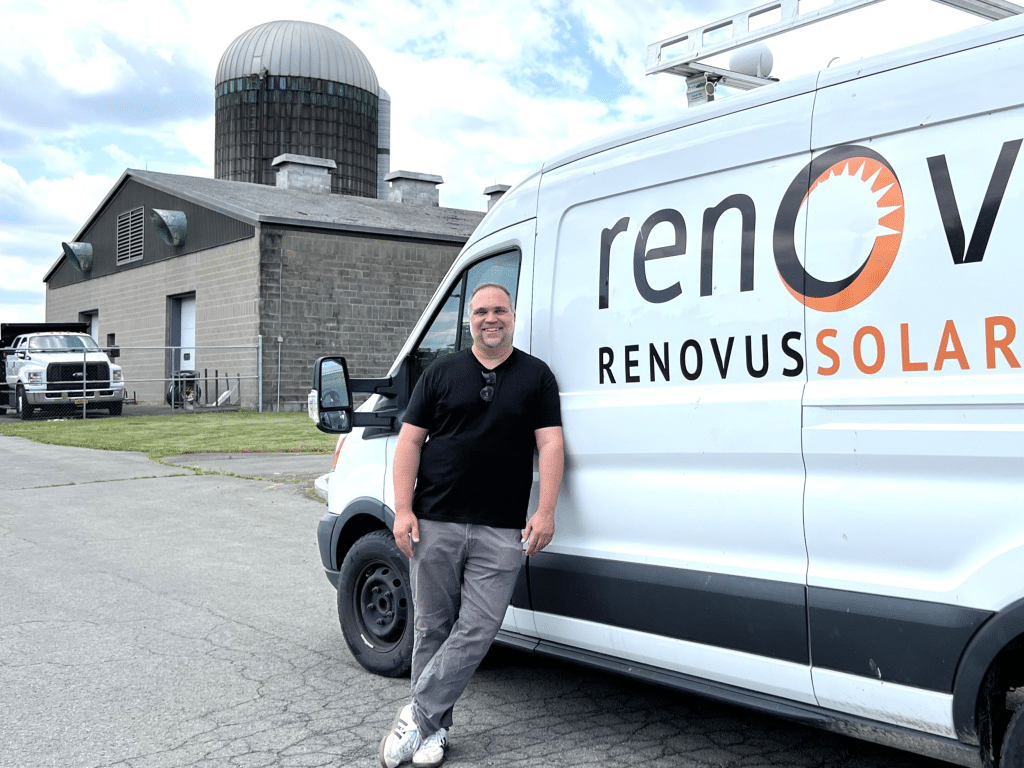
Joseph Sliker, president and CEO of Renovus Solar, stands in front of the company’s new building on Sheffield Road. It currently houses office space for all of Renovus’ employees and is also the new home of Standard Battery.
On Sheffield Road, in a rural setting between the city of Ithaca and the village of Trumansburg, lies the new location of Renovus Solar, a local company that specializes in providing and installing solar energy systems for homes, businesses, schools and communities.
The sprawling building is the former home of bull genetics company GENEX, which shut down its Ithaca location, where it cared for livestock and processed bovine semen, in 2021.
Now that Renovus has relocated, Trade Design Build, an Ithaca-based integrated architecture and construction firm, has purchased the solar company’s former location at 1520 Trumansburg Rd. The design company is renovating its newly acquired building, which will serve as its office location.
A unique old building for an established local company
Renovus was founded in 2003, and Joseph Sliker, Renovus president and CEO, came on board with the company in 2011.
“It’s been really nice to have everybody under one roof,” Sliker said of the move. “Our old spot was two separate buildings, but having everybody all working together has been awesome.”
While the larger footprint of the building seemed daunting at first, it no longer feels oversized.
“We’ve been filling up the space quicker than we thought,” Sliker said. “Initially, we got [the building] because it was an interesting opportunity to get a unique, big property that has a lot of room for potential expansion, and we were trying to figure out how we would make that work for our operations. … Instead, we found that it’s actually extremely well set up for what we do and much more efficient than we even expected it would be.”
Certain parts of the building were ready for Renovus’ staff of around 35 employees to move right in and settle into their new offices. Other parts will present more of a challenge.
“But that’s the nice side of it being bigger, is that we don’t need to fill every space,” Sliker said.
Some parts of the building that need renovation before they can be used are the large open areas with tall ceilings and dirt floors where the bulls were kept.
“It’s pretty industrial, and it’s a little overbuilt and a little outdated in a lot of ways,” Sliker said of the facility. But, he added, he enjoys the challenge of renovating an old space.
“I like buildings,” he said. “I like architecture. I think that when places like this just sort of sit and are left abandoned, that that’s crazy. You should do something cool with it, and when it’s been sitting for a little bit, we were able to get a deal that was appealing to us.”
Part of that real estate deal was the property across the street, also previously owned by GENEX, which came with 30 acres of land.
“It seemed like a very unique opportunity to get both parcels at once, with a pretty clear plan of how Renovus could move into here and how we could expand here, while we’re not sure what to do across the way,” Sliker said. “We’re looking at a couple different options, as far as leasing it out; I might even consider putting it on the market and just sort of doing the baseline level stuff that we did here — just cleaning, painting, deodorizing, getting it nice, getting the stink off it — and see if there’s some other, grander vision for it.”
One overarching goal is to make the main facility more energy efficient.
“We’ve got a lot of plans to do a lot of things to change out the heating system and make it all based off of heat pumps so that we can offset it all with solar,” Sliker said. “And that’s just going to take a while, because it’s big.”
“Our bigger vision,” he added, “is to sort of expand into this being more of a campus of renewable energy, recycling, reusing — sort of green-minded stuff. And this place is perfect for doing that kind of thing.”
Standard Battery partnership
A recent partnership with Standard Battery fits perfectly into this mission, Sliker said. He believes that storage is going to be “the next big thing in renewables,” and he said the startup, founded by local electrical engineer James Mead, is on the cutting edge of solving problems related to energy storage and will eventually be manufacturing batteries on site.
One large, open section of the building already houses some of Mead’s autonomous solar farm mowers. They are designed to automatically mow solar arrays by being attuned to their specific layout. They would come equipped with a battery pack and plug into the array’s power station. “We’re considering having a solar panel on top of it,” Sliker said, which would give the mower the ability to charge while it’s working. He said the machines are designed to handle all manner of challenging terrain, given that solar farms “tend to be rough.”
Sliker is also interested in the broader potential of new energy storage technology.
“He’s as much of an artist and an inventor as he is someone who’s driving the business forward,” Sliker said of Mead. “He’s positioned himself in a really interesting way where, doing more with grid resiliency, doing more for when power fails, doing more for energy storage,” adding that battery power is “an amazingly powerful tool to enhance what the existing grid can already do. And there’s a lot of interesting ways that those technologies can be used now that the technology has matured more. … It’s sort of the front end of what I think the next wave of interest is going to be over the next 10 years.”
Federal cuts mean consumers should act quickly
President Donald Trump’s One Big Beautiful Bill Act, passed by the House of Representatives Thursday, ends long-standing federal support for solar and wind power. The Associated Press reported that the bill “takes an ax” to clean energy incentives, including killing a 30% tax credit for residential solar by the end of the year, an incentive that the previous administration had extended into the next decade.
“A lot of projects are going to have to get started earlier than they otherwise would have,” Sliker said. “They’re basically just shortening the timeframe for the end of these incentives. And that will hurt clean energy development.”
Even with the challenges ahead, Sliker is optimistic about the future.
“All forecasts say that, even with whatever shrinkage we have in the industry, there’s going to be more new energy added through solar than any other technology. … Solar is the cheapest form of energy production there is in the world.”
He added that he is most excited about the potential for utilizing solar power within local school districts.
“I have worked with a bunch of [school districts] around here, where they can own a solar farm that offsets the utility bills for the entire district,” Sliker said. “They’re not paying federal taxes, so a federal tax credit, to them, doesn’t really change their economics of the project.”
The NYSEG electricity rate hikes of the last five years also make solar an attractive option for many people, Sliker said.
His biggest advice to homeowners interested in going solar?
“With the tax credits and just the general landscape of things, and with the volatility of electricity, doing something sooner and trying to get the ball rolling is going to be in your best interest.”
Author

Related Articles
Cayuga Medical Center nurses to rally, alleging anti-union tactics by hospital management
CMC nurses plan a rally, alleging unsafe staffing and illegal anti-union tactics as the hospital highlights recent patient-safety gains.

Holiday traditions bring community cheer
Tompkins County holiday traditions light up homes, farms, and schools with festive cheer and community spirit.

Design details unveiled for new Center of Government
Design details for the Tompkins County government building in downtown Ithaca are now public, with a county survey open for feedback.