
Rising fuel prices put strain on county pocketbooks
It’s no secret that gas prices have spiked recently. Although prices were on a steady incline through much of this year, this month saw prices starkly increase, with some local stations going as high as $4.50 per gallon from around $3.80 last month. And though there are some signs of a slow price decline in the past week, it’s unlikely the high prices are going away anytime soon.
In that light, Tompkins Weekly spoke with local officials to discuss how we got here and how residents can cope with high prices at the pump.
How did we get here?
If you’ve consumed any national news coverage of the rise in fuel prices, you’ll see many economists point out that there are numerous factors that have contributed to this increase, with the top three being a post-pandemic demand for gas, global cuts to oil production and U.S. sanctions on Russia in light of the current Russia/Ukraine conflict overseas.
Steven Kyle, an associate professor at the Charles H. Dyson School of Applied Economics and Management at Cornell University, outlined just how multifaceted this issue is.
“It is a matter of world supply and demand, and no one country is really big enough to completely determine what the market does,” he said. “So yes, Russian oil, less of it has gotten to the market. But on the other hand, there have been hits to demand as well from omicron surges elsewhere in the world. Particularly, China is starting to lock down again now. So, there are going to be, going forward, major adjustments or hits or additions to supply and demand. And it’s how those balance out that make for what the oil price does.”
Kyle said that the more recent spike in prices can be attributed to “volatility because of uncertainty.”
“People really don’t know what’s going to happen, and so, they want to lock in the fuel that they need, and that gets prices up,” he said. “I also would add to this that just because we’re not consuming Russian oil doesn’t mean somebody is not. And even if we try to engineer a worldwide boycott of Russian oil, there are going to remain poor countries who will be happy to take a boatload.”
Many drivers will remember that the last time the nation’s average gas price was above $4 per gallon was during the 2008 recession, but Kyle said that the recent rise doesn’t paint as bad of a picture for the nation’s economic future.
“We economists like to deal in real prices, that is to say prices adjusted for inflation,” he said. “And yes, we have not seen the number plate on the pump prices that high before, but in real terms, they’ve been higher than this. So, this is something we have seen before. And in fact, those previous episodes are what spurred those parts of the economy that could do it to lessen their dependence on oil, which is where we’re at now.”
Local effects
Local transportation officials said that residents from across the county are feeling the strain on their wallets from the rise in gas prices. Jane Brady, program director for GO ITHACA, said that she and her coworkers have “definitely had a few people reach out to us” due to the rise in gas prices.
“It’s been a good time for people to evaluate, how are we getting where we need to go?” she said. “Gas prices being really high, that’s a big motivator for people to shift their transportation to, ‘OK, I’m going to take the bus. I’m going to walk. I’m going to bike.’ So, we’ve definitely had some queries about, ‘How do I do that? What are my options?’”
That local interest in transportation alternatives has also been evident at TCAT. General Manager Scot Vanderpool said that “we’re seeing ridership increases due to the escalating gas prices.”
“Statistically, we are seeing an increase already in our rural boardings or rural ridership,” he said. “We’re seeing a 22% increase, on average, over the past three weeks. So, time will tell whether this holds or not. We do know that historically, as gas prices rise, people tend to shift from driving personal vehicles to using public transit. It happened in 2008. And data from studies suggests that for every 10% … increase in gas prices, U.S. transit demand has increased by 1.2%. So, it’s inevitable that the ridership is going to increase.”
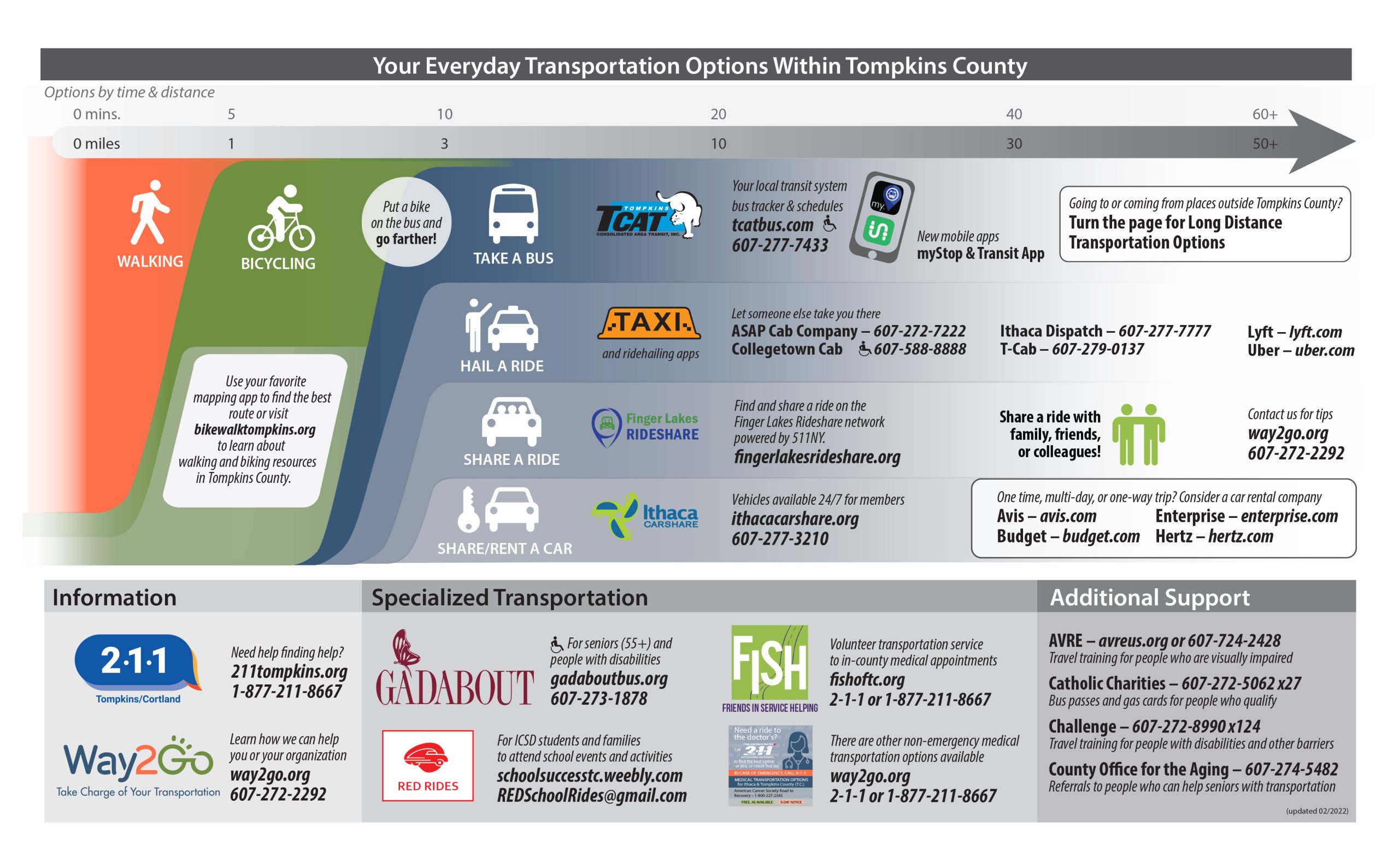
GO ITHACA and TCAT recently worked with other transportation service and resource providers in the county to create a resident’s guide to alternative modes of transportation (view at tinyurl.com/y7kc7sjh), and Brady said that release has already garnered considerable reaction.
“I had 30 new members last week after seeing that article,” she said. “It is a really important time for us to be able to push to people like, ‘Hey, we’re here. We’re here to support you. We hear that things are really hard with high gas prices, and we want you to know that we’re available and we can show you all of these different options, ways to get around and also give you a little bit of money to help try out those options and see if they’re for you.’ And so, we’ve been taking this time to think about, how can we engage directly?
And even as resources like GO ITHACA help direct residents to car alternatives, some of those alternative options are feeling the fuel price strain, too. At TCAT, for example, Vanderpool said his drivers are seeing significant price hikes for the diesel that most of TCAT’s fleet needs.
“We don’t have enough electric buses in our fleet yet to really make a significant difference,” he said. “However, the seven electric buses we have in service certainly helped with our costs. Our diesel buses are getting 4.18 miles to the gallon. That’s all they get. So, that’s pretty putrid. … Our diesel buses used over 23,000 gallons of fuel in January alone, so if you multiply 23,000 gallons of fuel by the extra $2 a gallon that the cost of diesel has jumped, that’s a cost of $46,000 just for January for TCAT.”
Vanderpool added that while the price hikes have hit TCAT hard, its biggest challenge of staffing shortages has actually helped to lessen the impact. However, the goal is still to strengthen its workforce, and Vanderpool said that even if expenses increase as a result, TCAT has no intention of raising its fare above the current $1.50 per ride.
Local response and looking ahead
Ever since the gas prices spiked in recent weeks, local transportation leaders have worked to help residents mitigate the effect the hike has on them. At the Ithaca-Tompkins County Transportation Council, for example, Executive Director Fernando de Aragón encourages residents to find alternative options that work for them. Not only will it save money at the pump, he said, but it will also help the environment.
“This is not an all-or-nothing situation where you have to never use a car,” he said. “But it’d be great if you can reduce your car use by 10%. And if everybody reduced, … you can really start to have an impact and start to reduce the demand for energy, and we would have cleaner air. All these things come together just by a marginal reduction in automobile use. We don’t have to go 100%.”
Grace Johnston-Fennell, easy access coordinator for GO ITHACA, said that while many communities nationwide are struggling to cope with the rise in gas prices, “the infrastructure that’s in Tompkins County is really welcoming to this moment.”
“If we don’t have the resource, we can, and I do regularly, connect people with other resources,” they said. “So, when in doubt, we’re happy to chat. And we really believe in what we’re doing and are happy to consult even if we don’t have the exact right thing for somebody. And I think that we’re all very grounded in the dire reality of the current moment and the challenges that the past two years have brought for so many reasons. And there’s just an opportunity in the current moment to really shift.”
As for how long this price hike will last, sources acknowledged that that is hard to predict right now. De Aragón shared some advice for residents for as long as prices stay high.
“I don’t think it’s going to be years, but it might be months that we have gasoline in the $4 range, and I would not be surprised if that becomes the new normal,” he said. “Think imaginatively. Help each other. Offer each other rides [like] your co-workers. Use the tools that are available. You can call 2-1-1. … We provide funding and training to the 2-1-1 system to provide transportation information and education. So, that’s a place you can call and troubleshoot your situation because everybody has a different situation.”
To learn more about the resources listed in this story, visit TCAT’s website at tcatbus.com, GO ITHACA’s website at goithaca.org or the Transportation Council’s website at tompkinscountyny.gov/itctc. More resources are available at the previously mentioned resource guide from GO ITHACA, TCAT and others.
Jessica Wickham is the managing editor of Tompkins Weekly. Send story ideas to them at editorial@vizellamedia.com.
Related Articles

Holiday traditions bring community cheer
Tompkins County holiday traditions light up homes, farms, and schools with festive cheer and community spirit.

The gift of an experience: Local businesses offer hands-on holiday fun
Holiday experience gifts in Tompkins County include candle making, gourd crafts, and pottery workshops for creative seasonal fun.
Code Blue shelter opens amid praise, concerns and ongoing debate
Ithaca’s Code Blue shelter opens with larger space, showers, and case management to help residents during cold weather.