County unites behind program to fix the region’s most dangerous roads
Safe Streets Tompkins plan targets 21 dangerous roads, securing federal funds for safety improvements, per Tompkins Weekly.
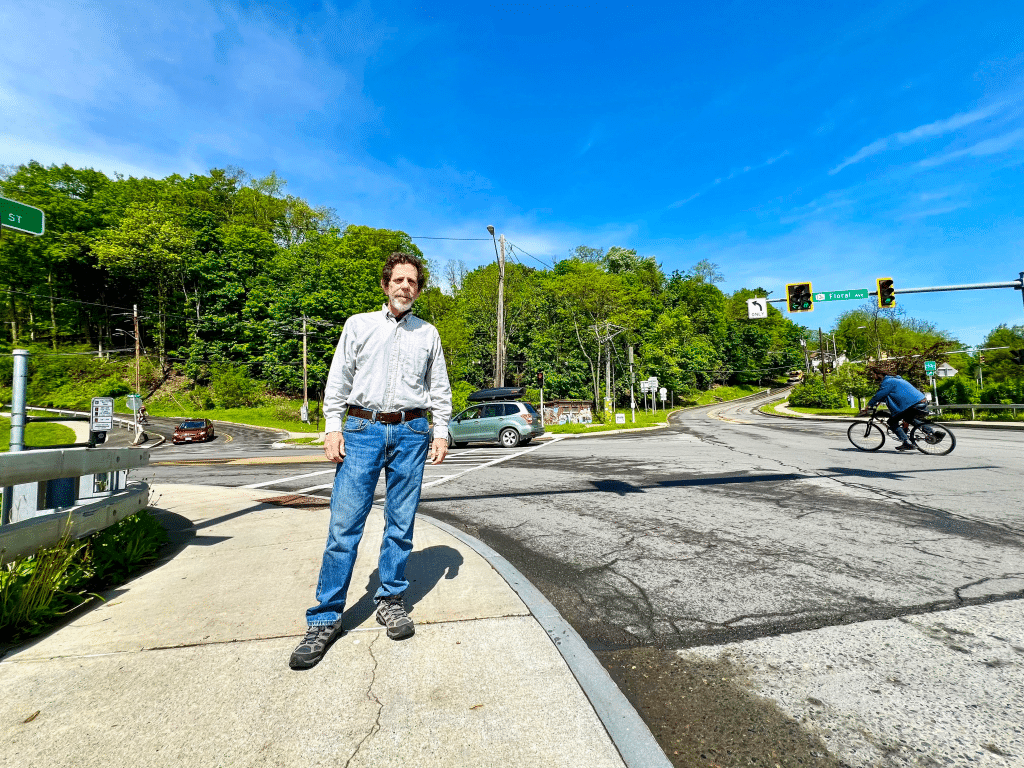
Fernando de Aragón, Director at the Ithaca-Tompkins County Transportation Council, stands at the intersection of Elm Street and Floral Avenue (to the left) and West State Street and Floral Avenue (to the right), on a recent weekday morning. The Ithaca intersection has been identified as one of the most hazardous roadways in the county, according to the recently-released Safe Streets/Roads Tompkins report.
A group of 10 Tompkins County municipalities is advancing a joint Safe Streets and Roads for All (SS4A) plan, which identifies the county’s most hazardous roadways and sets the stage for millions in federal funding to address them.
The municipalities are currently bringing the latest draft of the plan, which was released last month, to their respective boards for approval, with the intention of opening the door to grants that would improve some of the most dangerous roads in the county.
The plan addresses some of the “most costly” motor vehicle crashes on the region’s transportation network.
In 2023, the U.S. Department of Transportation awarded The Tompkins County Joint Safety Action Project Team an SS4A planning grant to develop a comprehensive roadway Safety Action Plan. Cambridge Systematics was selected as the lead consulting firm.
The participating municipalities are the city of Ithaca, which was the contracting municipality that took the lead on the securing the grant, town of Ithaca, village of Cayuga Heights, town of Caroline, town of Danby, town of Dryden, village of Dryden, town of Lansing, village of Lansing and town of Newfield. Tompkins County also partnered on the project, and the New York State Department of Transportation is a partnering agency as well.
Several Tompkins County municipalities opted not to participate in the collaboration, including the village of Trumansburg and the town of Ulysses. “We received a request to see if we wanted to participate in a joint grant application with less than a week (with the 4th of July in the middle of the week) to make a commitment to submit an application,” explained Ulysses Town Supervisor Katelin Olson, adding, “Ulysses has a gatekeeper resolution that requires the town board to approve all applications, and the timing was just too short of notice to affirmatively participate back in 2022.”
Trumansburg officials, likewise, did not feel that they had enough time to respond and at the time were simultaneously applying to their Safe Routes to School grant for West Main Street sidewalks, which they were subsequently granted, said Trumansburg Mayor Rordan Hart.
Below is a list of the 21 roads that the plan, called Safe Streets/Roads Tompkins, identified as the worst in the county when taking into consideration a number of factors, including the number of crashes and the number of fatalities.
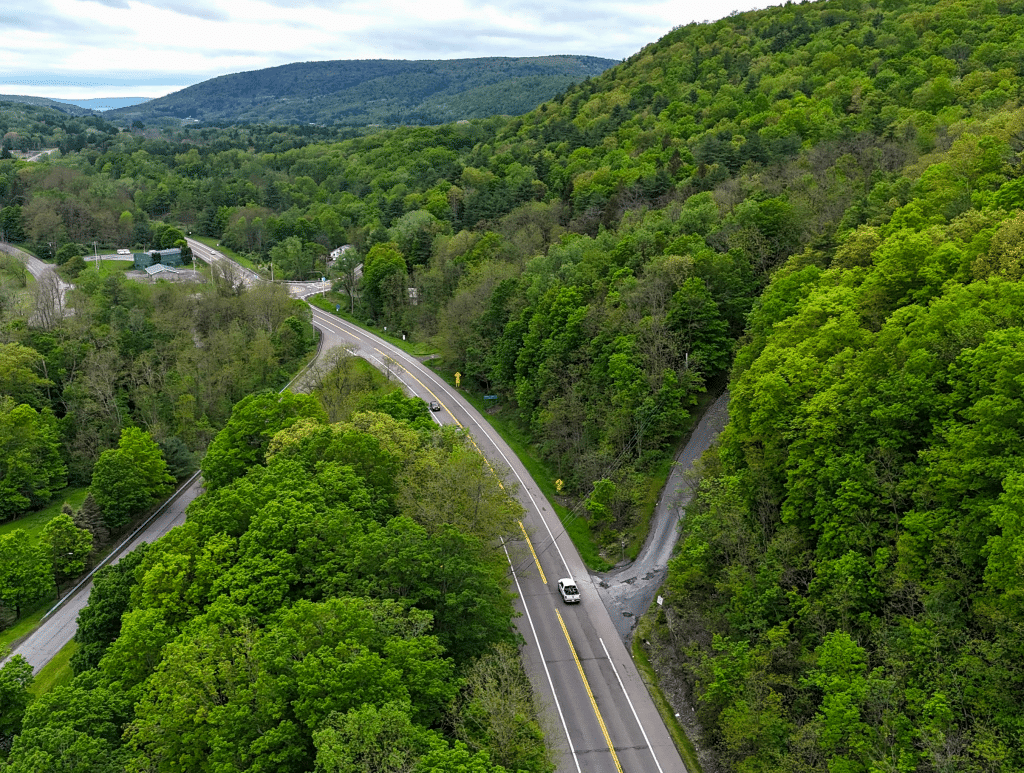
This stretch of road, NY-13 between Protts Hill Road and Main Street in Newfield, was ranked as one of the roadways most in need of safety improvements.
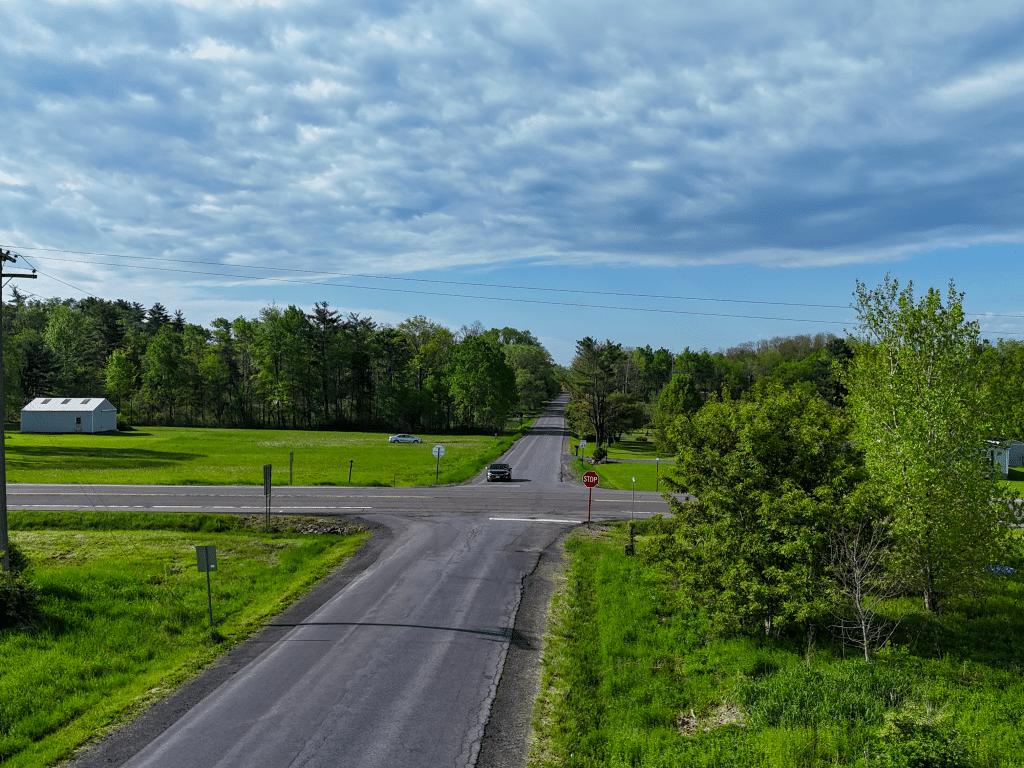
A recently conducted Safe Streets for All study listed the intersection of Peruville Road (NY-34B) and Scofield Road in Lansing as one of the most hazardous in Tompkins County.
Tompkins County’s most dangerous roads
The following is a list of roadways that the report ranked high priority based on the number of fatal crashes and other contributing factors.
#1. NY-13 northbound (NB) between Protts Hill Road and Main Street, town of Newfield: NYSDOT segment
#2. Mecklenburg Road (NY-79)/Sheffield Road, town of Ithaca: NYSDOT owns Mecklenburg Road (NY-79); Tompkins County owns Sheffield Road intersection
#3. West Danby Road (NY-34/96)/ Decker Road, town of Newfield: NYSDOT owns NY 34/96; town of Newfield owns Decker Road intersection
#4. Station Road/Maple Avenue and Route 34/96, town of Danby: West Danby intersection
#5. Floral Avenue/Elm Street/Hector Street, city of Ithaca: City of Ithaca intersection
#6. NY-13 from the town of Newfield/town of Ithaca line to the city of Ithaca/town of Ithaca: NYSDOT segment
#7. NY-13 NB between West Seneca Street & West Green Street, city of Ithaca: NYSDOT segment
#8. Route 96B from Miller Road to Michigan Hollow Road, town of Danby: NYSDOT segment
#9. Cayuga Heights and Wyckoff Street, village of Cayuga Heights: Village of Cayuga Heights intersection
#10. Cayuga Heights Road and East Shore Drive, village of Lansing: Village of Lansing intersection
#11. NY-13 and Warren Road, village of Lansing: Village of Lansing intersection
#12. Hanshaw Road, village of Cayuga Heights: Village of Cayuga Heights segment
#13. NY-34B NB between NY-34 and Van Ostrand Road, town of Lansing, south Lansing CDP: NYSDOT segment
#14. Peruville Road (NY-34B) and Scofield Road, town of Lansing: NYSDOT owns Peruville Road (NY-34B); town of Lansing owns Scofield Road intersection
#15. Sheldon Road and West Dryden Road, town of Dryden: Tompkins County intersection
#16. Valley Road/Lounsberry Road, town of Caroline:Tompkins County intersection
#17. Freeville Road (NY-38) and Springhouse Road, town of Dryden, Brooktondale CDP: NYSDOT owns NY-38; town of Dryden owns Springhouse Road intersection
#18. North Road between Fall Creek Road and NY-13, town of Dryden/village of Dryden: Tompkins County segment
#19. NY-13 and West Main Street, village of Dryden: NYSDOT intersection
#20. NY-13 NB between NY-38 and West Main Street, village of Dryden: NYSDOT segment
#21. 76 Road between Yaple Road and Smith Road, town of Caroline: Tompkins County segment
These locations were selected using an approach that assigned points to each segment or intersection, with 100 being the maximum number of points that could be assigned to any given road. The categories in which the roadways could gain the most points were the number of fatalities, for which a road could be assigned up to 45 points, and whether or not the road was in an equity priority area, for which a roadway could be assigned an additional 20 points. Equity priority areas are locations where vulnerable people, such as minorities, youth, the elderly and those experiencing poverty, reside.
This list, which the report refers to as a “final priority location network,” was developed using a three-step process, which the plan describes as taking the following steps:
• Step 1: Mathematically combine and weight each of the elements to calculate a combined safety score for roadway segments and roadway intersections.
• Step 2: Identify the top-scoring locations from that mathematical exercise by smoothing out the weighted scores, filling in logical gaps in the network, considering feedback from community engagement efforts and validating the top locations by ensuring robust crash histories.
• Step 3: Refine that list of top locations with the Joint Safety Action Plan team and other relevant stakeholders.
Relevant stakeholders included representatives from Tompkins County and each of the 10 municipalities involved in the Tompkins County Joint Safety Action Plan. “Each municipality gave feedback on whether the first draft of locations was appropriate, given their knowledge of the area, and gave options for substitute locations that reflect a greater concern from their point of view,” the plan states.
Tompkins County’s fatal crashes: What we know
Geographic analysis shows the three jurisdictions with the highest number of crashes were the city of Ithaca (3,475 crashes, 35% of geolocated crashes in the region), town of Dryden (1,514 crashes, 15%) and town of Lansing (1,278 crashes, 13%).
There were 31 fatal crashes between 2019 and 2023, according to the report, and thousands more injury and property damage crashes. But the relatively few fatal crashes imposed a much greater substantial cost — collectively nearly $488 million — which was more than the cost of all injuries combined.
The crash-related costs include both direct and indirect costs to individuals and society from a decline in crash victims’ general health, such as costs of emergency services, medical services, market productivity loss, household productivity loss, congestion impacts, etc., the Safe Streets/Roads report states.
“Highway safety programs should continue a focus on the impacts of passenger vehicles,” the report states. “Most fatal crashes in Tompkins County involved a car, van, or pickup truck, with fewer fatal crashes involving motorcycles, trucks, or buses.”
One of the big takeaways that Tompkins County residents should be aware of is that while there are more crashes in urban areas, such as within the city of Ithaca, severe crashes most frequently occur on rural roads. Between 2019 and 2023, rural crashes accounted for 60% of all fatalities and serious injuries, even though only 46% of the total number of crashes happened on roadways identified as rural.
Drivers tend to travel faster and speed more on rural roadways, often convincing themselves that they can let their guard down on straightaways or in areas they have driven through many times before, said Fernando de Aragón, director at Ithaca-Tompkins County Transportation Council, who served as an advisor on the project.
“Most crashes happen close to home because you do get complacent,” de Aragón said. “[Drivers] know the streets, take the turn without looking, and that’s where things happen — all of a sudden there’s a deer there, or someone’s trash can flies off in the wind — so people just need to be attentive. I mean everybody, including myself.”
Fatal accidents: How Tompkins County compares
Statewide, traffic fatalities saw a significant increase last year compared to prior years, so much so that NY State Comptroller Thomas P. DiNapoli titled his 2024 traffic fatalities report “Moving in the Wrong Direction.”
“Since 2019, motor vehicle fatalities in New York State have risen sharply, reversing the improvements made in the years prior to the COVID-19 pandemic. In fact, 2022 fatalities in New York are at the highest level in a decade,” the report states, adding, “Moreover, fatalities have grown even as the number of vehicle miles travelled, licensed drivers and traffic accidents in the State have declined.”
Though the comptroller’s report came out in June of 2024, it largely cited data gathered in 2022. That data showed that Tompkins County had a fatality rate of 7.5 per 100,000 people. Removing New York City from the equation because it is a very low outlier at 2.9 per 100,000, the Finger Lakes ranked third-lowest of the nine regions in the state. Mid-Hudson had the lowest fatality rate, at 6.8 per 100,000, and North Country was the highest at 12.9.
The sharp statewide increase in fatalities described by the comptroller mirrors the statistics for Tompkins County, according to the Safe Streets report, which finds that from 2017 to 2022, the five-year average decreased from 8.8 to 6.0 fatalities per year, a decrease of 32%. The trend switches in 2023, when the five-year moving average increases to 7.2, an increase of 20%.
Caroline and Brooktondale: One community’s struggle
Keeping the roads safe for everyone in Brooktondale, a hamlet located in the town of Caroline, presents some particular challenges, said Kathleen Kelley-Mackenzie, a member of the Ithaca-Tompkins County Transportation Council Planning Committee and the Caroline Town Council.
“Hamlets don’t exist legally,” Kelley-Mackenzie said. “We’re not a legal entity in New York state, so we get a lot of people zipping through. … It’s been a problem in the hamlet on Valley Road, past that intersection down the hill with the church to the left.”
The SS4A plan did not identify the stretch of road she described as a priority. “They looked at the intersection up the hill from it,” Kelley-Mackenzie said, referring to the plan listing the nearby intersection of Valley Road and Lounsberry Road as an area targeted for improvement.
Kelley-Mackenzie said that intersection is important to the hamlet because, she believes, it should indicate to drivers that they are in a more populated area and should therefore reduce their speed when going down the hill into the Brooktondale Community Center area — but she said that doesn’t seem to happen. “So, it’s frustrating,” she said.
Next steps
This month, municipalities are working on adopting or approving the Safe Streets/Roads Tompkins plan. The plan was unanimously approved by the members of the Facilities and Infrastructure Committee of the Tompkins County Legislature on May 15. The next step will be approval by the full legislature.
Once the governing bodies of all 10 municipalities officially vote in favor of the plan, those towns and villages can then apply for SS4A federal funding, available only to municipalities that have an SS4A plan.
The list of 21 priority locations is designed only to serve as a guide, and municipalities are not tied to those specific projects when applying for SS4A funding. There is also no specific timeline that the towns and villages must adhere to; it is up to local officials to decide when and where they want to focus their efforts on improving their roadways.
“If we didn’t have this study, we would not be able to apply for some pretty substantial pots of money,” de Aragón said, “and now we can.” He added that while there is uncertainty around federal funding at this time, he remains hopeful that funds will remain available for SS4A projects.
The most recent round of SS4A provides over $982 million in funding, and applications are due June 26, 2025, according to the National League of Cities.
Aiming for a zero-fatalities future
Embedded in the plan is a Vision Zero action plan, designed to allow Tompkins County and its communities to use a holistic framework to recognize that traffic deaths are preventable, with the goal of zero deaths on the area’s roads.
“The ultimate goal of the plan is the elimination of fatal crashes and a 50% reduction in serious injuries by 2040,” de Aragón said, adding that he believes wholeheartedly that this is possible.
“I think if everybody focuses on [reducing traffic injuries], it could almost become a community challenge to take care of each other on the streets,” de Aragón said. “It can be pretty powerful.”
Hoboken, New Jersey, achieved zero deaths seven years ago and has maintained that achievement ever since, de Aragón cited as one success story. “It’s become a point of pride and a real plus for them,” he said.
“We have a lot of rural areas, which present a different challenge, but very much a worthwhile effort,” he added.
Author

Related Articles

TC3 reaches transfer agreement with Hobart and William Smith Colleges
TC3 transfer agreement guarantees acceptance and scholarships for graduates entering bachelor’s degree programs at Hobart and William Smith Colleges.