
Second COVID-19 stimulus another step toward long recovery journey
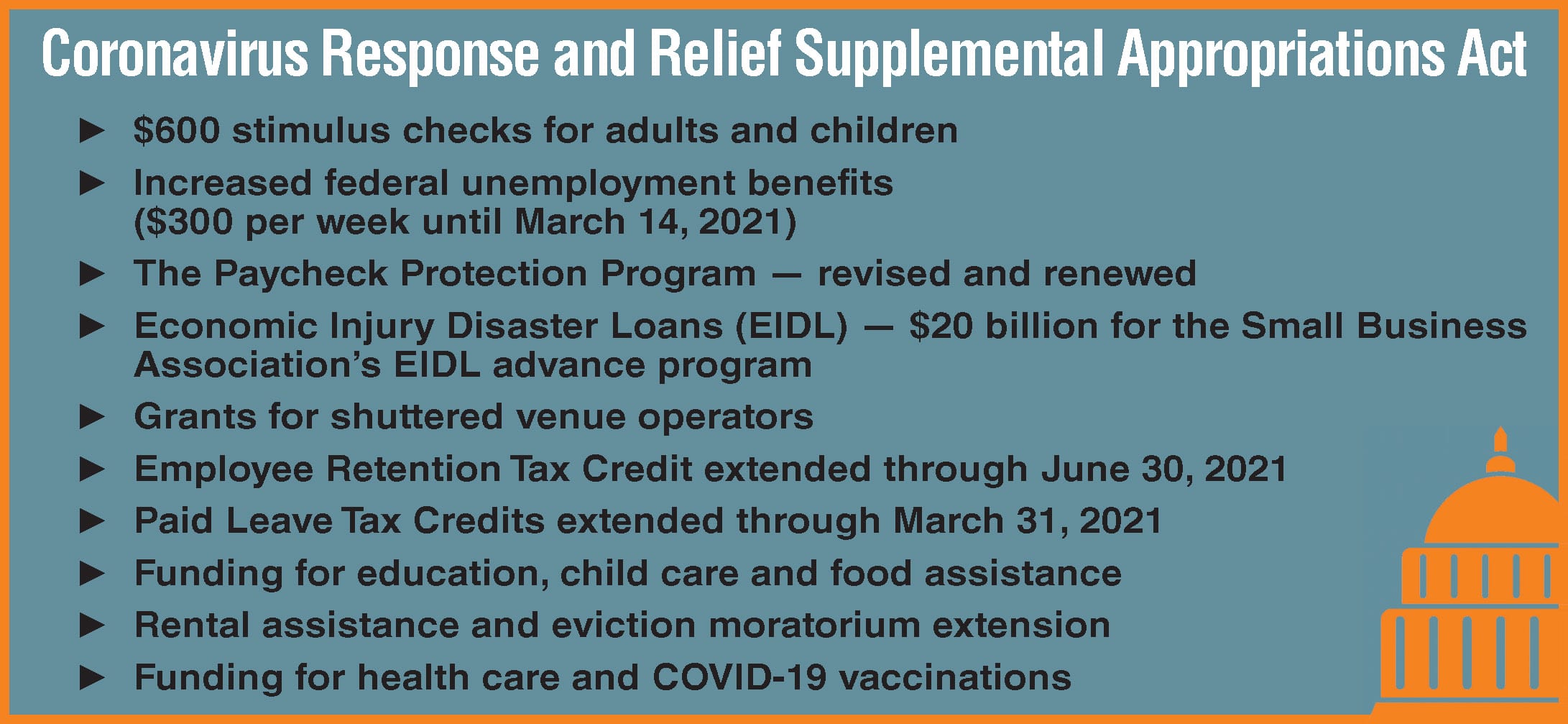
The long-awaited second round of federal COVID-19 stimulus funding was signed into law late last month, providing $900 billion in relief covering a variety of sectors. Part of the Consolidated Appropriations Act of 2021, the Coronavirus Response and Relief Supplemental Appropriations Act (Coronavirus Relief Act) is set to have a significant impact on the county.
Local leaders agreed that the Coronavirus Relief Act will benefit the county’s economy as a whole, but for the change to be long-lasting — and to properly recover from the economic downturn caused by the pandemic — much more aid will be needed from the federal government throughout 2021.
As Tompkins Weekly has covered before, the pandemic has rocked the county’s economy since it hit last March, and its effects continue to be far-reaching.
“The most negative impact and most dramatic impact happened during those shutdown periods, and as places have reopened and found other ways to do business, there has been an improvement from what had happened, but it’s nowhere near where we were in 2019,” said County Administrator Jason Molino.
Molino said that current estimates put county sales tax numbers for 2020 close to 10% below 2019, almost double the loss during the 2008 recession.
When Tompkins Weekly last covered COVID-19’s impact on the county’s economy as a whole this past summer, many sources highlighted the need for more federal assistance. After almost six months of waiting, county and town leaders described how the Coronavirus Relief Act compared to hopes and expectations.
The Coronavirus Relief Act includes $600 stimulus checks for adults and children, increased federal unemployment benefits, revision and renewal of the Paycheck Protection Program, $20 billion for the Small Business Association’s Economic Injury Disaster Loans advance program, grants for shuttered venue operators (Save Our Stages Act), extensions on Employee Retention Tax Credit and Paid Leave Tax Credits, rental assistance and an eviction moratorium extension.
In addition, the package includes funding for education, child care, food assistance, health care and COVID-19 vaccinations.
Several sources interviewed for this story highlighted a few key areas covered by the stimulus package that will especially help county residents. Molino, for example, pointed to the business- and unemployment-related assistance.
“The unemployment benefits are probably one of the most impactful pieces to it,” he said. “And hopefully, the PPP can help businesses stay afloat and keep people getting paid and employed for a period of time while we continue to try to manage the spread of the disease.”
Tompkins County Legislator Martha Robertson called attention to the child care piece.
“The child care money is really important,” she said. “When we talk about infrastructure, most people think about roads and bridges, maybe they think about airports, maybe they think about broadband. They better start thinking about child care. People can’t work if their kids aren’t taken care of.”
Ithaca Town Supervisor Rod Howe described the impact of direct assistance to residents.
“The checks that are coming to individuals, families and businesses as a result of the most recent federal COVID-19 stimulus package will help the county as a whole as it provides some relief to the ability to pay rent, buy food and other life necessities,” he said. “Money spent here in turn helps support our local economy.”
Thomas Knipe, director of economic development for the city of Ithaca, was glad to see a focus on small businesses, particularly the simplification of the PPP loan program. In addition, the PPP program has been altered to allow 501 C6 organizations to apply, which includes business associations like the Tompkins County Chamber of Commerce.
“The Chamber of Commerce and the Ithaca Tompkins County Convention and Visitor’s Bureau, which is a division of the Chamber, have been wonderful partners through the pandemic in supporting our business sector, but they themselves haven’t been able to take advantage of those relief funds or PPP,” he said. “Now, they can, and I think that’s really wonderful because we need a strong group of economic development service providers at the table to help with COVID response and recovery. And I think that’ll really help them do that.”
While sources agreed the stimulus will be a boost for the county, many also called to areas where the package falls short. For one, the package — much like the original CARES Act — includes no direct funding for state, county or municipal governments.
“I’m not a huge proponent of the federal government paying for everything that we need, but in this particular case, it actually made a lot of sense because, when it comes to police, fire, EMS, water, sewer, the roads, those are the things that small municipalities [do],” said Trumansburg Mayor Rordan Hart. “We don’t have the ability to stretch our budgets or borrow or print money like the federal government can, so if one of our revenue streams is suddenly closed off, then that’s where we would feel it, and those are the services that would be potentially hurt.”
Dryden Town Supervisor Jason Leifer shared that sentiment. For a place like Dryden, which often invests in development projects that are financially reimbursed by the state, a lack of state funding has a large ripple effect at the town level.
“If the state doesn’t have enough [money], getting reimbursement from the state will take too long,” he said. “If the state can’t meet its obligations under grants that we already have or grants we might find out we’ll get or even loans or whatever, we won’t be able to complete these projects.”
Leifer also addressed how the direct payments to adults and children aren’t continuous.
“The way it’s structured is a one-time payment to people,” he said. “But I think if you had a universal, basic income piece instead of that, you might be able to reduce some of the money in the other areas of the bill. … It’s like throwing a bunch of Band-Aids all over the place.”
Sources agreed that the journey toward full economic recovery is a long one, and many voiced that, with COVID-19 cases rising across the nation, conditions could get worse before they get better.
“We’re certainly concerned about another reduction in revenues to some of those same businesses that were heavily impacted in the spring and concerned about what that means for their ability to get through,” Knipe said. “There’s a general sense that it’s going to be a tough winter for some of our local businesses, particularly those in the hospitality and food and beverage and retail sectors.”
Several sources voiced optimism toward the prospect of more stimulus packages to help weather the storm, particularly with the change in federal government later this month.
“The flip in the White House and in the Senate, it gives us a lot of hope that we’ll have a partner to work with … who understands that local state and federal governments all work for the same people and one entity can do things that another entity can’t,” Robertson said. “I think we will see, starting on Jan. 20, a lot more coordination, not just in the money that’s already gone out, but in understanding what the needs are going forward and in responding to those needs.”
Moving forward, some sources described how COVID-19 will continue to affect the county’s economy for months and years to come, so focusing on what life will look like after the pandemic is crucial.
“The question on everybody’s mind [is] what is it going to look like on the other side of whatever this is, in terms of the business environment, the business climate?” Hart said. “What is New York state’s revenue going to look like? Is state aid to local municipalities going to be cut? And all of those things are still up in the air and a bit of an unknown.”
Molino described an approach to managing whatever the business climate may look like.
“Maybe the effort isn’t immediately right now, but the effort may need to be in a few months, when we start to come out of a pandemic, or in a year, what type of investments need to be made to enhance certain industries that are going to want to blossom and bloom post-pandemic,” Molino said. “I would imagine the economy and the landscape is going to look different post-pandemic than it was pre-pandemic.”
For now, sources asked residents to continue following health guidelines and to get vaccinated when you become eligible. Both measures will help to slow the spread of the disease and mitigate the pandemic’s effects on the county as a whole.
Related Articles

Dryden Fiber looks back on another year of service
Dryden Fiber reflects on a year of growth as the municipal internet provider expands service across Dryden and Caroline.
Cayuga Medical Center improves patient safety score
Cayuga Medical Center Leapfrog Grade rises to “B,” showing improved patient safety and nursing care quality.

Local startup Seen Nutrition wins $500,000 prize in GROW-NY competition
Seen Nutrition wins $500,000 in the GROW-NY prize to expand sales, marketing, and global reach of its bone health product.