
Short-term rental market in Lansing sees decline as Ithaca faces new regulations
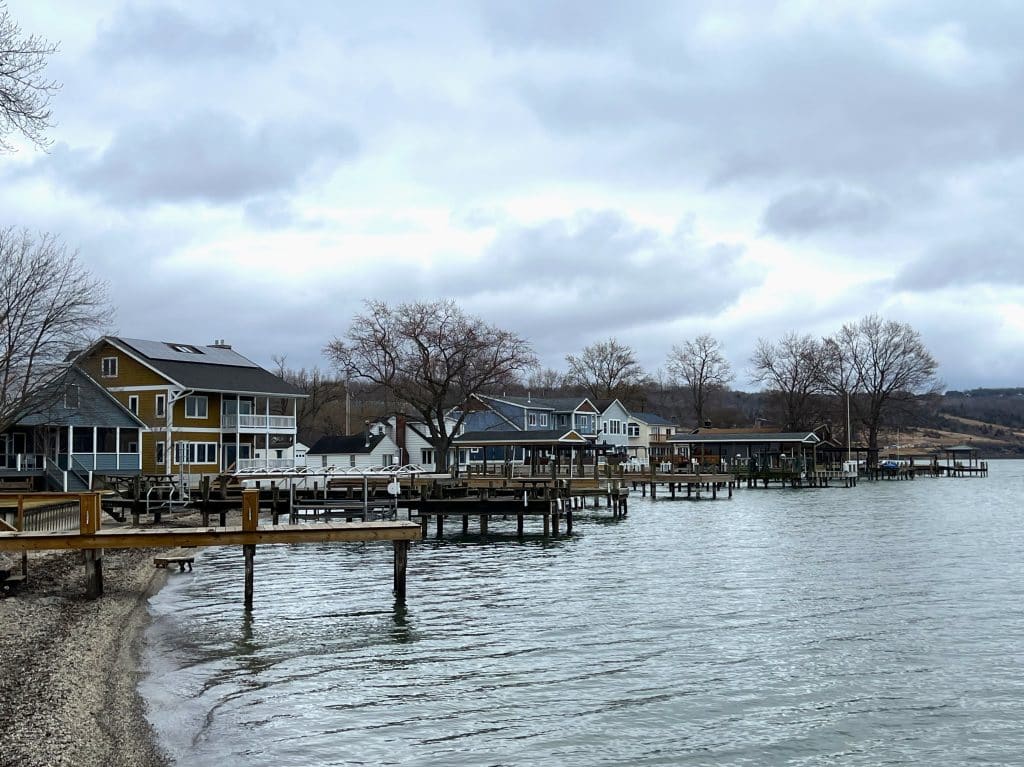
Many lakefront homes in Lansing are used as short-term rentals. More than 2,000 short-term overnight stays were lost in Lansing in 2024, according to a recent report by Tompkins County Tourism Program Director Nick Helmholdt. The report used data compiled by KeyData, a company that develops data visualization and organization tools for property owners.
Short-term rental units in Tompkins County have declined by about 20% since last April, according to a report from the county’s tourism program director presented to members of the Tompkins County Legislature’s Housing and Economic Development Committee on March 5.

Tourism Program Director Nick Helmholdt said that the report uses data compiled by KeyData in 2023 and 2024. KeyData is a company that develops data visualization and organization tools for property owners.
The report comes on the heels of state guidance and legislation passed last year in the city of Ithaca seeking to regulate the short-term rental market, which in Tompkins County mainly comprises properties listed on platforms like Airbnb and VRBO.
Helmholdt told legislators that the monthly supply of short-term rental units has fluctuated between 945 and 1,603, but the almost 20% decline started in April, 2024.
“We have between roughly 1,000 and 1,600 active short-term rentals at any given month,” he said. “Occupancy has been relatively stable in this segment the entire time I’ve been keeping track of it: roughly 20% on average, but fluctuating between roughly 9% and 36%. This is substantially lower than you’d expect for a hotel, but it’s in line with this segment.”
The time frame analyzed in Helmholdt’s report also seems to suggest an overall downturn in the number of nights available for rental for these properties. This trend affects the Lansing area, where more than 2,000 nights were lost in 2024.
The report also shows that Lansing led the municipalities analyzed by Helmholdt in the county in average daily rate, a metric used to measure the average income earned per night for a short-term rental property, in all but two months in 2024. KeyData shows that the average daily rate in short-term rentals in the county ranged from $148 to $267 over the past two years. In 2024 in Lansing, that range was $235 to $417, showing the highest peak for any of the municipalities studied by Helmholdt.
“Even though we have a higher volume of supply in the city of Ithaca, you see higher rates in some of the other municipalities,” Helmholdt told legislators.
This is in large part due to size and access to the waterfront, Helmholdt and County Legislator Greg Mezey said. Mezey represents the town of Dryden.
“I expect we’d find more, you know, three-, four- or five-bedroom units in the outer rural areas than we would in the city of Ithaca,” Helmholdt said.
Helmholdt also commented on the advantages short-term rentals have over other forms of short-term stay.
“Short-term rentals can sometimes command higher rates than hotels and motels because they offer multiple bedrooms and other amenities,” Helmholdt wrote in the report. “For larger travel parties, short-term rentals can offer a significant advantage in terms of price per person.”
The total revenue generated by short-term rentals in Tompkins County was $32.5 million in 2024. If the local portion of sales tax (4%) were applied to this, it would generate over $1.3 million.
Legislator Deborah Dawson, who represents the village of Lansing, asked if the state was collecting sales tax on short-term rentals.
“The governor signed off on the short-term rental bill on Feb. 28, and I believe the sales tax goes into effect immediately,” Helmholdt said.
The county will have to set up a way to register short-term rentals as if they were hotels. But officials seemed unclear about how this may work.
In the case of a platform like Airbnb, Mezey and Helmholdt wondered if every individual short-term rental owner would have to register as an individual entity dealing with sales tax, or if Airbnb would handle sales tax for its users.
On other effects of legislation on the market, Helmholdt wrote in his report to legislators that he believes the city of Ithaca’s ordinance on short-term rentals is affecting the market. The city’s ordinance created a list of requirements owners must meet to qualify for a short-term rental permit. Applications for these permits were released by the city in January. The following properties are eligible for a permit:
- Single and two-family homes
- Any owner-occupied unit, as long as they are someone’s primary residency, which requires the landlord to live at the property for at least 184 days out of the year
A permit is needed for landlords to advertise a short-term rental. The property must also be in compliance with property codes.
“It seems reasonable to assume that the ordinance adopted by the city of Ithaca last year presumably caused some short-term rental hosts to transition to the long-term rental market or sell their property,” Helmholdt wrote.
The regulations take effect starting June 1.
Lansing at Large appears every week in Tompkins Weekly. Send story ideas to editorial@vizellamedia.com. Contact Eddie Velazquez at edvel37@gmail.com or on X (formerly Twitter): @ezvelazquez.
In brief:
The Lansing Community Library is announcing its 12th annual logo contest. Interested parties can submit an entry to the contest by April 9.
Instructions for the contest are as follows:
“Create a vibrant book cover illustration that embodies the theme of this year’s Summer Reading Program, ‘Color Our World.’ This year, we’re only accepting full-color submissions — black and white entries will not be considered. So grab your markers, colored pencils, and let your imagination run wild!
“All artwork must be submitted to the library by April 9. The winning design will be revealed at the Annual Trustee Meeting on April 21 at 7 p.m. and will be featured on Summer Reading Program gifts, library newsletters, and promotional posters.
“If you need extra copies, you can download one from the Lansing Community Library’s website [LansingLibrary.org] or pick up a printed copy at the circulation desk. Don’t forget to fill out the information on the back!”
Author

Related Articles
Street Beat: What are you looking forward to in the new year?
We asked five random people. Here’s what they had to say.

5 things to do in Tompkins County this weekend
Plan your visit and discover what’s happening this weekend.

Meinig Fieldhouse built to protect iconic red-tailed hawks
The Meinig Fieldhouse hawks project shows how Cornell protected Big Red and other red-tailed hawks during construction.