
Signs of Sustainability – Fall composting, outdoors or indoors
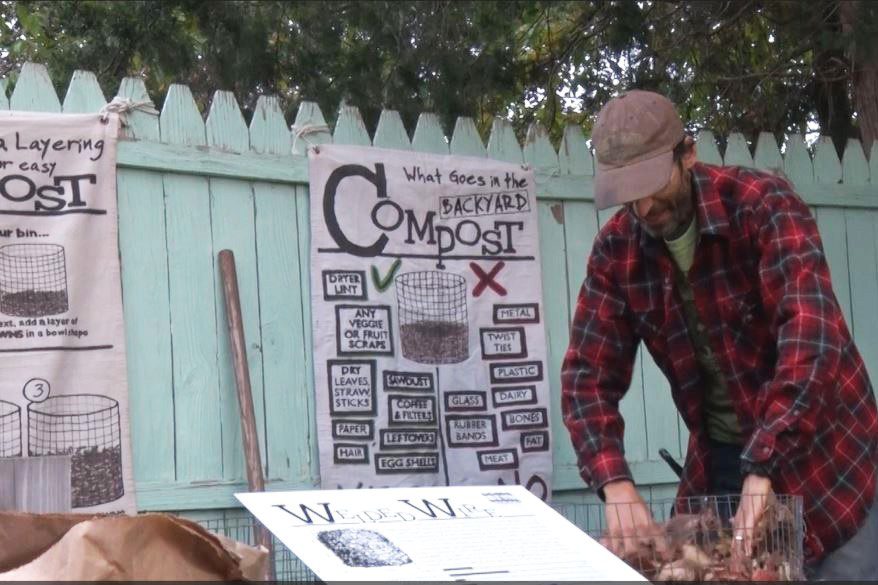
Fall is the perfect time to start composting or improve upon your composting practice. With the time-intensive work in the garden behind us, fall can be a good time to lay the groundwork for future soil building. With leaves abundant, it is easy to properly balance out wet, dense food scraps with a dry, carbon-rich material.
Maybe you are one of the many Tompkins County residents who does not have access to outdoor space for composting. In that case, you can learn how to set up and maintain a worm bin, or a “bokashi” composting bucket.
If making your own compost at your home is not for you, the Tompkins County Department of Recycling and Materials Management (TCRMM) offers 15 drop off locations. At no cost, you can “fork over” your food scraps. Courtesy of their Program, food scraps are taken away, mixed with wood chips and turned into compost.
Keeping food scraps out of the landfill is something everyone can do to help conserve resources, protect the environment, and contribute to growing things in our community. Transporting food scraps to the landfill generates carbon emissions. At the landfill, the food scraps decompose without air – generating methane, a potent greenhouse gas, for decades to come. Composting at home, or through TCRMM’s drop off program, helps reduce our carbon footprint.
Outdoor composting can be a particularly enjoyable experience during these crisp, fall days. The activity puts you in touch with the cycles of life; from death of plant material to decomposition, to new life; you experience it all. Imagine the sweet aroma of fall, with its more diffuse lighting, and leaves falling all around…
The key to enjoying outdoor composting is to do it correctly! I already mentioned maintaining a balance dry, carbon-rich “browns” (i.e., fall leaves) and wet, dense “greens” (i.e., food scraps). Strive for a ratio of 3 parts brown to 1 part green. Doing this guarantees that you’ll have the correct balance of the essential compost inputs: water, oxygen, nitrogen and carbon.
Unless you are using a compost tumbler, an effective way to compost outside is to layer browns and greens in your pile or bin. Use crisscrossed sticks only on the bottom and then start with a layer of browns, no more than a couple of inches thick. Build it a little higher on the sides and then dump your greens in the middle. Spread the greens out with a stick or shovel, and then cover with browns until no food scraps are showing.
One other trick to avoiding problems in the outdoor compost is to avoid adding meat, dairy, bones, or excessive oils. Egg shells are okay, as are coffee grounds (and the paper filter), and a variety of plant-based foods – cooked or raw.
There is a bit more to composting with a worm bin or a bokashi bucket. However, once you learn, you will produce compost to use in your house plants, garden, or as an ingredient of your homemade seed starting mix. Even if you do compost outside, you can always start an indoor worm or bokashi bin for the colder, winter months. This keeps composting actively going and allows you to compost in the comfort of your home.
Bokashi is a fermentation technique, originally from Japan. Like making sauerkraut or kimchee, you ferment food scraps in an airtight bucket for about two weeks using bokashi bran, a special starter which can be purchased or made more economically at home. Bokashi composting is a 2-step process. First you ferment your food scraps, and then you add it to your compost system, or you bury it directly in the soil. Fermented food scraps become compost quite quickly.
This fall, the Compost Education Program at Cornell Cooperative Extension Tompkins County (CCETC) is offering a series of composting classes. The first one, on Thursday, October 17 from 5:30-7:00pm is about outdoor composting. Part of the class will be held outside in the compost demonstration site. The second class on Saturday, October 26, 10:00am-12:30pm, will focus on worm composting. Every paying household goes home with a worm bin and the knowhow to use it. The third class on Saturday, Nov. 16, 10 a.m. to noon, will address Bokashi Composting. Each household will go home with a bokashi composting kit, complete with bokashi bran made in class. All classes will be held at the CCETC Education Center, 615 Willow Ave in Ithaca. More details and links to register can be found at ccetompkins.org/compost or call the “Rotline” (compost helpline) at 607-272-2292.
Adam Michaelides is the Program Manager for the Compost Education Program at Cornell Cooperative Extension of Tompkins County. The Compost Education Program is funded by the Tompkins County Department of Recycling and Materials Management. The Signs of Sustainability column is organized by Sustainable Finger Lakes.
Related Articles

Signs of Sustainability: Growing trust and resilience in Danby
Danby community resilience grows as neighbors build relationships, share resources, and create supportive local networks.
Letter to the editor: Don’t let development erase Ithaca’s natural beauty
A letter urging Ithaca officials to protect mature trees and preserve the city’s character as development and high-rise expansion continue.

Democratic View: Rural Healthcare Is At A Breaking Point. Here’s How We Fix It.
Josh Riley outlines the rural healthcare crisis and proposes bipartisan solutions to protect hospitals, workers, and seniors in Upstate New York.