
Paleontological Research Institution donates Smith Woods to Ulysses
Smith Woods donation ensures the 32-acre forest remains protected, providing educational and community opportunities for Ulysses residents.
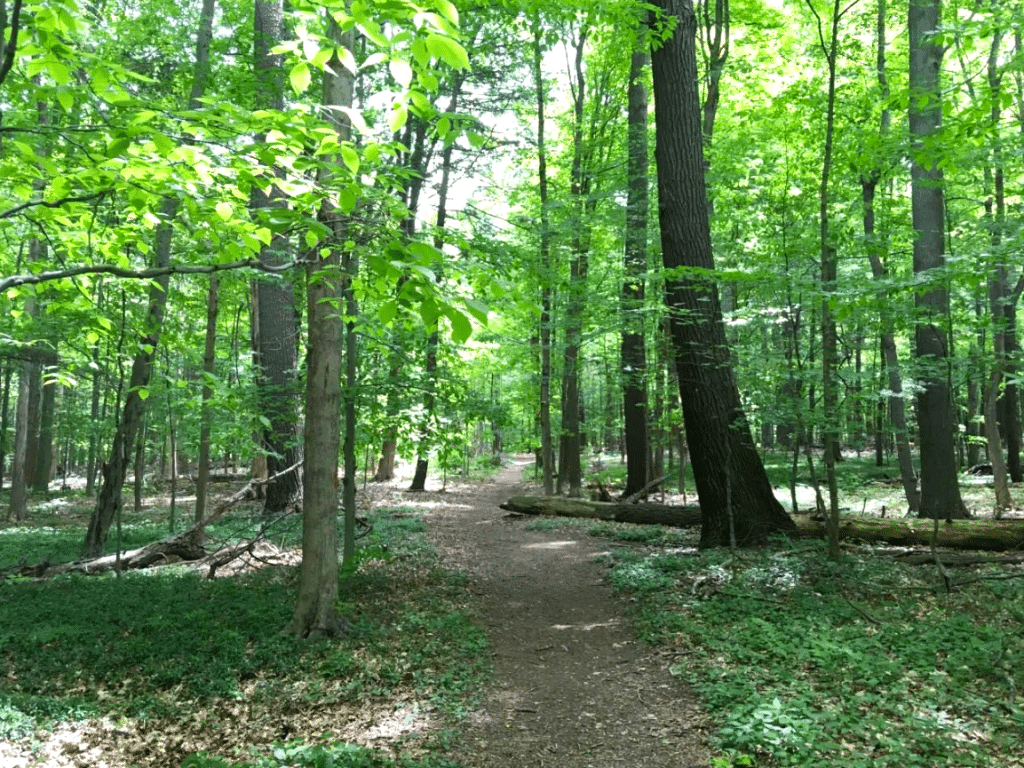
The Paleontological Research Institution recently donated the 32-acre parcel known as Smith Woods to Ulysses.
The town of Ulysses is now the steward of the Henry A. Smith Woods.
The Paleontological Research Institution (PRI) donated the 32-acre parcel in late October, following conversations dating back to at least June about having the town take over care of the natural area.
The 32-acre old-growth forest, located in the village of Trumansburg, has been protected, owned and cared for by PRI and Cayuga Nature Center (CNC) since 2013, when the merger of the organizations came to fruition. CNC itself has been in charge of Smith Woods since 2007.
The PRI board voted on Sept. 30 to transfer ownership of Smith Woods. PRI board members have said in the past that the move would allow PRI to refocus its efforts toward the sustainable support of a “world class” museum and an exceptional collection of invertebrate fossils.
PRI owns and operates the Museum of the Earth at 1259 Trumansburg Rd. in Ithaca.
PRI also manages one of the largest fossil collections in North America and publishes, among other things, the oldest journal of paleontology in the western hemisphere: Bulletins of American Paleontology.
The land donation was accepted by the Ulysses Town Board at their Oct. 28 meeting.
“This transfer ensures that one of Central New York’s most remarkable natural areas will remain protected and accessible for generations to come,” RPI officials wrote in a press release.
Smith Woods is one of the largest remaining old-growth forests in central New York. The property was first established as a public park in 1909 by the family of Henry A. Smith, a New York City businessman who purchased the woods in the 1870s and is buried in Trumansburg’s Grove Cemetery.
“Under PRI’s stewardship, Smith Woods became not only a cherished community resource but also an outdoor classroom,” officials said through a press release. “PRI expanded educational programming in the forest and, in partnership with local supporters, enclosed the property with a protective deer fence. This effort allowed native wildflowers and young trees to regenerate, restoring some of the forest’s ecological balance.”
Marvin Pritts, a PRI trustee and a resident of Ulysses who has spearheaded outreach to the Ulysses Town Board, said that hundreds of public tours have been conducted at the site, highlighting the forest’s educational value.
“This site has been a valuable resource for students from elementary school through college who want to learn what forests looked like prior to European colonization,” Pritts said in a press release. “Adults in this community and beyond have appreciated the history and beauty of the woods. I’m delighted that the town will steward the woods for generations to come.”
Back in August, Pritts and his family donated a 16-acre parcel on Cold Spring Road to the town, which could become the town’s first public park.
Recently re-elected Town Supervisor Katelin Olson said in a press release she appreciated PRI’s donation of Smith Woods.
“I am grateful to PRI for their stewardship of Smith Woods, and their donation of the property to the town,” she noted. “This incredible site will continue to be open to their public, and an important educational and environmental resource for future generations.”
In other environmental news in the town, board members at the Nov. 11 town board meeting tabled a measure to send out a request for proposals (RFP), aiming to use a grant from the New York State Energy and Research Development Agency for a ground-mounted solar energy system.
Ground-mounted solar is a system of solar panels installed on a rack structure that is anchored to the ground instead of a roof.
Supervisor Olson said that the rRFP delay is mostly due to the time of year and availability of contractors.
“In part, it gives everyone a little bit more time to fine tune any components of [the RFP],” Olson said. “More specifically, because the engineering firm that has been helping us with it and solar contractors are so busy trying to wrap up 2025 projects, that if we sent out an RFP in December, no one would be able to respond. So, the recommendation has been to move it to January.”
Author

Related Articles
Trumansburg schools consider regionalization as TST BOCES plan advances
Trumansburg school regionalization remains undecided as TST BOCES outlines goals for shared services and student learning.

Trumansburg Community Chorus readies inspiring winter concerts
The Trumansburg Community Chorus performs “I Dream A World” this December, celebrating hope, reflection, and community in inspiring winter concerts.

Trumansburg school board considers AI classroom adoption
Trumansburg schools explore AI in classrooms, focusing on interactive learning, automation, and preparing students for future careers.