
Local organization brings solar cooking to a Uganda school
Words Into Deeds brings solar cooking to UNIFAT School in Uganda, reducing firewood use by 90% with a new kitchen, celebrated May 20.
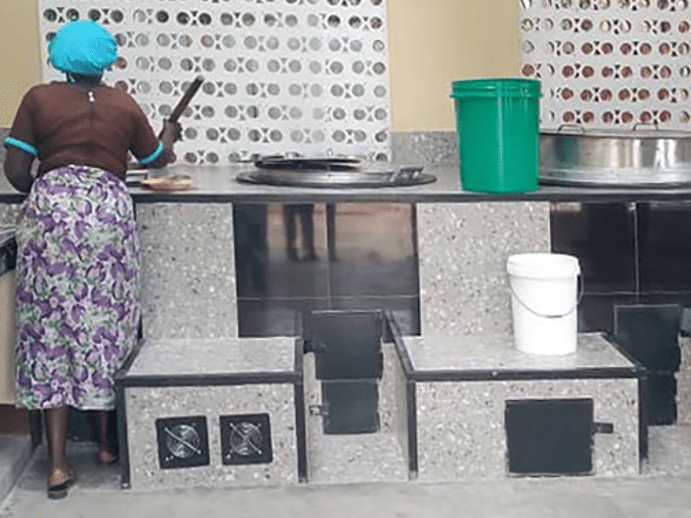
The 4-burner solar-powered cooker system now installed at UNIFAT Primary School.
The environmental benefits of shifting from fossil fuel-based energy sources for cooking and heating to other sources, e.g., solar, wind, dams, are well known. However, many countries do not have the infrastructure capacity, including electric power distribution, to adopt these alternative technologies. For example, in Uganda 95% of families and schools use firewood for cooking, and schools typically use 1-4 truckloads of firewood per month. Each load requires felling 50 small pine trees.
To reduce unauthorized foraging and deforestation, the Ugandan government recently outlawed unlicensed harvesting and roadside selling of firewood. This has resulted in higher prices, and most families and schools cannot afford the cost of alternative sources of fuel for heating.
Words Into Deeds (WID) is a local nonprofit organization founded by Gertrude (Shaffer) Noden. Since 2019, WID has launched educational and youth empowerment programs in schools located in Uganda and South Sudan. These programs are designed using the Sustainable Development Goals framework and emphasize engaging youth in community service activities.
For several years, Noden has worked closely with a primary school called UNIFAT that provides daily meals for 550 students plus staff. It is located in Gulu, a city of over 150,000 persons located in northern Uganda. Last year the school management listed replacing their outdated kitchen as a top priority. Noden then formed a team composed of UNIFAT administrators, teachers, cooks and students, who were charged to assess the school’s needs, study the available cooking technologies, and draft a proposal.
Noden learned about a Rotary Club in Santa Rosa, CA, that works with a Kampala, Uganda-based company called Vron Engineering. They design and install solar-powered cookers for both home and institutional use, and she invited the company founder (Khalid Nyende) to meet with the school planning team. Vron’s system uses small solar panels to power fans to blow air through a firebox that is located beneath a layer of locally sourced lava rocks. This reduces the amount of firewood needed by 90%, creating a hotter fire that reduces both the cooking time required and the amount of unhealthy smoke generated.
With the “wish list” completed, it was time to act.
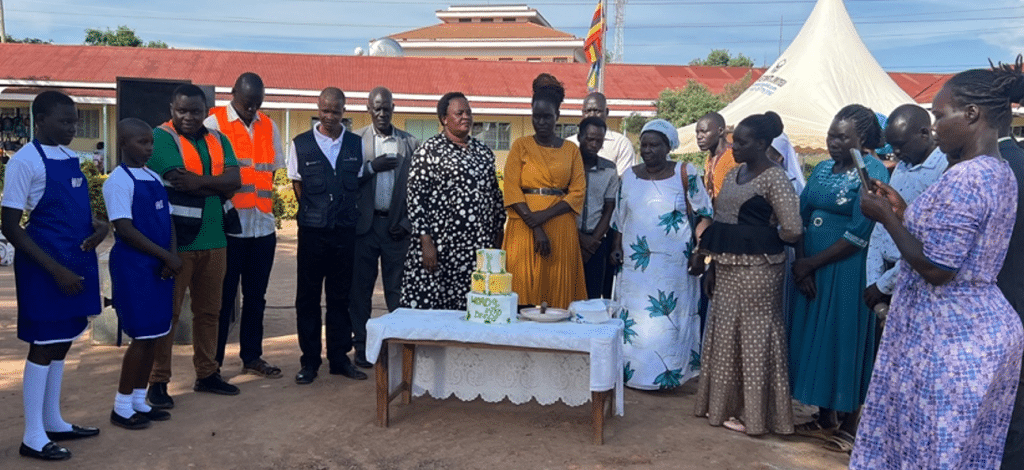
Students, teachers, staff, construction managers and city officials at a prayer and cake-cutting held on May 20 to celebrate the construction of a new solar-powered kitchen at a Ugandan school.
According to Noden, “The most important part of launching and successfully completing any project is establishing positive working relations with partners who are dedicated and willing to become engaged in the process. This requires a lot of time, patience, and conversations, especially when working with people from other cultures.” She emphasizes the importance of including students and young people in all phases of each project, paraphrasing a famous quote by Martin Luther King, “Education without action lacks value for the community, and action without education is a weak expression of energy.”
Working with a small team at the Rotary Club of Ithaca, Noden applied for and was awarded a grant from the Central New York Rotary District to help with the cost of the solar-cooking system. With this seed money guaranteed, she enlisted assistance from a Philadelphia-based nonprofit called Friends of UNIFAT (FOU), which agreed to provide funds for building a new kitchen. With additional donations to WID, full funding was in place. At the request of FOU, Noden served as project manager, prepared contracts, and along with school personnel verified compliance and reviewed all expenditures.
Site preparation and construction began in early April, and a community-wide dedication celebration was held on May 20. This included a day-long series of workshops for students and teachers from throughout the Gulu District, which focused on issues related to deforestation and climate change and also introduced several affordable ways that families can reduce their use of firewood.
Following local custom, a tree was planted to commemorate the event and a prayer of thanks (and cake) offered.
The event concluded with all staff, students, teachers and invited guests enjoying a dinner cooked using only a small armful of firewood.
Author

Related Articles
Beginnings Credit Union holds ribbon cutting
Beginnings Credit Union celebrates a branch rebrand in Ithaca, providing improved services and engaging with the local community.

Donation of Cayuga Lake watershed property supports conservation and education
Cayuga Lake Conservation: 73 acres in Ulysses protected by FLLT easement.
Why Is My Sewer Bill Higher? An update from Village of Freeville Treasurer Heather Murray
Freeville Sewer Bill Increase of $25/month in 2025 due to usage, upgrades. Learn more!