
Spotted lanternfly, box tree moth threaten region
Tompkins County faces rising spotted lanternfly and box tree moth threats, impacting vineyards and shrubs, per Tompkins Weekly.
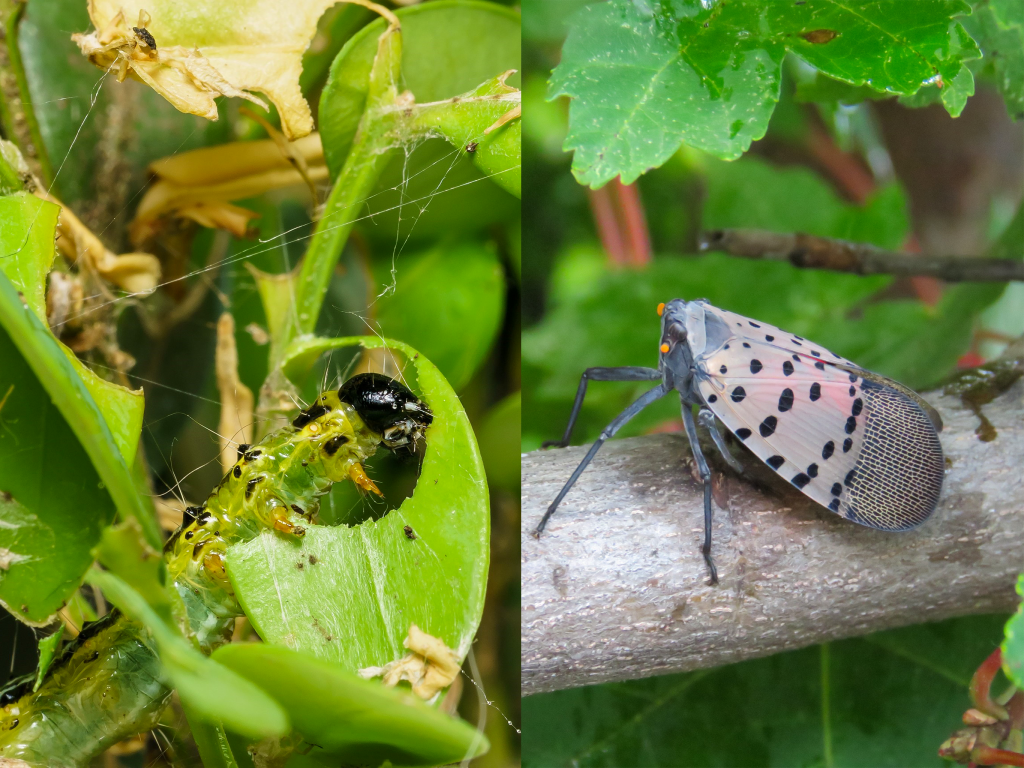
The box tree moth, shown here in its caterpillar stage (left) has been spotted as close as Rochester, while the spotted lanternfly (right) is expected to grow in numbers in Tompkins County this summer.
Tompkins County is bracing for a dramatic uptick in sightings of the invasive spotted lanternfly this summer, with experts warning that the pest’s population is entering a phase of exponential growth. At the same time, the destructive box tree moth was recently spotted near Rochester and is now posing a serious threat to the popular ornamental shrub across the region.
Spotted lanternfly: “The big one”
“The big one is the spotted lanternfly,” said Jacob Leeser, extension support specialist with Cornell Integrated Pest Management (IPM). “That is the species that we’re going to be facing in Tompkins County.”
The pest does not kill healthy trees but has been known to kill grape vines.
Spotted lanternfly eggs are hatching right about now, in the middle of May, and the invasive species is in Ithaca for what will be its fourth year this summer. It has been seen on the Cornell University campus and in Lansing.
There is also a well-known population of the insects closer to downtown Ithaca.
“I would describe [the infested area] as kind of along Fall Creek, along either side of Ithaca Falls Natural Area,” said Brian Eshenaur, senior extension associate and invasive species coordinator for Cornell University’s IPM. “That’s a hot spot for them, kind of extending out from there.”
This is the first year the species has also been identified in Ovid.
“We’re expecting those numbers [of sightings] to go up, sadly,” Leeser said, “so people might be seeing them for the first time in Tompkins County.”
Every year, the population goes up exponentially. “So, where there may have been a few dozen in one place, this year there will be hundreds, and next year thousands,” Leeser said.
The natural balance that is usually observed in places like Philadelphia, Pennsylvania, where the spotted lanternfly has been present for longer, is that for the first three years the population grows. In the fourth and fifth year, local predators such as praying mantises and sparrows learn to eat the bugs and the population starts to go down.
“It’s a behavioral adaptation,” said Leeser. “No food source in nature is going to go uneaten, but [predators] have to get used to it.”
After hatching in May, the insects don’t start to fly until July. They mature in August, growing to about an inch in length. “Those are the ones that people start calling us about,” Leeser said. “They’re pretty big for a bug, and they have a tendency to gather, sometimes thousands in one tree.”
They also have many associated annoyances. They tend to fly into people’s faces, Leeser said — not because they are aggressive; in Leeser’s words, “they’re just dumb.”
The insects excrete sugar water, which rains down on whatever is underneath the tree they are feasting on, attracting wasps and bees and causing mold growth on decks and other garden items.
“We’re hearing from vineyards in Pennsylvania that it took them a few years to figure out how to manage them on grape vines, but the bigger problem is lantern flies annoying people on the patio during wine tastings,” Leeser said.
In addition to grape vines, spotted lantern flies are very attracted to the “tree of heaven,” an invasive species that most people would recognize, even if they haven’t noticed it before. These trees have a similar leaf pattern to a black walnut, Eshenaur said. “When [the spotted lanternfly] has access to the tree of heaven, it can lay seven times the number of eggs,” he said.
Eradication of the insect is probably no longer possible, Leeser said, though it does appear likely that in the long term, an equilibrium will be reached of a lower number of bugs than is usually observed in the first few years of infestation of a given area.
Leeser said the US Department of Agriculture (USDA) is currently conducting research on the potential use of predators that kill the spotted lantern flies, such as a parasitoid wasp. The wasp, which is just a centimeter long, stings the lanternfly and deposits its eggs inside the living lanternfly. After the eggs hatch, the juvenile wasps feed on the inside of the lanternfly, a process that kills the lanternfly.
“In this case, it is the enemy of our enemy,” Leeser said of the wasp, adding that the study of introducing such species is carefully regulated work that only the USDA has the authority to do.
Box tree moth: A new imminent threat
The box tree moth is a pest of boxwoods, a common evergreen shrub. The larvae look like small green, black and white caterpillars.
“They hang out in the middle of boxwood shrubs, and by the time you see them, you typically have a pretty large infestation,” said Leeser.
The moth first came to Canada stowed away in a shipment, and in recent years it has spread along the north shore of Lake Ontario. It has been spotted as close as Rochester and has also been seen in the Sodus area.
Box tree moths spread from one tree to another, and often their spread is facilitated by people transporting them on a young shrub they purchased at a nursery, Leeser said.
A telltale sign of the caterpillars is that they skeletonize the leaves, nibbling them around the edges and leaving the stems intact. They also feed on the bark, and the damage to the plant causes defoliation and dryness, eventually leading to the plant’s death.
Orange box tree moth eggs, which can be spotted on the bottom of leaves, hatch in about three days; the caterpillars take about 14 days to mature into moths. The box tree moth can go through about three life cycles between May and October. They overwinter as caterpillars and can survive temperatures as low as -22 degrees Fahrenheit.
Adult box tree moths, which typically do not cause substantial damage to the shrub, usually have white bodies with a brown head and abdomen, though there is also a dark brown variant.
Those who spot the box tree moth are asked to photograph it, report it to the New York State Department of Agriculture and Markets website (see QR code) and bag the infested plant material.
Boxwoods are common classic topiary shrubs that grow slowly and have dense foliage. “They make a great hedge for a privacy screen,” Leeser said. They are also shade tolerant and deer resistant, making them top sellers at local garden centers.
“It’s a significant pest to the industry,” Leeser said of the box tree moth, adding that the United States Agriculture Commissioner estimated boxwood sales to have an economic impact of about $141 million in the US in 2019.
An application of neem oil can be effective for ridding plants of the pest at home and is safe for use around people and animals, Leeser said, adding that the oil is available in any garden store. “You do have to apply it on a fairly regular basis,” he said, “and it will run off in the rain.”
Picking the bugs off the plant individually can also be an effective strategy.
Those looking to landscape their yards this year may want to choose a different shrub, Leeser said. The IPM website recommends bayberry, dwarf hinoki cypress and inkberry holly as good alternatives.
Author

Related Articles

5 things to do in Tompkins County this weekend
Plan your visit and discover what’s happening this weekend.


Tompkins County to temporarily relocate Office for the Aging and Department of Assessment during Center of Government project
Office for the Aging and Department of Assessment temporarily relocate to Lansing during Center of Government construction.