
State officials announce $2.5 million conservation efforts on Cayuga Lakeshores in Lansing
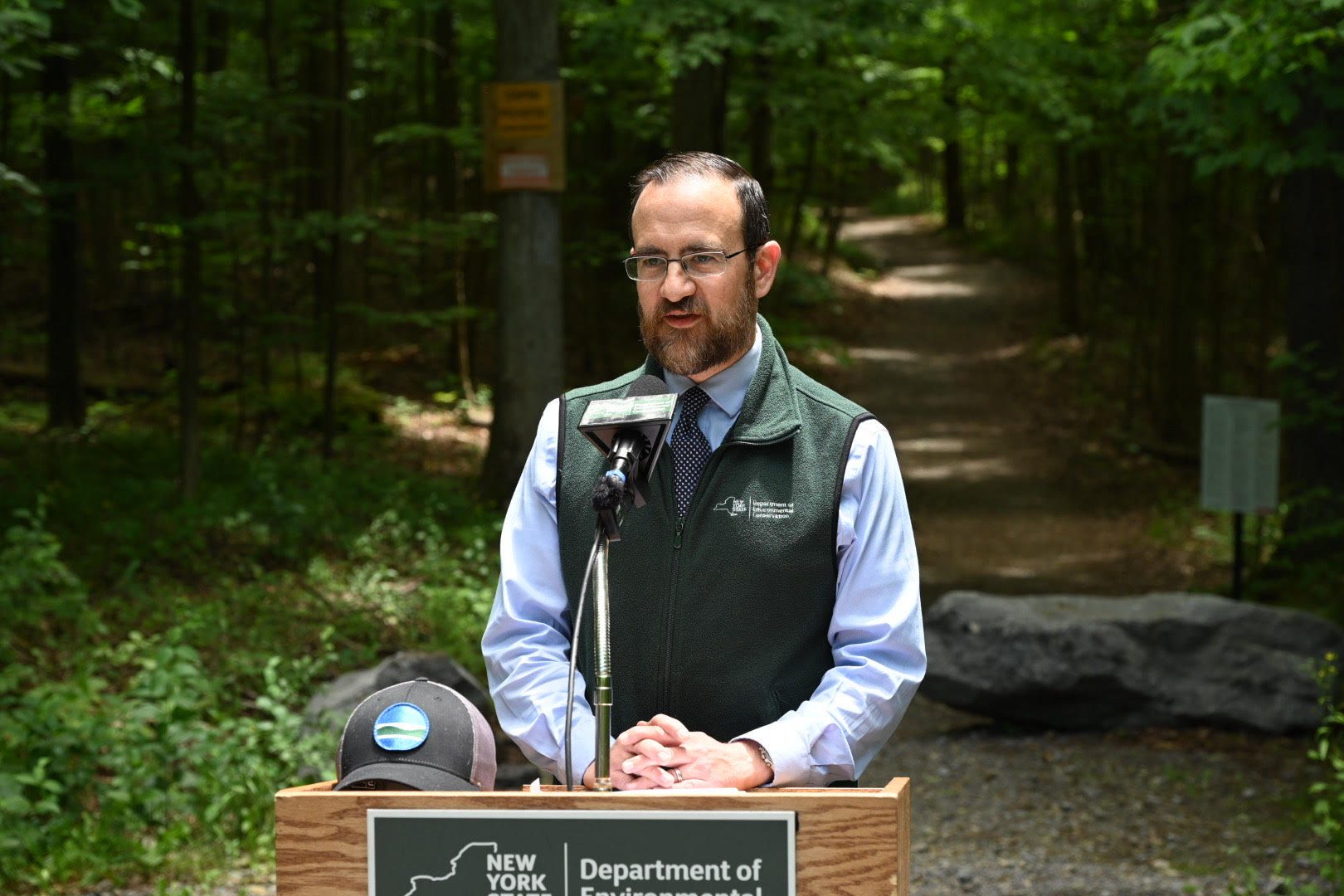

Gov. Kathy Hochul and state and regional conservation officials announced last week the creation of a 287-acre Cayuga Shores Wildlife Management Area (WMA) in the town of Lansing.
The new WMA will be created following a state investment of $2.5 million coming from the New York’s Environmental Protection Fund to purchase the former Bell Station Parcel in Lansing. The state acquired the property from the Finger Lakes Land Trust (FLLT), an Ithaca-based nonprofit focused on local conservation efforts, which purchased the land in 2022. The parcel was formerly owned by New York State Electric and Gas (NYSEG).
As a wildlife management area, Cayuga Shores includes more than 3,500 feet of undeveloped shoreline on the east side of Cayuga Lake and features a variety of fish and wildlife habitat, including multiple streams, wooded hillsides and extensive fields.
State officials said in a press release that the WMA would increase public recreation opportunities by providing direct shoreline access, as well as new hunting, trapping and wildlife-viewing opportunities.
“Generations of New Yorkers have experienced the extraordinary beauty of Cayuga Lake, and these investments will ensure this invaluable resource is protected for decades to come,” Hochul said in a statement. “Through investments that foster a healthier environment and safeguard access to clean drinking water, we’re securing the promise of this region and acting on our commitment to preserve it.”
The purchase of the property, state officials said, is also important because 90% of the east side of Cayuga Lake is privately owned.
The lake supports noteworthy sport fisheries, including largemouth bass, chain pickerel, northern pike, crappie, yellow perch, sunfish, lake trout, rainbow trout, gar and bowfin. Cayuga Lake is also designated an Important Bird Area by Audubon New York and supports a large and diverse population of waterfowl and other birds, particularly during migration and winter. Audubon New York is part of the larger National Audubon Society, a nonprofit that protects birds and the spaces they need.
Approximately 200 acres of the easternmost portion of the property is expected to be retained by FLLT and utilized to produce renewable solar energy.
“Lansing is extremely grateful that [the WMA] is within the town’s boundaries,” said town of Lansing Supervisor Ruth Groff. “Cayuga Shores is a scenic and ecological treasure that brings an abundance of benefits to Lansing.”
The State Department of Environmental Conservation (NYSDEC) will manage Cayuga Shores for wildlife conservation, habitat and wildlife-associated recreation, including hunting, trapping, fishing, wildlife viewing and photography. Habitat management for wildlife is a critical aspect of the statewide wildlife management area system and vitally includes forested and open landscapes, NYSDEC officials said in a press release.
Common management techniques to enhance wildlife habitat involve invasive species control, patch clear-cutting, seed tree release, vegetation thinning, mowing and planting, according to the release. Some wildlife that can commonly be found on and around the gently sloping topography of this WMA include white-tailed deer, many songbird species, bald eagles, numerous species of waterfowl, mink and gray squirrels.
For Groff, the ecological benefits to the region are significant.
“This protected portion of the Cayuga Lake watershed will ensure less erosion and a cleaner runoff, contributing to a healthier water quality for the lake,” she added. “Better water quality safeguards aquatic life and inhibits harmful algal blooms, so I see this as a benefit not only to Lansing but to the entire Cayuga Lake region.”
Cayuga Shores, Groff noted, was part of the town’s Comprehensive Plan as a desirable property for Lansing as “the largest undeveloped privately owned parcel of land in the Finger Lakes region.” She added that the area’s conservation will be a boon to present and future generations.
“I can safely say that Lansing has long awaited this outcome for the area, seeing it as a boon to our local economy, a critical addition to our open space, an expansion of recreational area, a scenic wonder and an ecological necessity for our region,” Groff said.
Lansing at Large appears every week in Tompkins Weekly. Send story ideas to editorial@vizellamedia.com. Contact Eddie Velazquez at edvel37@gmail.com or on X (formerly Twitter) @ezvelazquez.
In brief:
The Lansing Community Library is hosting caregiver and child movement and Kali Filipino martial arts sessions on June 12 and 26 at the library community room at 1 p.m. No registration is required.
Author

Related Articles

Local representatives push HEAP as winter nears
Lansing HEAP program applications are now open, helping low-income households cover heating costs and access energy assistance this winter.
Lansing’s $17M capital project advances amid construction challenges
Lansing Central School’s $17M BOBCAT capital project upgrades schools, athletic facilities, HVAC, and infrastructure.