
State redistricting affecting local candidates, voters

Early last month, Gov. Kathy Hochul signed New York’s new congressional map into law. The recent redistricting places all of Tompkins County in Congressional District 22 — where as it was mostly in District 23 previously — and turns the county into an anchor for a majority-Democrat district.
Local officials and political candidates for the district spoke with Tompkins Weekly about the effects this redistricting will have for voters, candidates and election officials going forward.
Democratic sources interviewed for this story support the new redistricting, saying it stands to greatly improve the county’s representation. Linda Hoffman, chair of the Tompkins County Democratic Committee, specifically highlighted the fact that many local voters felt that Congressman Tom Reed, who has represented the 23rd District for several years, wasn’t properly invested in county issues.
“We are more likely [to] have a representative who will connect with all constituents and not just those in a certain zip code,” she said. “That goes back to the original feeling of what Democrats were feeling in Tompkins County under the Republican representation that we did have. It’s key always to having a representative who addresses their position on key issues that are being decided in Congress. … It is most important because it’s important for our democracy.”
While Hoffman said the redistricting has the potential to greatly increase Democrats’ influence in state government, Mike Sigler, county legislator and chairperson of Tompkins County Republicans, said the redistricting doesn’t hugely disadvantage Republicans in Congress.
“I don’t think 22 is actually that bad,” he said. “[District] 22 used to be a D plus 5, so that means that any given year, a Democrat will beat a Republican by 5. So yeah, a blue district, but again, a Republican can win it. It’s now, I think, a D plus 6, according to registration. That’s not terrible.”
However, the State Senate is another matter, Sigler said. He said the redistricting lines for the State Senate were “certainly drawn to give a lot of favor to the Democratic Party.”
“They took those Republican voices, and they took them out of more purple-ish districts,” Sigler said. “So now, yeah, you’ve made for districts that are very Republican or very Democrat. I’m not happy, particularly, that the Democrats — who already run everything — decided to go that direction. It’s like, how much stronger do you want to be in this? I would have liked if they found some middle ground on it.”
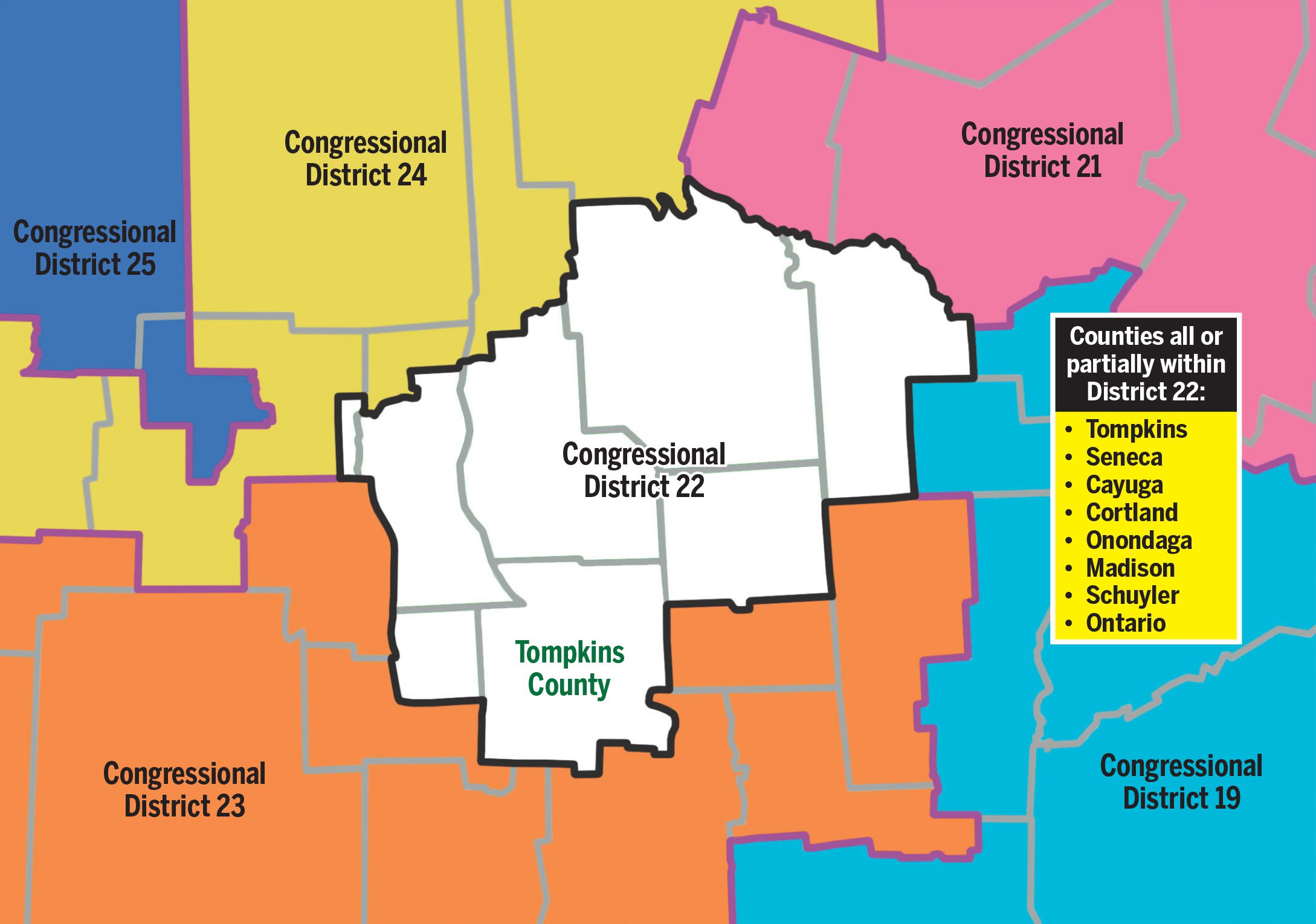
Folks on both sides of the aisle recognize that there is great concern regarding the redistricting process itself, especially as it relates to proper representation.
“My personal concern is that redistricting can have a sense of really diminishing competition of candidates and people coming forward,” Hoffman said. “That can have long-term impact. We don’t know what that will be at this point [in] time. There’s a striking example of that. In the state of Texas in 2020 elections, there were 12 competitive districts. Currently, there is only one in the state of Texas. There’s a lot of questions about that, even Democrats questioning it. So, my sentiments are we need to look at this. … But we haven’t determined yet what those long-term impacts could be in a negative or a positive way.”
Sigler shares Hoffman’s concerns.
“If you’ve got somebody who gets elected to a district, and it’s safely in one party or the other party, then they really don’t have to answer to anybody,” Sigler said. “They’re going to raise the money and they’re going to go into the next election cycle with a million dollars. And even if people are unhappy with them, they’ll have the name recognition or they’ll have the money. And then, you don’t you don’t get any new people; you don’t get any new ideas. … And that’s not how democracy is supposed to work.”
In regards to how the redistricting stands to impact local candidates, Sigler and Democrat Vanessa Fajans-Turner offered their thoughts.
Fajans-Turner was the first local Democrat to announce her candidacy for Congressional District 22 and said that the redistricting was a big motivator for throwing her hat in the ring.
“I can run, now, as somebody true to my Democratic and progressive values on issues of equity, inclusion, criminal justice and climate with a real focus on those,” she said. “It’s something that I would not have been able or comfortable running in a different district where some of those issues might have been considered to be deal-breakers. So, for me, it’s very important to me because it opens up room to talk about and fight for issues I really care about without it jeopardizing the prospect of leadership from the Democratic side.”
Fajans-Turner added that while she is glad for the benefits this redistricting could bring to her party, she knows it’s crucial to look beyond party and district lines when it comes to proper representation.
“It’s always important and the responsibility of any candidate to say that any race, no matter what the party affiliation, needs to be about running to best represent every single voter in an area,” she said. “Most of the issues that I care about and that voters care about are not delineated or defined at all by a border, especially an arbitrary one that is inherently political in nature or arbitrary in nature. We have a number of Native American reservations in this region, and they know more than anything how arbitrary borders are and can be.”
Sigler announced his candidacy for District 22 late last month and won a three-way race March 7 to become the Onondaga County Republican Committee’s pick as the Republican candidate in the new District 22.
Sigler said that he sees the redistricting as having a negative effect on many of the issues that are important to him and many other voters across the county, both Democratic and Republican.
“I look at something like bail reform,” Sigler said. “The problem is now, because we’re in a single-party state like this, these people will not change course. They also will refuse to look at the facts on the ground and say, ‘We need to let our judges have more power over decision-making.’ That would be something you would think most people would get on board with. And yet, the people that are in charge are saying, ‘No, we’re not doing it.’ And that’s the kind of accountability you lose when you have this kind of situation. So, it really goes beyond party.”
Regardless of party, all sources interviewed for this story encourage eligible county residents to vote in this year’s elections and make their voices heard.
“For anybody who is feeling discouraged [because] their party is not in the … majority in their new district, I want to send a message that I hope they still vote, that their voice still matters and that they should always still feel entitled and empowered to contact whoever their representative turns out to be,” Fajans-Turner said. “It can be very hard and very frustrating, but it doesn’t mean that there isn’t still capacity to be heard, and that’s important.”
Check out a full map of the recent redistricting at tinyurl.com/yaga5c9o. To learn more about how redistricting will impact state and national politics, visit tinyurl.com/yad3v5k4.
Jessica Wickham is the managing editor of Tompkins Weekly. Send story ideas to them at editorial@vizellamedia.com.
Related Articles
Holiday traditions bring community cheer
Tompkins County holiday traditions light up homes, farms, and schools with festive cheer and community spirit.
The gift of an experience: Local businesses offer hands-on holiday fun
Holiday experience gifts in Tompkins County include candle making, gourd crafts, and pottery workshops for creative seasonal fun.
Code Blue shelter opens amid praise, concerns and ongoing debate
Ithaca’s Code Blue shelter opens with larger space, showers, and case management to help residents during cold weather.